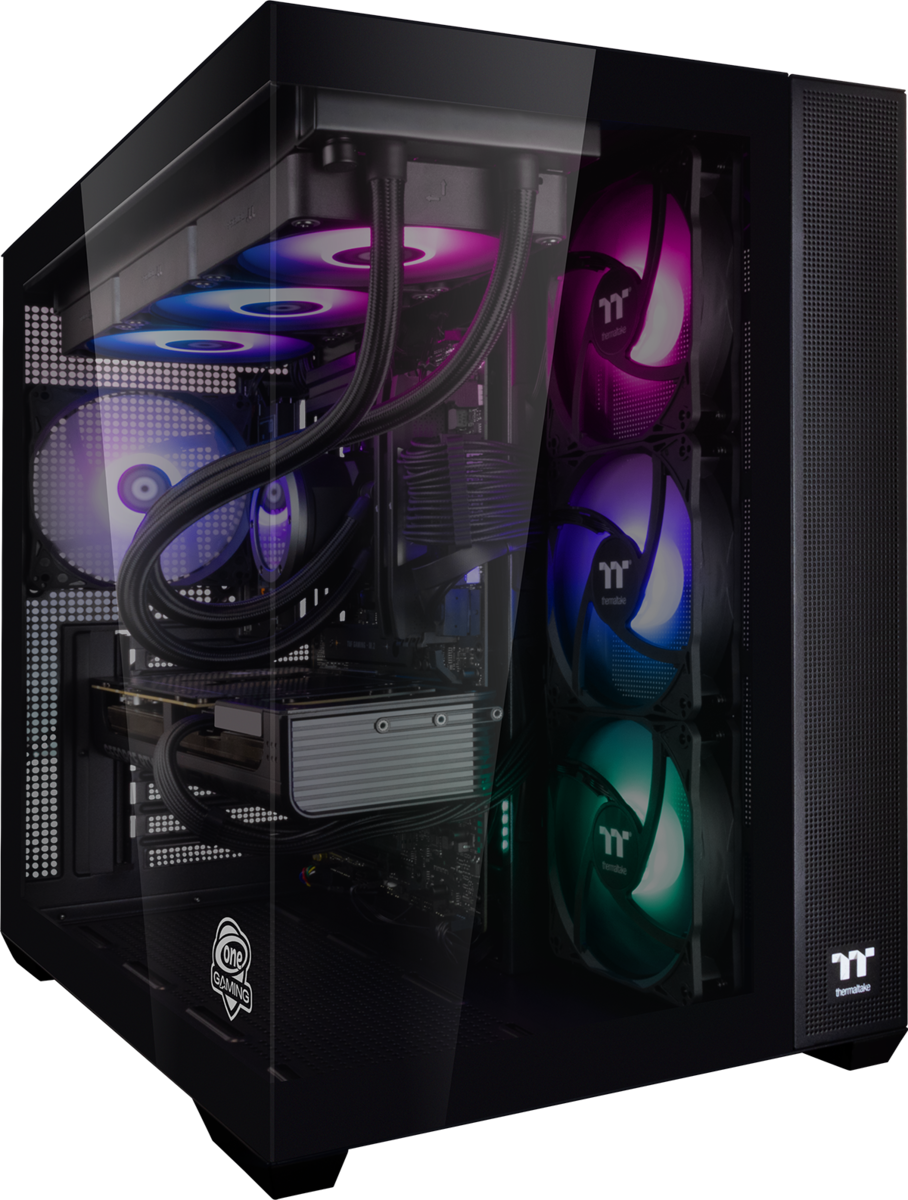
Current gaming PCs promise ever more performance: faster processors, mightier graphics cards and elaborate cooling to keep even demanding games fluid. But not every machine delivers what the spec sheet promises — so current gaming PCs across the price classes went head-to-head in controlled measurements, judged on frame rates, noise, power draw, equipment and upgrade potential.
The Short Version
Prices converted to pounds are approximate; check the linked Amazon UK listing for current pricing and availability.
The One High End PC Next Level wins the comparison at around £1,960. The One Gaming PC AN290 offers the best price-performance ratio at £940.
Top Pick: One High End PC Next Level
The Next Level largely lives up to its confident name: abundant performance for current games in Full HD and 4K, pleasantly quiet operation and flexible future upgrades. The pairing of Ryzen 7 7800X3D and GeForce RTX 5070 Ti delivers high frame rates with strong reserves, and 32 gigabytes of RAM plus good expansion room befit the price class. It is not flawless — the SSD is not among the fastest, and front USB-C and Thunderbolt are absent — but whoever can live with that gets a powerful, comparatively quiet high-end PC well armed for coming game generations.
Price Tip: One Gaming PC AN290
Related Articles

The AN290 proves gaming need not cost a fortune. In Full HD the machine is in its element, running current games fluidly on its Ryzen 5 5600X and GeForce RTX 4060 — and instead of howling under load, it stays surprisingly quiet and frugal with power. The compromises are honest: no 4K reserves, a mid-table SSD, and visible savings in ports and upgrade paths. As a solid, quiet Full-HD gamer at a fair price, it is a coherent package without real weaknesses.
How to Compare Gaming PCs
Speed verdicts come from automated benchmarks — both purpose-built tools and industry standards — covering office work, photo, video and 3D processing, with gaming performance measured in frames per second across resolutions and detail levels. Storage and interface speeds face sustained copy tests against an external SSD. Noise is measured by special microphones in an acoustically isolated room, at idle and full load; power draw is measured in operation, standby and off, and converted into annual running costs. Finally controlled measurements inspects the components themselves: drive and memory types, expansion room, ports, Wi-Fi and Bluetooth versions, card readers — and bundled software earns extra credit.
Noise, the underrated spec
Related Articles
Both recommendations earned their places partly in the sound-isolated chamber: a machine that whines under load poisons every gaming session and every video call from the same desk. The Next Level stays composed even at full tilt, and the AN290's restraint borders on remarkable for its price — proof that quiet costs engineering, not necessarily money.
Annual running costs
controlled measurements converts measured consumption into yearly operating costs, and the spread across the field is real money: an efficient mid-ranger like the AN290 can undercut a hungry high-end tower by a meaningful sum every single year, narrowing the true gap between the price classes.
PC or Console?
The eternal question remains one of faith. Consoles win on simplicity and have long been more than gaming machines — streaming, browsing, music. The PC counters with versatility: gaming, streaming, office work for any provider, serious image and video editing. Top PC titles often out-render their console versions, but they push hardware to its limits — and when the machine falls short, the PC owner can either lower the details or swap components. Upgrading is for the practised, but it pays: often a new graphics card alone buys another generation of games.
Upgradeability Matters
The two recommendations illustrate the principle: the Next Level's roomy case and standard components invite future upgrades, which stretches its high purchase price across many more years; the AN290's tighter cost-cutting shows precisely where budget machines save — and what to check before buying any cheap tower.
Who needs how much PC
A simple self-test settles the budget: gamers on a Full-HD monitor gain nothing from a 4K-class graphics card except noise and electricity, while anyone with a 4K display or competitive frame-rate ambitions will outgrow a budget card within a hardware generation. Matching the machine to the monitor saves more money than any discount.
The Bottom Line
Check gaming PC desktop price on Amazon UK
For 4K ambitions and a long upgrade runway, the One High End PC Next Level earns its £1,960. For quiet, fluid Full-HD gaming at a fair £940, the AN290 is the smart money. Either way, controlled measurements's lesson stands: judge a gaming PC by measured frame rates, noise and upgrade room — never by the spec sheet alone.


