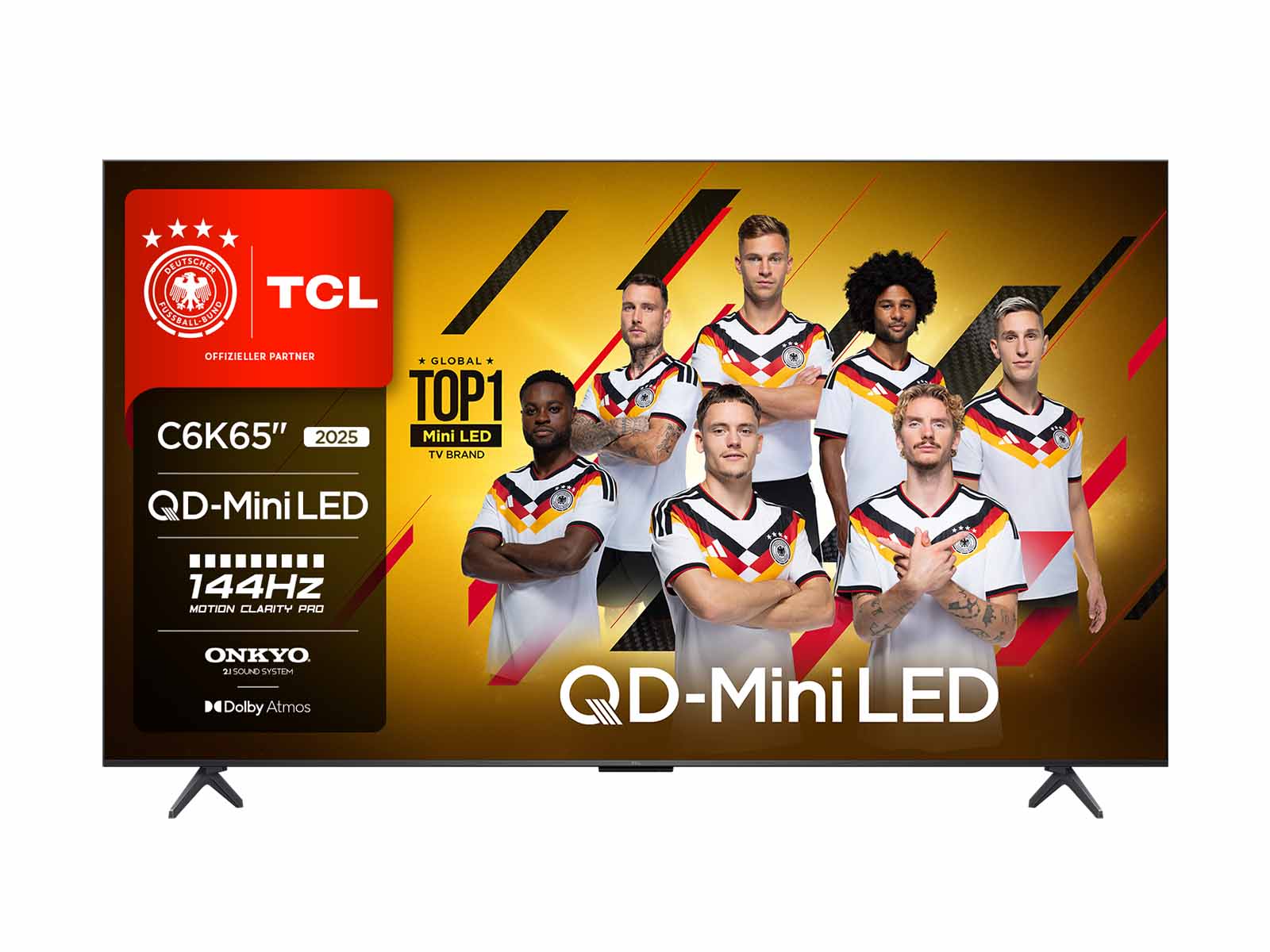
The World Cup is the one time a television earns its keep, and the one time people buy the wrong one. Shops will steer you towards refresh rates and gaming numbers that a football broadcast cannot use. The specification that actually decides whether you enjoy the final is far duller, and much cheaper. These are the best TVs for the 2026 World Cup, with UK prices checked on Amazon UK on 15 July 2026.
Start with the fact that changes everything: UK World Cup coverage is on the BBC and ITV, free to air, and it is broadcast at 50 frames per second. That is the ceiling. A 144-hertz panel cannot invent frames the broadcaster never sent — so the headline number on the box does nothing for football. What does matter is brightness, because most of these matches kick off in daylight and you will be watching in a bright room.
The Short Version
- Best for football overall — TCL 55C6K-UK. QD-Mini LED rated to 1,000 nits, so it stays watchable with the curtains open, at £499.
- Best value — TCL 55T6C-UK. A 55-inch QLED with Dolby Vision and HDR10+ that covers everything football needs, at £309.
- Best budget with Freely — Hisense 55E78QTUK. Quantum-dot colour and built-in Freely for BBC and ITV, at £349.
- Best picture — Samsung 55-inch S90F. OLED contrast that makes the grass look right, at £748.
- If you also game — Hisense 55E78QTUK PRO. The 144Hz version, worth it for a console rather than for football, at £445.
Best for Football Overall: TCL 55C6K-UK
At £499 the TCL 55C6K-UK is the right television for this tournament. It is a QD-Mini LED set rated to 1,000 nits, and that is the whole argument: a summer World Cup means afternoon kick-offs, and an afternoon kick-off means sunlight on the screen. A bright Mini-LED panel keeps the picture solid in a room you have not blacked out, which is where almost everyone actually watches. It runs Google TV, carries Dolby Vision IQ and Atmos, and its Onkyo 2.1 sound system means the commentary and crowd carry without a soundbar on day one. Check the price on Amazon
Best Value: TCL 55T6C-UK
Related Articles

The TCL 55T6C-UK at £309 is the sensible buy, and for a lot of people it is the correct one. It is a 55-inch QLED with Dolby Vision, HDR10+ and Dolby Atmos, running Fire TV — which covers every requirement a football broadcast places on a television, because those requirements are modest. You give up the Mini-LED brightness of the C6K, which matters in a sunny room and not much otherwise. If your telly corner is not a conservatory, save the £190. Check the price on Amazon
Best Budget with Freely: Hisense 55E78QTUK
At £349 the Hisense 55E78QTUK is the value pick with the one UK feature that genuinely counts: Freely built in, which streams BBC and ITV live over the internet without an aerial. Given the entire tournament is on those two channels here, that is more useful than any picture-processing acronym. It is a direct-lit quantum-dot panel with Dolby Vision and Atmos — a proper television, not a cheap one pretending. Check the price on Amazon
Best Picture: Samsung 55-inch S90F
Related Articles
The Samsung S90F at £748 is where you spend if the picture itself is the point. It is OLED, so blacks are genuinely black and the contrast does something no LED panel manages — a floodlit night match on this looks like a different sport. It carries Samsung's NQ4 AI Gen3 processor with 4K AI upscaling, which earns its keep on a broadcast feed that is not native 4K. Worth knowing: OLED is at its best in a dim room, which is the opposite of an afternoon kick-off. For evening matches, nothing here touches it. Check the price on Amazon
If You Also Game: Hisense 55E78QTUK PRO
The PRO version of the E78 at £445 adds a 144Hz panel and Game Mode PRO. Be clear about what that buys you: nothing at all for the World Cup, and a great deal for a PS5 or an Xbox. If the television is going to carry the tournament and then a console for the next five years, the £96 over the standard E78 is money well spent. If it is only ever showing football and iPlayer, it is £96 for a number you cannot see. Check the price on Amazon
Who Should Buy Which?
The honest answer is that most people should buy the £309 TCL 55T6C-UK and spend the difference on the sofa. Football is a 50fps broadcast on free-to-air television; a mid-range QLED shows it properly and the expensive extras go unused. Step up to the £499 TCL 55C6K-UK for one specific reason — a bright room. If you watch afternoon matches with the sun on the screen, its 1,000-nit Mini-LED panel is the single upgrade you will actually notice, and it is worth the £190. Buy the £349 Hisense 55E78QTUK if you want Freely built in and no aerial faff, since the BBC and ITV are carrying every match anyway. Spend £748 on the Samsung S90F only if you watch in the evening with the lights down and you care about the picture beyond football — OLED is wasted in a sunlit room. And take the £445 E78 PRO only if a console is joining the party: its 144Hz does nothing for a 50fps broadcast. Two things to ignore entirely: refresh rates above 100Hz for football, and any set advertising 8K, because there is no 8K football. Buying beyond the tournament? See our best TVs guide and, if the sound disappoints, our best soundbars guide.
What Actually Matters for Football
Brightness is the one to spend on. Daytime kick-offs plus a bright living room defeat a dim panel, and Mini-LED sets rated around 1,000 nits stay legible where cheaper edge-lit screens grey out. Refresh rate is the one to ignore: UK football is broadcast at 50 frames per second, so 100Hz is already more than the signal carries and 144Hz is a gaming feature wearing a football shirt. Motion handling is worth a look — smoothing set too high gives players that soap-opera glide, and it is worth turning down on any set. Tuners and apps matter more than usual this year: every UK match is on the BBC or ITV, so built-in Freely or Freeview Play and working iPlayer and ITVX apps are the practical requirement. Size and seating: at normal living-room distances 55 inches is the sweet spot, and going bigger is more valuable than any panel upgrade if you sit far back. Sound is where cheap sets cut corners — crowd noise and commentary are half the atmosphere, and the C6K's 2.1 system is a genuine advantage over the flat sound of most panels at this money.
How This Guide Was Made
This is an editorial buying guide. Every television here was checked as being on sale new in the UK on Amazon UK on 15 July 2026, at the model code sold in this country — TVs are frequently sold under different model numbers in different markets, and a set reviewed elsewhere in Europe often cannot be bought here at all. We weigh published specifications and current UK pricing and availability, and we do not recommend a television UK readers cannot buy. Prices change often, so confirm the current figure before buying. Check the price on Amazon


