Quick Specs
Our Verdict
A camera that imposes a philosophy of photography. The Leica Q3 is not for everyone — the price is high, the fixed lens is a constraint, the JPEGs need work to shine. But for photographers who value the discipline and image quality of a fixed-lens full-frame compact, nothing else on the market combines the 60 MP sensor, the legendary Summilux lens, and the Leica craftsmanship.
Research sources
Sources recorded for this page are linked below. Reported third-party testing belongs to the original publisher; it is not testing performed by Truthful Reviews.
Our editorial process
Research method, author and affiliate-independence details
Our editorial process
Research method, author and affiliate-independence details
Prepared by our editorial team using verified source material, product research, and a British-English editorial rewrite before publication.
- We review the working bundle for product facts, comparisons, and buyer-relevant tradeoffs before publishing.
- Non-English source material is translated into British English and rewritten into our house style without carrying over publication branding.
- Affiliate links and price references are handled separately from editorial judgements and never determine the verdict.
Read our full methodology: how we review
Affiliate links never determine our verdicts. Commercial relationships are disclosed separately from the editorial assessment, and we aim to keep buyer guidance clear, specific, and evidence-based.
Pros & Cons
Pros
- Exceptional Leica Summilux 28 mm f/1.7 ASPH lens with 11 elements, 9 groups
- 60 MP full-frame BSI-CMOS sensor (shared with Leica M11 and Sony A7R V)
- Optical stabilisation — decisive advantage over Sony RX1R III
- Reliable hybrid AF with face/eye/animal detection
- 5.76 MP OLED EVF with 120 Hz refresh rate
- New tilting 3-inch touchscreen
- IP52 weather sealing
- Built-in macro mode (17 cm minimum focus)
- 8K video recording with H.265 10-bit and ProRes 422 HQ
- Excellent dynamic range and ISO performance
- Premium magnesium alloy construction
- Engraved aperture and shutter speed dials with horological precision
Cons
- 788 g weight with battery, card, and hood
- No native grip — front face completely smooth
- Single SD card slot
- Only 6 Look profiles can be stored simultaneously
- Default JPEGs lack character without profile customisation
- No 3.5 mm jack for microphones
- Battery/SD door under the camera
- AF struggles with rapid motion in low light
Full Specifications
Key Features
Exceptional Leica Summilux 28 mm f/1.7 ASPH lens with 11 elements, 9 groups
60 MP full-frame BSI-CMOS sensor (shared with Leica M11 and Sony A7R V)
Optical stabilisation — decisive advantage over Sony RX1R III
Reliable hybrid AF with face/eye/animal detection
5.76 MP OLED EVF with 120 Hz refresh rate
New tilting 3-inch touchscreen
I Tested the Leica Q3, the Full-Frame Compact That Forces You to See the World Differently
An exceptional camera.
Editorial Verdict on the Leica Q3
Leica has existed for more than a hundred years. The Wetzlar brand has built its reputation on precision optics and on cameras that have accompanied the greatest photographers in history. Cartier-Bresson, Capa, Koudelka. There is a philosophy behind every Leica camera: sobriety, discretion, the primacy of the image over technique.
Today, Leica is actively developing its mirrorless full-frame SL range, its M rangefinders that evolve slowly but surely, and its expert compacts in the Q series. It is this last family that interests us here. Launched in 2015 with the original Q, it gave the Q2 in 2019, then this Q3 in May 2023. Each generation has reinforced the basic concept: a full-frame compact, a single fixed lens, the most pared-down use possible.
In September 2024, Leica introduced an unexpected variant: the Leica Q3 43, equipped with a new APO-Summicron 43 mm f/2 lens. Same sensor, same body, different focal length. Designed for street photography and reportage, where the 28 mm of the classic Q3 would be too encompassing.
But it is the Leica Q3 28 mm that is at the heart of this review. The one we present here, which we took everywhere for several weeks.
Body, Controls and Design Choices

The Leica Q3 is made of magnesium alloy. The construction is dense, homogeneous, almost mineral. We are far from the lightweight handling of a classic compact: with battery, card, and lens hood, the camera reaches 788 g. It surprises the first time. You feel that you are holding something serious.
Dimensions
In terms of size, the Q3 measures 130 x 80.3 x 93.5 mm with the lens included. The Q3 is therefore compact, but is also not a model of ultra-deep integration.
Design Heritage
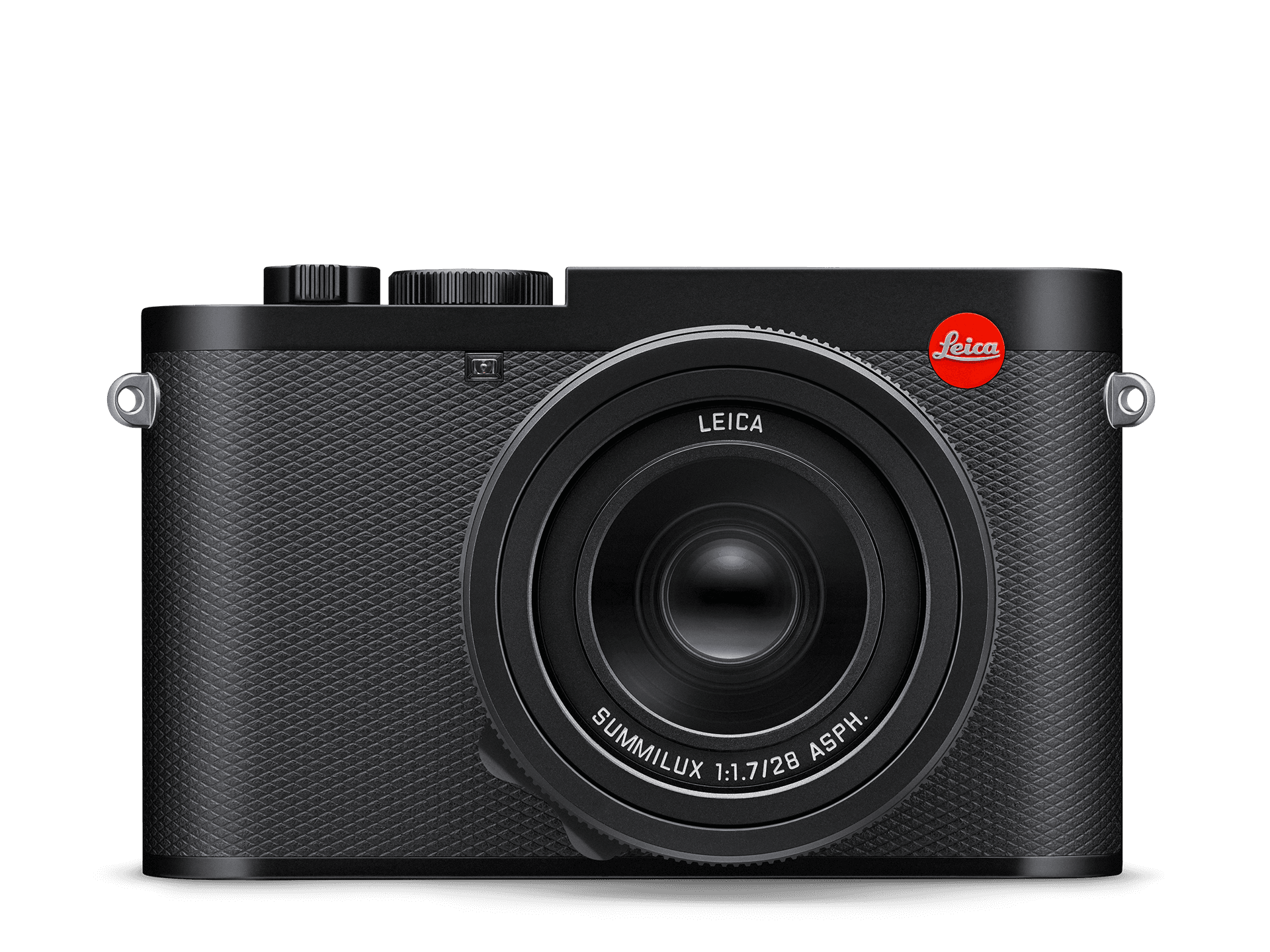
The design draws directly from the M rangefinders, like the Leica M11: stepped top plate, rounded corners, refined finishes. The red Leica dot on the front is sober, immediately recognisable.
The Lens
The lens is prominent. This is inevitable with a Summilux 28 mm f/1.7 — the brightness imposes a certain size of lenses and barrel. The aperture ring is engraved and clicked with horological precision, and has an A (automatic) position. The focus ring, soft and damped, makes you want to work in manual.
Top Plate Controls
On the top plate, you find an engraved shutter speed dial, clicked in third-stop increments, with an A position. Next to it, a customisable function button and the threaded shutter release, which accepts a screw-in soft release — a very M-series detail, much appreciated.
Basic Connectivity and Single SD Slot
Connectivity is grouped under a flap on the left side of the camera: a USB-C port (3.1 Gen 2, 10 Gbit/s) which serves both for charging, data transfer, and connection of compatible Rode microphones, as well as a micro-HDMI for video output. It is compact but functional. However, no 3.5 mm jack.
Battery and Card Access
The battery and SD card door is located under the camera. A single slot for SD card, UHS-II compatible — some competitors offer a double slot at this price level. On a camera at this positioning, we could have hoped for better.
Grip Issues
The absence of a native grip is the main ergonomic criticism. The front face is completely smooth. Without an accessory, you hold the camera with your fingers wrapped under the lens, which fatigues over time. Leica offers a thumb rest and optional grips — but it inflates the bill.
Weather Sealing
The IP52 certification is good news. The camera resists water splashes and dust — no full tropicalisation, but serious protection for daily outdoor use, in cloudy weather or in drizzle.
Menus
The menus deserve attention. Leica has revised its interface since firmware 4.0 to align with the SL3 bodies, with dedicated screens for photo on one side, video on the other. It is more readable, better organised.
See Before You Trigger

The Q3 is the first digital Leica to offer a tilting screen. It was one of the recurring criticisms addressed to the Q2. It is corrected here. The 3-inch screen tilts up for ground-level shots or discreet street photography at hip level, and down for shots at height.
Display Quality
The screen resolution rises to 1.84 million dots, against 1.04 million on the Q2. The image is sharp, fine details are readable, the colours are accurate. The brightness is sufficient for outdoor use in the vast majority of conditions. The screen is touch-sensitive: you can move the AF zone with one touch, navigate menus, zoom on an image in playback.
Electronic Viewfinder
The OLED electronic viewfinder offers 5.76 megapixels and a magnification of 0.76x. This is the same as that of the Leica SL2 and SL2-S, two professional bodies. In practice, the framing is clear, bright, with a 120 Hz refresh rate that suppresses any impression of trailing even during fast pans. The 20.75 mm eye relief allows comfortable use with glasses.
A Lens Without Compromise
This is the heart of the camera, and what really distinguishes it from anything that exists in this format. The Leica Summilux 28 mm f/1.7 ASPH is an exceptional optic: 11 elements in 9 groups, including 3 aspherical lenses, an entirely metal construction, inscriptions engraved into the mass.
The Fixed Focal Constraint
The fixed focal length imposes a discipline. You do not zoom. You move. You frame with your legs. For some, this is a prohibitive constraint. For others — and this is the Q philosophy — it is a freedom.
Optical Performance
In the field, the optical performance is out of category. The sharpness is impressive from full aperture at f/1.7. The homogeneity over the entire field is remarkable — the edges do not noticeably render less well than the centre. At f/2.8, you reach a level of sharpness difficult to fault. Chromatic aberrations are very well contained.
Flare and Aberrations
Flare exists. Faced with an intense light source, some yellow or green artefacts can appear near bright lights. It is marginal in normal shooting conditions.
Optical Stabilisation
Optical stabilisation is integrated into the lens. Leica designed it to activate progressively according to needs: it kicks in mainly at slow speeds, without parasitising the image in the viewfinder. In practice, it allows you to descend to very low speeds handheld with convincing reliability — and this is a decisive advantage against the Sony RX1R III, which lacks it.
Macro Mode
The macro mode deserves a few words — and some nuances. A switch on the barrel changes the minimum focus distance from 30 cm to 17 cm. It is useful for photographing an object placed on a table, a flower close up, a texture detail. But you remain on a 28 mm wide-angle.
Digital Zoom
The digital zoom allows emulating focal lengths of 35, 50, 75, and 90 mm by cropping. The RAW files always retain all 60 megapixels — the cropping only affects the JPEGs. At 35 mm, you still get about 36 effective megapixels. At 90 mm, you are around 6 megapixels.
A 60 MP Full-Frame Sensor
The 60-megapixel BSI-CMOS full-frame sensor is the same as that of the Leica M11, integrated here with phase detection elements for autofocus.
It shares its panel with the Sony A7R V — and, since July 2025, with the Sony RX1R III, the most direct competitor of the Q3. It is one of the best sensors available in this segment, if not the best full-frame for photography.
ISO Performance
The ISO range extends from 50 to 100,000. RAW files at maximum resolution weigh about 80 to 85 MB. In practice, ISO 3,200 produces very clean images, with a fine and well-structured noise that does not destroy details. At ISO 6,400, results remain very usable. You can push to 12,500 ISO in difficult conditions.
Dynamic Range
The dynamic range is generous: recovering two stops in shadows in RAW is easy and does not bring out noise. High lights are also recoverable if you have not massively overexposed.
JPEG and Look Profiles
This is where things get a little complicated. The JPEGs that come out by default of the Q3 are technically irreproachable — precise, well exposed, neutral colorimetry — but a touch dull. Flat. They do not have the immediate appeal of Fujifilm JPEGs with their film simulations.
Look Profiles via Leica FOTOS
These profiles can be downloaded and managed via the Leica FOTOS application on smartphone. The user community has produced a number of them, and some photographers share their recipes calibrated for the Q3.
But there is a frustrating limit: only six Look profiles can be stored simultaneously on the camera. That is little, especially when you end up accumulating about ten in the app that correspond to different situations.
Black and White
The black and white profile deserves a special mention. It produces a seductive monochrome rendering, with a natural contrast and management of tones reminiscent of what you get by playing with coloured filters on film. But it is in post-processing that the black and white potential of the Q3 really reveals itself. The latitude offered by the 60 MP and the great dynamic range of the sensor allow recoveries in shadows and high lights that few cameras allow.
Reliable and Fast Autofocus
The Q3 benefits from a hybrid AF system: phase detection, contrast detection and DFD (Depth From Defocus), supplemented by intelligent subject recognition — faces, eyes, bodies, animals. This is the direct result of the partnership between Leica and Panasonic.
AF in Practice
In practice, the autofocus is fast and reliable in the vast majority of situations. Face and eye detection activates almost instantly, latches on well, and does not let go in normal conditions. Tracking of moving subjects in broad daylight is satisfactory. This is considerable progress compared to the Q2.
AF Limitations
Limits appear in low light on rapidly moving subjects: there, the AF hesitates and can drop. The Q3 is not a sports camera. For posed street photography, portraiture, travel, landscape: no problem. For frenetic action, it is less obvious.
A Processor That Holds Pace
The mechanical shutter covers from 120 seconds to 1/2,000s. The electronic shutter rises to 1/16,000s, which is useful for large apertures in full sunlight. The burst rate reaches 15 frames per second in 12 bits (slightly reduced dynamic, without AF tracking), 9 fps in 14 bits (full dynamic), or 4 fps with full AE/AF tracking in 14 bits.
In the Field
The Q3 changes the way of photographing. The fixed lens, the mechanical rings, the balanced weight: everything pushes you to slow down, to look before triggering. You do not blast away with a Q3.
The 28 mm Constraint
The 28 mm focal length forces you to get closer to subjects to obtain engagement in the image. It is sometimes uncomfortable, in street photography especially — you enter people's space, and you have to accept it. But it is precisely this constraint that often produces the best images.
Colour Rendering
The automatic white balance is ultra-reliable in varied conditions. The colours rendered by the Q3 have a particular quality, difficult to define objectively: a certain neutrality that can disappoint at first, a discreet saturation, almost too much. It is clean, natural, credible.
The Summilux Advantage
The Summilux 28 mm f/1.7 is the main argument. It offers a bright aperture that really changes the relationship to low light: where the Sony RX1R III caps at f/2 without stabilisation, the Q3 can expose at f/1.7 with optical compensation for shake.
RAW Files
Back home, you discover very malleable RAW files. Under Lightroom or Capture One, the DNG files of the Q3 respond very well to corrections of exposure, contrast, and colour, without caricature. You easily recover two stops in shadows without visible colour tearing.
Video
The Q3 films in 8K (16:9 or C8K 17:9) up to 30 fps, in 4K (16:9 or C4K 17:9) up to 60 fps, and in Full HD up to 120 fps. It offers H.265 (HEVC) in 10-bit, with 4:2:2 possible in 4K, as well as ProRes 422 HQ — the latter being limited to 1080p/60. For a compact, the offer remains solid, even if 8K and 4K rely on a slight crop of the 60 MP sensor.
The connectivity goes through USB-C (3.1 Gen 2) and micro-HDMI. The camera accepts Rode microphones via USB-C, but the absence of a 3.5 mm jack remains a real shortcoming.
Editorial Verdict
Positive Points
- Exceptional Leica Summilux 28 mm f/1.7 ASPH lens
- 60 MP full-frame BSI-CMOS sensor (same as Leica M11)
- Optical stabilisation for low-light handheld shooting
- Reliable hybrid AF with phase detection and subject recognition
- 5.76 MP OLED EVF with 120 Hz refresh
- New tilting 3-inch touchscreen
- IP52 weather sealing
- Built-in macro mode (17 cm minimum focus distance)
- 8K video recording with H.265 10-bit and ProRes 422 HQ
- Excellent dynamic range and ISO performance
- Premium magnesium alloy construction
Negative Points
- 788 g weight with battery, card, and hood
- No native grip — front face completely smooth
- Single SD card slot
- Only 6 Look profiles stored simultaneously
- Default JPEGs lack character without profile customisation
- No 3.5 mm jack for microphones
- Battery/SD door under the camera (impractical for changes)
Ready to Purchase?
Check current prices and availability
Affiliate Disclosure: As an Amazon Associate I earn from qualifying purchases. Truthful Reviews may receive a commission when you buy through eligible Amazon UK or Amazon US links, at no extra cost to you. Affiliate partnerships never determine our verdicts or recommendations.