Quick Specs
Our Verdict
Record-breaking battery life, outstanding physical controls and unusually flexible connectivity for the money. Noise cancellation is mid-tier and call quality is poor, but the fundamentals are strong.
Research sources
Sources recorded for this page are linked below. Reported third-party testing belongs to the original publisher; it is not testing performed by Truthful Reviews.
Our editorial process
Research method, author and affiliate-independence details
Our editorial process
Research method, author and affiliate-independence details
Prepared by our editorial team using verified source material, product research, and a British-English editorial rewrite before publication.
- We review the working bundle for product facts, comparisons, and buyer-relevant tradeoffs before publishing.
- Non-English source material is translated into British English and rewritten into our house style without carrying over publication branding.
- Affiliate links and price references are handled separately from editorial judgements and never determine the verdict.
Read our full methodology: how we review
Affiliate links never determine our verdicts. Commercial relationships are disclosed separately from the editorial assessment, and we aim to keep buyer guidance clear, specific, and evidence-based.
Pros & Cons
Pros
- Around 80 hours of measured battery life with ANC — a market record
- Five minutes of charging gives eight hours of playback
- Engaging sound with punchy, well-controlled bass
- Exemplary physical controls — roller, paddle and customisable button
- Triple connectivity: Bluetooth 5.4, USB-C audio with DAC, and 3.5 mm jack
- 8-band parametric equaliser in the Nothing X app
- Bluetooth multipoint handled well, with LDAC support
- IP52 rating, uncommon at this price
Cons
- ANC struggles in the bass and lower mids against class leaders
- Call microphones make voices thin and nasal, with sibilant saturation
- Lower midrange is deliberately hollowed, thinning deep voices
- No LE Audio support
- Soft case only, and the structure does not fold
- Wear sensors removed compared with the Headphone (1)
- Headband adjustment requires real force
- Earpads and headband padding are not removable
Full Specifications
Key Features
Around 80 hours of measured battery life with ANC — a market record
Five minutes of charging gives eight hours of playback
Engaging sound with punchy, well-controlled bass
Exemplary physical controls — roller, paddle and customisable button
Triple connectivity: Bluetooth 5.4, USB-C audio with DAC, and 3.5 mm jack
8-band parametric equaliser in the Nothing X app
The Nothing Headphone (a) is a cheaper reworking of the Headphone (1), and its pitch is simple: keep the identity and most of the functionality, cut the cost. To get there Nothing changed materials, took the sound tuning in-house rather than continuing its partnership with hi-fi specialist KEF, and fitted a battery that outlasts anything else on the market.
That last point is not marketing. It is the single strongest reason to consider these headphones.
Design and materials
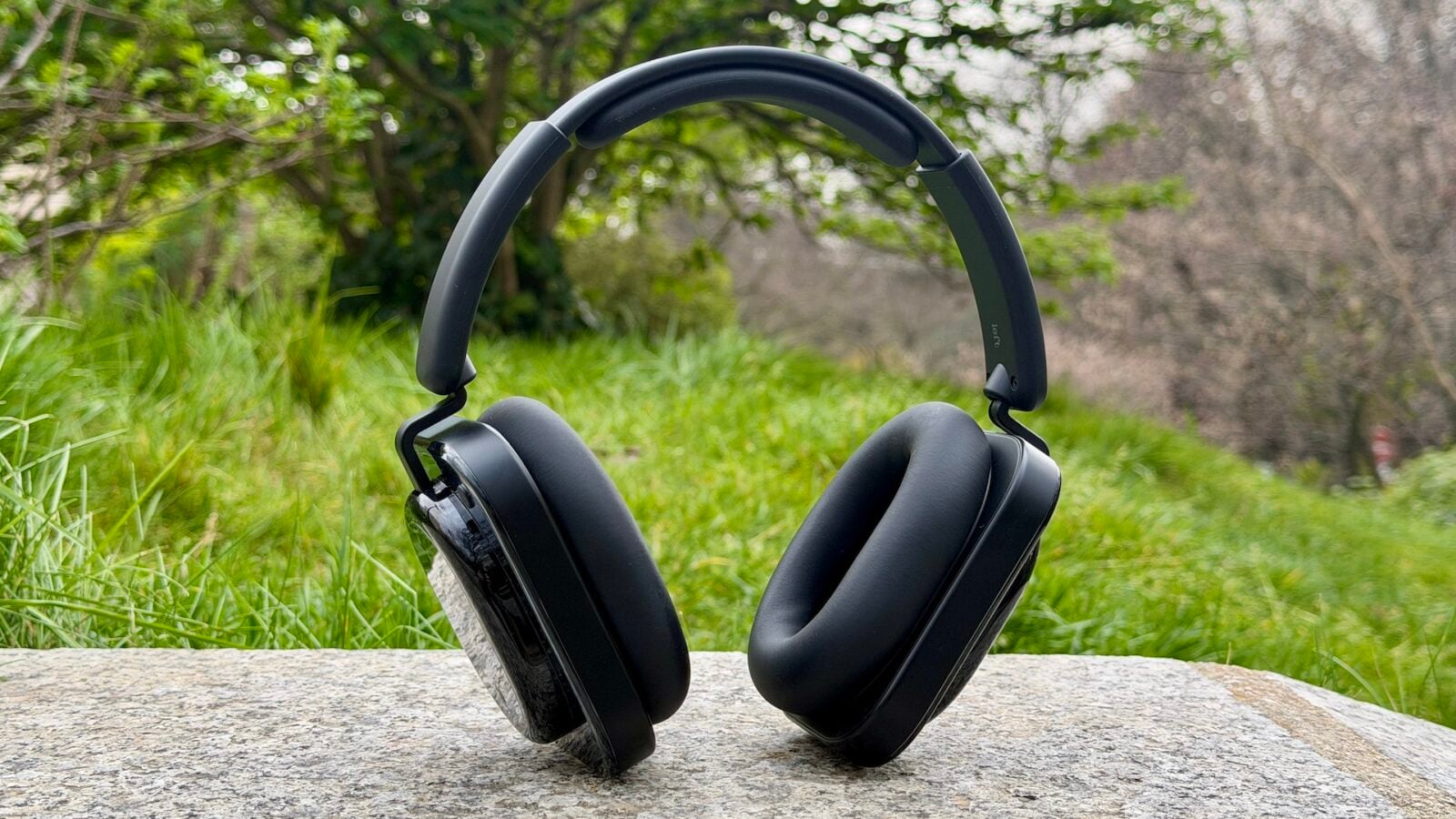
At a glance the Headphone (a) is hard to distinguish from its more expensive sibling. The sliding-arm headband, the rounded-rectangular cups and the semi-transparent styling all carry over, with the transparency simply moved to the rectangular section of the cups. Four colours are offered: white, black, pink and a limited-edition yellow. Under the coloured shells the battery structure and flex cables are visible, a nod to the industrial aesthetic Nothing has built its identity on.
The cost savings are real and visible. The headband padding drops from imitation leather to rubber, the central section of each cup changes from aluminium to plastic, and the foam reinforcement inside the earcups has gone. In compensation the arms remain steel and the hinges are metal-injection moulded for rigidity, so despite the predominantly plastic construction the whole thing feels notably solid. An IP52 rating against dust and splashes is a genuine surprise at this price and still uncommon in the category.
Two details grate. A permanent sticker applied to the outside of the cups looks cheap and seems likely to peel in time — easily avoided. And while the earpads are imitation leather and appear durable, neither they nor the headband padding are removable, which limits the lifespan of parts that wear out first.
Comfort
The Headphone (a) weighs 310 g, only 19 g less than the Headphone (1) despite the partial move away from aluminium. It is not light — a Sony WH-1000XM6 stays under 250 g — but the weight is well distributed and the headphones are easy to forget over long sessions. There is no excessive pressure on the ears or the top of the head, and they stay put during active movement.
The headband adjustment is the irritation: it requires real force to move. The non-folding structure also makes them awkward to pack into a small bag, and the supplied soft case protects less well than a hard one would. These are acceptable compromises at the price, but worth knowing.
Controls

This is where the Headphone (a) genuinely excels, and it inherits the strength almost unchanged from the Headphone (1). The control interface is among the best on any wireless headphones.
A roller handles volume by rotation, play and pause with a short press, and isolation modes with a long press. A paddle slider changes tracks, scrubs through a timeline and answers calls. A customisable button on the outside of the right cup can trigger a voice assistant, mute the microphones, switch equalisation profiles, fire a remote camera shutter — a new addition — or launch ChatGPT on Nothing phones.
Power and Bluetooth pairing get separate controls, a switch and a distinct button, which is a small mercy when so many manufacturers combine them onto one overloaded key. Everything is intuitive, well placed and precise.
One regression: the wear sensors that pause playback when the headphones come off have been removed.
The Nothing X app
The companion app is unusually generous for the money. Its centrepiece is an 8-band parametric equaliser allowing fine adjustment of both the frequency and width of each band — a rare tool at any price, and one that can transform the sound to taste. An Explore tab offers a library of equalisation profiles created by the community and by partner audiophiles.
Also included are adaptive ANC, straightforward codec selection, a tone-alert locator, a low-latency mode that cuts Bluetooth latency from 210 ms to 140 ms, and three spatial audio modes. Those spatial modes come without head tracking and sound artificial; ordinary stereo is the better choice.
Some Headphone (1) features are gone: hearing-adapted sound personalisation, the personalised hearing test, and finer bass-boost control, now limited to three levels. Reasonable sacrifices at this price.
Connectivity

Bluetooth 5.4 with multipoint, handled exemplarily across two simultaneous devices, plus Fast Pair on Android and Swift Pair on Windows. Codecs are SBC, AAC and LDAC, the last carrying 24-bit/96 kHz audio wirelessly from a compatible phone. The absence of LE Audio is a genuine omission in 2026.
The distinctive feature is wired audio over USB-C with an integrated DAC, giving lossless playback and near-zero latency, alongside a 3.5 mm analogue input. That triple connectivity — Bluetooth, USB audio and jack — is a real advantage and rare at this level.
Noise cancellation and calls
The ANC uses two microphones on the outside of each cup in a hybrid feedforward/feedback arrangement. Nothing claims average attenuation above 40 dB, effective to 2 kHz, with passive isolation taking over beyond that.
In practice it is competent rather than exceptional. Against the best in the category — the Sony WH-1000XM6 or AirPods Max — it struggles in the bass and lower mids, so engines, sustained ventilation and low-frequency urban noise remain audible. Higher up it is convincing: sirens and screeches are well suppressed, and the ANC creates no unpleasant sensation of pressure in the ears. The adaptive mode adjusts attenuation to the environment sensibly, and in an open-plan office voices remain audible but lose much of their presence and definition. Passive isolation from the dense pads is very effective, particularly in the treble.
Transparency mode is average for the price. A conversation is perfectly possible, but a marked drop from 2 kHz costs finesse and presence, and someone calling from a distance can become hard to make out. Sound sources do remain naturally locatable.
Call quality is the weakest area. Three microphones point toward the mouth, but the underlying voice signal is very average: the mics make the voice thinner and more nasal than it really is, and introduce unpleasant saturation on sibilant consonants. Clear Voice Technology, trained on 28 million real-world scenarios, delivers good intelligibility — but intelligibility is not the same as a good-sounding capture.
Sound quality
Drivers are 40 mm with titanium-coated diaphragms. With the KEF partnership not renewed, tuning came from Nothing's own team, and the result is different from the Headphone (1) in ways that are often surprising. The signature does not chase audiophile neutrality; it aims at a balance of power and versatility, and largely achieves it.
Bass is a strength. Where the Headphone (1) slightly emphasised the very lowest frequencies, the Headphone (a) is less pronounced but more linear down low, combining punch with depth more successfully. Kick drums land realistically and definition is good.
To reach that balance Nothing has hollowed the lower midrange. Most material still sounds full-bodied, but instruments that live in that region — deep male voices, double bass — can seem slightly thinned. Combined with a more accentuated treble, this makes the reproduction of the lower components of voices less faithful.
Cymbals, brass and high piano notes are deliberately a little bright, though controlled: attenuation further up prevents any harshness, sibilants are not exaggerated, and the headphones stay comfortable at high volume. The soundstage is wide and reasonably immersive for the price, with sufficient if not enormous power in reserve. And the 8-band parametric equaliser can genuinely reshape all of this.
Battery life
This is the headline, and it is not close. Nothing claims 75 hours with ANC active and 135 hours without. In real-world use the headphones ran for around 80 hours with ANC on — beating the claim. For comparison, the Marshall Monitor III ANC, previously the benchmark, managed close to 70 hours under the same conditions.
Fast charging is present too: five minutes yields eight hours of playback with ANC off, and a full charge of the two cells, 1,060 mAh in total, takes around two hours over USB-C.
Availability
No current UK retail listing could be verified at the time of writing, so no UK price is shown on this page.
Verdict
The Headphone (a) achieves what it set out to do. In giving up aluminium cups, the KEF partnership, a hard case and wear sensors, Nothing preserved what mattered: a recognisable design, exemplary physical controls, complete connectivity including USB audio, a genuinely rich app, and battery life with no rival on the market.
Sound quality is less precise than the Headphone (1) but remains engaging and well judged for the vast majority of listening. The ANC does not compete with premium models, particularly in the bass, and call quality is the clearest weakness.
If you want class-leading endurance, excellent controls and flexible connectivity, and you can accept mid-tier noise cancellation and mediocre microphones, this is a strong choice.
Ready to Purchase?
Check current prices and availability
Affiliate Disclosure: As an Amazon Associate I earn from qualifying purchases. Truthful Reviews may receive a commission when you buy through eligible Amazon UK or Amazon US links, at no extra cost to you. Affiliate partnerships never determine our verdicts or recommendations.