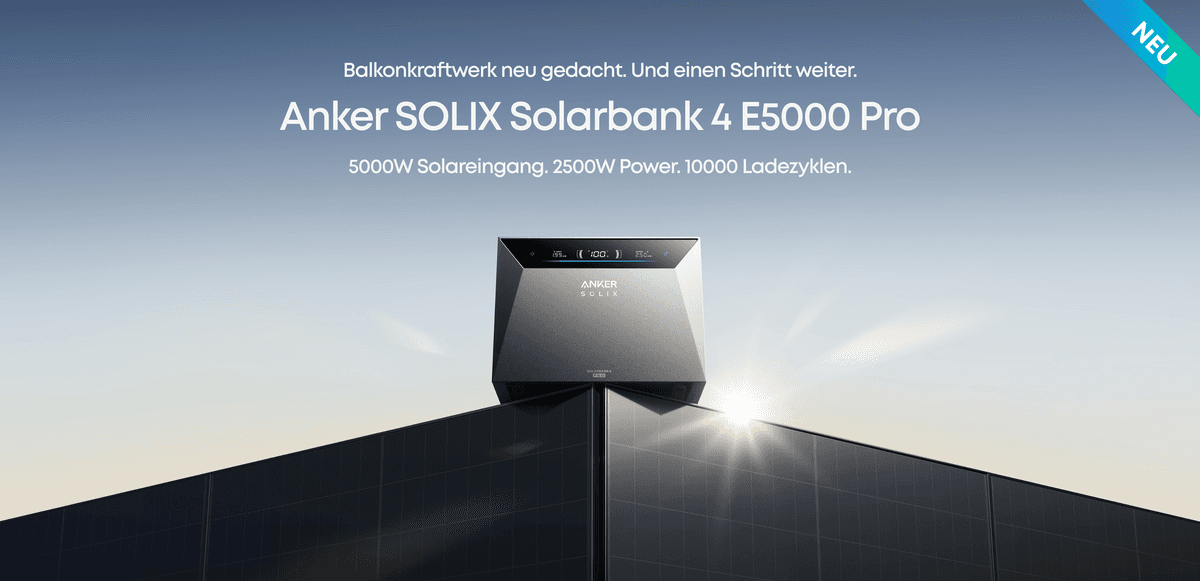
Quick Specs
Our Verdict
A very capable 5kWh balcony-solar battery with superb efficiency, a dependable backup socket and stable zero feed-in. Slow starts in weak light and a nested app cost polish points, but for four-panel-plus setups it is a strong choice.
Research sources
Sources recorded for this page are linked below. Reported third-party testing belongs to the original publisher; it is not testing performed by Truthful Reviews.
Our editorial process
Research method, author and affiliate-independence details
Our editorial process
Research method, author and affiliate-independence details
Prepared by our editorial team using verified source material, product research, and a British-English editorial rewrite before publication.
- We review the working bundle for product facts, comparisons, and buyer-relevant tradeoffs before publishing.
- Non-English source material is translated into British English and rewritten into our house style without carrying over publication branding.
- Affiliate links and price references are handled separately from editorial judgements and never determine the verdict.
Read our full methodology: how we review
Affiliate links never determine our verdicts. Commercial relationships are disclosed separately from the editorial assessment, and we aim to keep buyer guidance clear, specific, and evidence-based.
Pros & Cons
Pros
- Excellent 95 per cent real-world efficiency (4.74kWh usable from a full charge)
- Reliable backup socket with near-seamless switchover up to 2,500W
- Four MPPT inputs handle up to 5,000W of solar panels
- Stable zero feed-in with a smart meter - grid draw often near zero
- Premium IP66 build with fast 2.5kW grid charging
Cons
- PV production starts late in weak morning light, costing yield at the day’s edges
- App is feature-rich but confusingly nested; third-party meter setup is fiddly
- Oversized and heavy (50kg) for simple two-panel balcony systems
- Brief overshoot when compensating abrupt load jumps
Full Specifications
Key Features
Excellent 95 per cent real-world efficiency (4.74kWh usable from a full charge)
Reliable backup socket with near-seamless switchover up to 2,500W
Four MPPT inputs handle up to 5,000W of solar panels
Stable zero feed-in with a smart meter - grid draw often near zero
Premium IP66 build with fast 2.5kW grid charging
Price note: Overseas prices have been converted to approximate pound equivalents using the reference exchange rate current when this page was updated. UK prices and availability may differ.
The Anker SOLIX Solarbank 4 Pro E5000 is no typical compact balcony-solar battery. It offers around 5 kilowatt-hours (kWh) of storage capacity, four MPPT solar inputs and a powerful backup power socket, aiming squarely at larger balcony solar arrays and households with higher electricity demand. The test covered assembly, operation, the app, power regulation, the backup function — and the key question of how much energy actually arrives at the off-grid socket.
The Essentials in Brief
The Solarbank 4 Pro achieved a calculated real-world efficiency of around 95 per cent: from 100 down to 1 per cent charge, 4.74kWh of usable energy arrived at the socket. The backup socket made a good impression — when disconnected from the mains, a connected appliance carried on running with no visible interruption. For simple two-panel balcony setups the Solarbank 4 Pro is almost oversized; it makes far more sense with at least four solar panels. Paired with a smart meter it tracks household demand and adjusts its output so that grid draw frequently sat close to zero. Build quality is high throughout, with robust housing, connectors and cables.
What Does the Solarbank 4 Pro Offer?
The Solarbank 4 Pro E5000 combines battery, inverter, PV connections and control electronics in a single unit. Nominal capacity is 5,024 watt-hours (Wh), using lithium iron phosphate cells — a chemistry regarded as robust and long-lived. The IP66-rated housing keeps out dust and powerful water jets, the unit operates between -20C and +55C according to the spec sheet, and the main unit weighs around 50 kilograms.
Four MPPT inputs with MC4 connectors accept the solar panels. MPPT (Maximum Power Point Tracking) continuously hunts for each panel's optimal operating point, which is especially helpful when panels face different directions or sit partly in shade. In total the Solarbank 4 Pro processes up to 5,000 watts of PV input — up to 1,250W per input, at a maximum of 60 volts and 36 amps.
Output power needs careful classification. Connection, registration, metering and installer requirements vary by country and installation. Follow the manufacturer's instructions and current local guidance before connecting the system. The Solarbank 4 Pro can be capped at 800W, but technically runs far higher: in the test, output of up to 2,500W could be set in the app. The backup socket likewise delivers up to 2,500W from the battery; up to 3,600W is possible only in bypass mode, where the unit passes mains power through.
Unboxing and Assembly

The Solarbank 4 Pro is big and heavy. A strong person can move the 50kg unit alone, but it is not advisable — with two people the job is far safer and more relaxed. The packaging is sturdy and practical: release the transport locks and the upper carton lifts away, leaving the unit free-standing and easy to grip. The recessed handles are well shaped and the housing feels premium, with cooling fins on the rear. PV connections and the power switch sit on the left; the backup socket and AC connection on the right. The included Schuko cable feels robust, as does the optional Wieland cable. From opening the box to connecting pre-mounted panels and completing app setup took less than ten minutes.
App and Operation
Initial setup was straightforward and the Anker app found the unit immediately. The home screen presents energy flows, charge level and device data clearly. Pairing a third-party Shelly Pro 3EM energy meter demanded more patience: the Shelly cloud account had to be registered first, and the meter was then added through a rather dated-looking menu that was not fully self-explanatory.
The app structure takes some learning too. Anker works with terms such as device, system and plant; the logic is technically sound but feels nested in everyday use — tapping the Solarbank under "Devices" does not reach all the settings. Notably, the output slider could be raised from 800W to 2,500W even while the unit was connected via a standard Schuko plug, which is not officially intended; Anker recommends a Wieland connection or professional fixed installation for higher power. Without a smart meter, a user-defined mode runs fixed time windows with output adjustable from 100W to 2,500W in 50W steps.
Grid Charging

Charging from the grid worked reliably, though the function is somewhat hidden — there is no clear "grid charging" menu item; instead the fast-charge option lives inside the active mode, where a time window can be set. The unit then drew around 2.5 kilowatts from the mains. That is practical for topping up quickly in poor weather, before an evening of high usage, or for the backup function — and potentially useful with dynamic electricity tariffs, charging when prices are low.
A Weakness in Low Light
At the start of PV production a weakness emerged. The same four fixed panels delivered small but visible amounts of power on a previously tested rival unit in weak morning light; connected to the Solarbank 4 Pro, the app mostly showed 0W, with only brief readings of 10-30W. Since location, orientation and panels were unchanged, the evidence suggests the Anker's inputs reach a usable operating range later in very weak light. Some solar yield can therefore be lost at the edges of the day; how much depends on location, weather and orientation.
Connectivity
For consumption measurement and zero feed-in, the Solarbank 4 Pro works with the Anker Smart Meter Gen 2, Shelly 3EM and Shelly Pro 3EM, and the everHome EcoTracker IR. A planned Home Assistant integration is also interesting for smart-home users: Anker offers an official integration working locally over Modbus TCP, so it would not depend on the cloud.
Zero Feed-In Performance
The zero feed-in check used a Shelly Pro 3EM while various household loads — lights, a television, a fridge compressor, a fan heater and, as a particularly hard test, a hairdryer with its abrupt load jumps — were switched on and off with measurements every second. The Solarbank detected load changes reliably and adjusted its feed-in. With smaller loads and the fan heater, regulation was mostly smooth; the hairdryer occasionally produced a brief overshoot-and-settle pattern before total power returned towards 0W. With a steady base load the zero feed-in held very stable, often just a few watts either side of zero — a good real-world result, even if hard load jumps are not compensated without a short delay. Feed-in typically began within a few seconds.
Capacity Test
For the capacity test the unit was discharged through the backup socket into a fan heater, with energy logged by a smart plug. From 100 down to 1 per cent charge, 4.74kWh arrived at the socket over roughly 2 hours 34 minutes — an average of about 1.8kW. Against 99 per cent of the nominal 5,024Wh, that works out at a practical efficiency of 95.3 per cent (an approximation, as battery percentage displays are not perfectly linear). Under high load and fast grid charging the housing warmed only slightly: at around 25C ambient, the app reported a peak of 42C — uncritical.
Backup Power
The backup function was checked first with a 17W lamp: no visible flicker when mains power was cut. Switchover was then tested with a fan heater at around 900W and 1,800W. Across four runs the appliance kept running; three times it audibly slowed for a moment before spinning straight back up, once no interruption was perceptible at all. The UPS-style function proved dependable in everyday terms, and the app reported the power cut immediately via push notification, confirming again once mains power returned.
AI Features
Anker also promotes AI functions — the Anka assistant and smart energy modes that factor in PV forecasts, consumption data and dynamic tariffs. The basics worked, but a reliable verdict on long-term savings would need several weeks of mixed weather, tariff data and a steady consumption profile.
Who Is It For?
The Solarbank 4 Pro suits larger balcony-solar setups with at least four panels. For classic two-panel systems the 5kWh battery is almost too big, since it needs enough solar power to fill regularly. Bundles including the Anker Smart Meter Gen 2 are common, and on capacity, four MPPT inputs and the strength of the backup socket it makes a strong case at its usual position in the range. A noteworthy alternative is the similarly sized 5kWh SunEnergyXT 500, which started PV production earlier in weak light.
Verdict
Anyone running a multi-panel balcony solar array who wants to buffer plenty of solar power gets a very capable battery in the Anker SOLIX Solarbank 4 Pro E5000. The high usable capacity, premium build, strong backup function, fast grid charging and stable zero feed-in under steady load all impressed, and the high-load test was excellent with a calculated real-world efficiency around 95 per cent. The weaknesses: PV production starts later in weak morning light than rival units, the feature-rich app is convoluted in places, third-party meter pairing could be simpler, and abrupt load jumps cause brief oscillation. For simple two-panel systems it is oversized; for users with four to twelve panels, higher base load and an interest in backup power, it is a strong solution whose flaws cost polish points but barely dent a very good overall impression.
Ready to Purchase?
Check current prices and availability
Affiliate Disclosure: As an Amazon Associate I earn from qualifying purchases. Truthful Reviews may receive a commission when you buy through eligible Amazon UK or Amazon US links, at no extra cost to you. Affiliate partnerships never determine our verdicts or recommendations.