Green smoothies are the reason most people buy a jug blender, and they are the reason cheap ones disappoint. Forty-eight blenders were tested for this guide; the best for most people is the Bosch VitaBoost, which combines excellent build, easy handling and genuinely good results.
The short version
Revolutions are what decide it
The specification that actually matters is speed, not just wattage. The smallest machines manage 500 watts and up to 20,000 revolutions per minute. High-performance blenders generally run 1,000 to 1,600 watts and reach up to 45,000 rpm.
That gap matters if you make green smoothies with vegetables, because only very high speeds properly purée the plant fibres in firmer produce — celery, kale, spinach. Below that you get woody fibres in the glass.
Test winner: Bosch VitaBoost
The VitaBoost convinced from the first second, starting with a modern, high-quality look straight out of the box.
It has six automatic programmes — Shake, Smoothie, Ice Cream, Soup, Sauce and Cleaning — plus a pulse function and a control wheel that varies speed steplessly. With 1,600 watts and up to 30,000 rpm it is a genuine powerhouse: puréeing whole apples gives it no trouble.
That power is audible. Like every jug blender it makes a serious racket in use — around 90 dB measured — though that is no louder than comparable machines.
The 2-litre jug is only plastic, but it feels well made, and there is a reason for the material: a Vitamix six times the price also uses plastic, because glass strong enough to match it would be impractical. It is BPA-free, dishwasher-safe, and there is a dedicated cleaning programme. The supplied tamper sits well in the hand.
It is a substantial object: 5.2 kg and 45.8 cm tall, which makes it a statement on the worktop — and that weight is what keeps it steady when it is working.
Fine-to-coarse control: Braun PowerBlend 9 JB9040
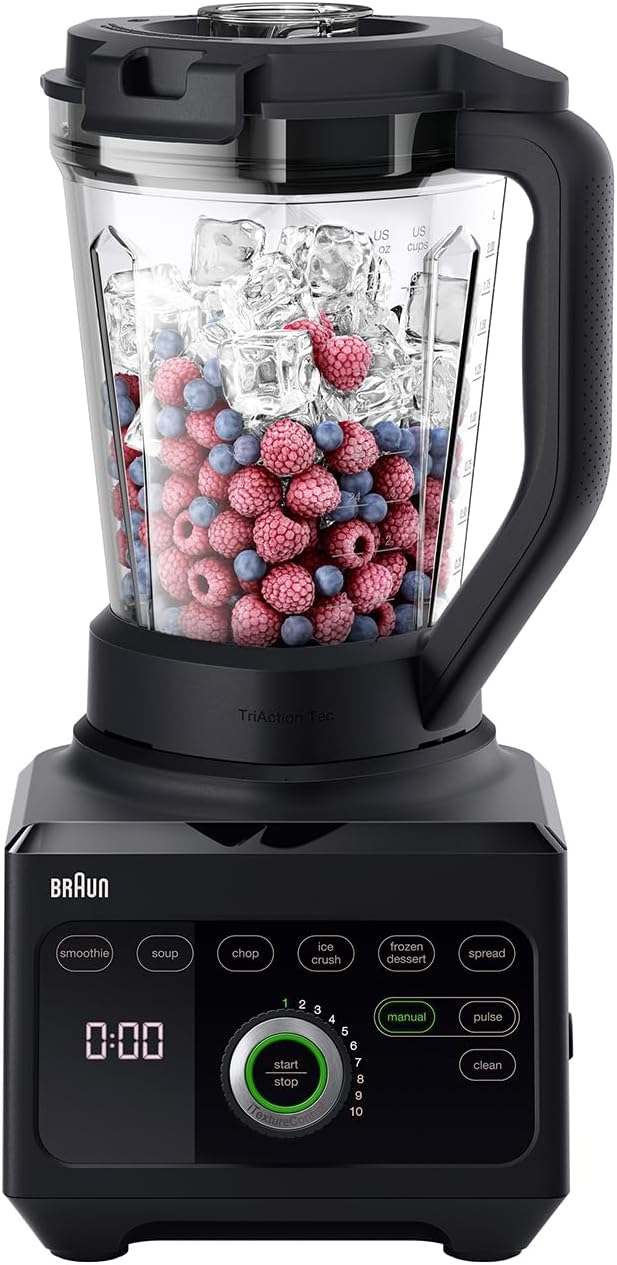
The Braun's distinguishing feature is that you choose the texture: whether you drink your smoothies very fine or with coarse pieces still in them. There are programmes for soups, crushed ice, spreads and frozen yoghurt as well.
The texture settings are named smooth, medium and coarse, and each runs its own automatic timer — 59 seconds on smooth, for instance — with a separate manual timer available too. On smooth the result came out especially fine, with no pieces at all.
Operation is straightforward, with a real power switch rather than a touch-only arrangement — though the labelling is English only, and the touch display shows fingerprints. The large triangular jug is the other highlight: unusually easy to clean, and a generous capacity. There is a cleaning programme here as well.
The power ceiling: Vitamix Explorian E310
The Explorian E310 is defined by incomparable power and superb quality: a two-horsepower motor rated at 1,500 W, a robust motor block and a high-grade titanium-effect plastic jug with a flexible lid. It keeps controls to a minimum, which makes it simple to use, and stores its cable underneath the motor block.
Everything is reduced to nothing in seconds. Two honest caveats, both the source's own: it is very expensive, and blend for long enough and friction genuinely warms your smoothie.
Budget compact: Philips HR2291/41
The price tip: a compact machine at a low price that still does its job pleasingly well. It has a glass jug, which some people much prefer, and takes up little room.
The compromises are visible. The control dial and the lid feel low-grade next to the others here, and there is no tamper in the box.
How jug blenders are built
They are more alike than the marketing suggests. The jug drops onto the motor block, where a gear underneath engages the drive — nearly every blender works this way.
Most have a safety switch on top of the motor block, so the machine runs only with the jug fitted and stops automatically the moment it is lifted off.
The blades are similar too: fixed inside the jug, not removable for cleaning, and numbering either four or six.
And they are big, heavy and loud. Most weigh over four kilograms — which is necessary, because that weight is what keeps them planted on the worktop when they are working hard.
About that "cell walls release more nutrients" claim
Some manufacturers claim that a high-performance blender breaks open the cell walls of plant fibres and releases nutrients the body otherwise cannot reach. It sounds good enough that it gets repeated widely.
The source's assessment is blunt: there is no scientific evidence for it, and it is principally good marketing. The digestive system is already a specialist at extracting nutrients from food, and it breaks down fibre cell walls with the help of gut bacteria — no high-performance blender required.
How to choose
Start with what you blend. Fruit and soft ingredients are within reach of almost anything. Firm vegetables demand high revolutions, which is where the wattage and rpm figures earn their place.
Decide about noise and size. These are large, heavy, loud appliances by nature — around 90 decibels for the winner — so think about where one will live before you buy.
Look at the jug, not just the motor. Plastic is normal even at high prices; the questions worth asking are capacity, shape and how easily it cleans. The Braun's triangular jug and the Philips's glass are the two distinctive answers here.
Check what is in the box. A tamper matters more than it sounds: the Bosch has a good one, the Philips has none.
Elsewhere in the tested field
The wider field of 48 shows how much noise varies. The KitchenAid K400 Artisan 5KSB4026 recorded 93 dB, a top figure in the test, and needed help with coarse pieces such as halved apples and pears. The Wilfa Xplode Vital BBLSP-1800S measured 88 dB, which the testers call unremarkable for a high-performance machine. The Severin SM 3737, WMF Kult Pro, Ninja CB350EU, KitchenAid K400 and Vitamix Ascent A3500i are among the others assessed without earning a recommendation.
Frequently asked questions
Which blender is best for smoothies? The Bosch VitaBoost for most people — 1,600 watts and up to 30,000 rpm handle whole apples and firm vegetables alike. If you want to choose the texture rather than accept it, the Braun PowerBlend 9 gives you fine-to-coarse control.
Is a Vitamix worth the money? On pure capability, nothing here matched the Explorian E310 — anything liquefies in seconds. The source is equally clear that it is very expensive and that long blending warms the contents.
How many watts do I need? Small machines run 500 watts and up to 20,000 rpm, which is fine for fruit. For firm vegetables such as celery, kale or spinach, you want the high-performance class: 1,000 to 1,600 watts, reaching up to 45,000 rpm.
Are jug blenders loud? Yes. Around 90 decibels was measured for the winner, and that is typical rather than exceptional for the category.
Can I remove the blades to clean them? No. On essentially all of these the blades are fixed inside the jug — which is why an automatic cleaning programme, as on the Bosch, is genuinely useful.
Does blending release extra nutrients? The source found no scientific evidence for that claim and describes it as marketing; the digestive system already breaks down fibre cell walls with gut bacteria.