A bread maker mixes, kneads and bakes for you, so a loaf can be ready for the moment you get up or the moment you get home. The trade-offs are real — the kneading paddles leave holes in the base of the loaf, and baking takes several hours — but if you eat bread often, the machine does the work. A recent group test baked ciabatta and wholemeal in nine machines under the same conditions, scoring the loaf itself at 40 per cent of the grade, and measuring energy use, noise and how hot each casing became. These are the results, and which ones you can actually buy here.
The short version
- Best overall: Rommelsbacher BA 550 — the best loaf in the test, and the reference the others were judged against.
- Best handling: Tefal PF240E38 — the easiest to live with, if you can ignore a very hot casing.
- Named but not confirmed here: the Nutrilovers, Medion MD12040 and Graef BA806EU, for the reasons set out below.
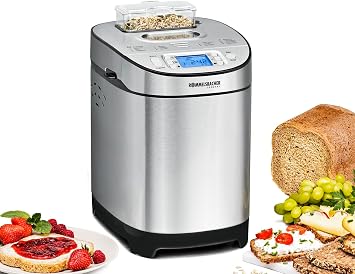
Best Overall: Rommelsbacher BA 550
The BA 550 baked so well that the testers made it the reference point for the whole group: ciabatta and wholemeal both came out ideally in three hours. It is also frugal, at 184 watt-hours a bake, and it is solidly built, taking up acceptable worktop space for the size of its chamber.
Two things to know before you buy. It is the loudest machine in the test at 14 sone, and the casing gets seriously hot — nearly 77 degrees Celsius — so it wants a clear spot away from anything that minds heat. Its 2.5-litre chamber suits the 700 or 900 gram loaves the manufacturer recommends rather than family-sized ones, and it offers only 13 automatic programmes, the lowest count here, though those include two cake settings, one for gluten-free bread, and a memory slot for a programme of your own. The cable, at 107 centimetres, is on the short side.
For the loaf itself, nothing else in this test matched it. Check the price on Amazon
Best Handling: Tefal PF240E38
If you want the machine that is easiest to actually use, this is it — it took the top ergonomics score in the test. The ciabatta came out of its 3.29-litre chamber close to ideal, and the wholemeal was sound if a little smaller than the quantity of dough suggested it should be. It is well made, simple to operate and straightforward to clean, no louder than average, and economical at 202 watt-hours a bake.
The compromises are worth weighing. Its casing reaches a very high 79 degrees Celsius, the highest recorded here. There is no ingredient hatch for adding nuts or fruit mid-cycle and no viewing window, so you cannot watch progress. The cable is only 99 centimetres, and despite a normally proportioned baking chamber the machine wants a 32 by 36 centimetre footprint. Check the price on Amazon
Also Tested
The test's other three recommendations are worth knowing about. Each links to a search for its exact model name rather than a specific listing, because we have not verified an exact-model listing for any of them — and we have not substituted a near-model for any either.
The Nutrilovers Nutri-Bread Maker was the test's top alternative and the second-best loaf of the group: the ciabatta was kneaded well, rose perfectly and baked ideally, while the wholemeal came out crisp though it could have risen a shade more. It bakes in the usual three hours on a thrifty 201 watt-hours, stays comparatively cool at about 63 degrees, and carries 19 programmes including cake, gluten-free, yoghurt fermenting and jam. Its faults are a 103-centimetre cable and a body that hogs space for a 2.5-litre chamber — 24 by 35 centimetres of worktop, plus 56 centimetres of clearance above for the open lid. Search Amazon UK · Amazon US
The Medion MD12040 is the one for big loaves: a 6.4-litre chamber that takes loaves up to 1.6 kilograms, without a huge footprint, though it also needs 56 centimetres of headroom with the lid up. Its wholemeal was very good, well risen and crisp; the ciabatta was good and crisp but finished slightly doughy inside. Build and operation are good rather than exceptional, there are 19 programmes plus a memory slot, and it runs particularly quietly on a mid-table 248 watt-hours. Note that other Medion bread makers are sold under different model numbers, so search for this exact code. Search Amazon UK · Amazon US
The Graef BA806EU is the quiet one, and the most versatile on paper: 35 programmes covering bread doughs plus jam, compote, chutney and porridge. Its baking is the weak point — ciabatta collapsed and turned doughy inside its 3-litre chamber, and the wholemeal, while better, was also a little doughy. That is more disappointing given it takes three and a half to four hours a loaf, an hour longer than most, and correspondingly needs 339 watt-hours. There is no viewing window, the cable is too short, and the build is middling despite the metal casing. Watch the model code when buying: a BA806 with 36 programmes baking 500 or 750 gram loaves is a different variant from the tested BA806EU. Search Amazon UK · Amazon US
What to Look For
Loaf size decides the machine. Compact bread makers usually top out around 750 grams, which is often too little for a family. Mid-sized machines manage a kilo, and the bulkiest will bake 1,800 gram loaves. That capacity drives the dimensions: a machine for 1,500 gram loaves is likely to be 40 to 50 centimetres wide and up to 40 tall, weighing between 7 and 9 kilograms, while a compact one is roughly 10 centimetres narrower and 2 kilograms lighter.
Kneading paddles. Machines up to 1,000 grams generally manage with a single paddle; a double paddle kneads larger quantities faster and more thoroughly. Sourdough needs special stirring paddles that work flour from the edges and base into the wet, sticky dough. Whichever you have, paddles that lift out easily are worth having — you can remove them before baking so only the wells remain. No machine gives you a completely unmarked loaf.
Programmes, not temperature. You generally cannot set the temperature yourself, only a browning level: the machine follows an exact recipe and controls kneading and baking automatically. That makes the breadth of stored programmes — different breads, dough variations, extras such as jam — the thing that matters, and a large colour display makes them easier to navigate.
Cleaning is hand-wash, always. The removable tin and paddles are non-stick, which is what stops dough clinging, but that coating means neither may go in the dishwasher and neither tolerates aggressive scrubbing. Warm water, a little washing-up liquid and a sponge is the routine, and rubbing a little sunflower oil into the tin keeps it in condition. Housings differ: keys behind a plastic cover wipe clean easily, and some lids detach for proper cleaning.
Wear and spares. The tin and paddles are the parts that wear — the coating scratches eventually even with careful use, and then bread starts to stick. Many manufacturers sell replacement tins and paddles, and it is worth checking that yours does before you buy, because if the mechanism itself fails, repair rarely makes sense against a new machine.
How the Testing Works
The baking result carries 40 per cent of the grade, judged over two bakes — ciabatta and wholemeal — following the instructions with the most appropriate programme, and looking for a crisp exterior, good volume, an even crumb and no doughy patches. Equipment counts for 30 per cent: what comes in the box, such as measuring cups and recipe books, and features including an ingredient hatch and viewing window, along with cable length, achievable loaf size, programme count, build quality and how much worktop the machine occupies relative to its chamber. Ergonomics takes the remaining 30 per cent — intuitive operation, restrained noise, easy cleaning, and baking time.
Frequently asked questions
How do you use a bread maker? You add the ingredients, choose a programme and start it; the machine mixes, kneads and bakes without further input, and many can be timed so the loaf finishes when you wake or get home. Bread mixes are the easiest route — you add the stated quantity of mix and water and press the button, and the machines cope particularly well with them. If you combine your own ingredients, you must follow the quantities precisely or the loaf will not work. Most machines come with recipes, either in the manual or as a separate book.
Can a bread maker handle sourdough? Only with the right features. Sourdough's lactic-acid bacteria need to ferment for up to half a day before baking begins, so without a sourdough programme and a long enough timer you end up kneading and baking in separate steps, which removes most of the labour saving. The wet, sticky dough usually needs help too, because flour clings to the sides of the tin and has to be pushed down with a spatula, and only a few machines have the special stirring paddles for it. Baking is its own challenge: sourdough needs a high initial temperature for a proper crust, and machines without a dedicated programme often produce a loaf that has not risen, has not baked through, or has no crust.
Can you make jam in a bread maker? Yes, and most machines have a jam programme. You need fresh fruit and preserving sugar in the right proportion — usually two parts fruit to one part sugar — and the ingredients cook for one to two hours in the machine. Follow your manual's quantities and check everything fits in the tin without boiling over.
How do you clean and care for it? Take out the tin and paddles, which normally come apart easily, and wash both by hand — the non-stick coating is not dishwasher safe, and steel wool and aggressive cleaners will damage it. Warm water with a little washing-up liquid is enough, and a wipe of sunflower oil helps keep the tin in good order. The shafts the paddles sit on are sometimes uncoated and can be rubbed with a little oil. Wipe the housing with a damp cloth, keeping water away from the buttons.
Is a bread maker cheaper than the bakery? Bread mixes are inexpensive and cost less per loaf than buying from a bakery, though you have to set the purchase price and running costs against that. You can skip mixes and combine your own ingredients, but the quantities must be exact.
What is the alternative? If you do not mind the work, knead the dough in a food processor or stand mixer and bake it conventionally in the oven with a suitable tin. That route also gives you more room to experiment — you can add or leave out ingredients and choose your own temperature and baking time, whereas only a few bread makers let you programme your own recipes. If you bake rarely, a dedicated machine is harder to justify.