A dog water bottle is an ordinary water bottle with the bowl built into it. That is the entire idea, and it is a good one: the drinking vessel folds, clips or screws onto the bottle itself, so there is no separate dish to find room for in a rucksack or a bag. On a long walk that matters. On a short one it is simply more comfortable than improvising. Sixteen bottles were tested, across a range of capacities and drinking mechanisms, and this guide covers what separates them.
What follows is recorded testing, translated. Nobody at Truthful Reviews has filled or carried any of these bottles. This page makes no claim about the health, hydration, joints or weight of any animal; it describes what the bottles are made of, what they weigh, how much they hold, whether they leaked and how the mechanisms behave.
The picks at a glance
The best for most people is the Gizzy stainless steel dog water bottle, which pairs a durable stainless body with a silicone leaf that suits the muzzles of most dogs, plus genuinely useful accessories. A lighter plastic alternative with its own extra kit is the Emmi-Pet dog water bottle 2in1. The Trixie Bottle with Drinking Bowl is the minimalist option, and the Milu 3in1 is the one for anybody who wants the contents to stay hot or cold.
Stainless steel or plastic
The bottle body is normally either stainless steel or plastic. Drinking bowls are usually silicone or a harder plastic, and manufacturers generally state which material is which.
The basic decision is between the two body materials. Plastic is lighter and more flexible, and it can be transparent or translucent, so the amount left in the bottle can be seen at a glance. Stainless steel is sturdy and normally lasts a great deal longer, where plastic has a shelf life. Stainless is also more expensive to buy in the first place, and it is heavier.
More manufacturers now state that their dog water bottle is BPA-free, and some also state that their bottles are food-grade. Both are label facts recorded here as they are stated, with no claim attached to them.
Bowl shape and how the bottle is carried
Every dog water bottle has to be carried by somebody, and almost nobody hands that job to the dog. So it is worth thinking about where the bottle will live before buying one: whether a tall, slim shape or a squatter bottle with a larger girth fits the rucksack or bag better, and whether it needs to hang on the outside of a rucksack, on a pushchair or on a belt. If it does, a carabiner or a hanging loop matters.
Bowl size is the other fit question. If the dog is larger than poodle standard, the drinking vessel needs to be big enough for its muzzle. The invertible silicone leaf shape has an advantage here, because it opens out rather than staying a fixed dish.
The first thing to do with a new bottle is check that it actually seals. Leaks are often a handling error rather than a fault: manufacturers tend to point out explicitly that the lid has to be closed carefully, and a lid sitting crooked on the thread will let liquid through however good the seal is. Sometimes the release button has simply not clicked into its closed position, which is worth checking before the bottle is packed away.
With or without a vacuum flask function
Whether to buy a bottle with a vacuum flask function comes down to how it will be used. A plain bottle without insulation does not heat or cool its contents within minutes either, but it will not hold a temperature for long. Testing found that after several hours in the sun, water in a metal bottle warmed a few degrees more than water in a plastic one.
The insulated bottles are considerably heavier, both empty and full, which is the trade-off.
Cleaning
Some dog water bottles can go in the dishwasher, and where they can, that generally applies to the bottle alone: the closure with the drinking bowl attached should be washed by hand. Take the connections apart so nothing is left behind in them.
For routine cleaning, warm water, a little washing-up liquid and perhaps a soft brush will do. Where the opening is too narrow for a brush, water and washing-up liquid can be put in the bottle and shaken vigorously instead. Special cleaning tablets exist for heavier soiling or a musty smell and can be used occasionally. All the parts — bottles, closures and drinking bowls — should be dried thoroughly after cleaning, and small parts and silicone inserts need the most attention. Only dishwasher-rated parts belong in the machine.
Top pick — Gizzy stainless steel dog water bottle
The Gizzy convinces on material and finish. The body is durable stainless steel, which is extremely sturdy and shatterproof and does not bring the problems plastic can. Its shape, with a slimmer waist, looks good and sits well in the hand, and it comes in blue and in green.
The drinking bowl is a silicone leaf sitting tight against the neck of the bottle, so it takes up no extra room. Water runs into it once the leaf is folded up, which takes a little force. The leaf is fixed directly to the closure, which is plastic; all the plastic parts are free of plasticisers according to the manufacturer.
Anyone meeting the design for the first time may be briefly baffled by it. A QR code on the carton leads to a video, and mercifully that video runs for one minute and explains the closure briskly. The button in the middle of the closure opens the water supply; the button on the side shuts it off. When the dog has finished, pressing the middle button again lets the remaining water run back into the bottle.
The large openings make the Gizzy easy to fill and easy to clean, and the bottle itself can even go in the dishwasher. The closure with the silicone leaf is better cleaned by hand.
For accessories it brings an additional silicone loop. The decisive extra — the thing that gave the Gizzy its edge in the scoring over the completely identical Lumoleaf — is the supplied towel in a silicone dispenser, for drying the drinking bowl after use. It will also wipe wet paws quickly before a dog gets into a car. Functionally the two bottles do not differ at all: the Lumoleaf has the same qualities, and whether the accessories are worth having is a matter of personal preference.
Drawbacks. Stainless steel is heavier than plastic, and at a little over 300 grams the Gizzy sits at the upper end of the bottles tested, the vacuum flasks aside. It also costs more than the plastic bottles.
Search Amazon UK · Search Amazon US
Lighter, with a treat compartment — Emmi-Pet dog water bottle 2in1
The Emmi-Pet 2in1 is clear plastic and carries the popular silicone leaf as its drinking bowl, fixed to the closure. Because the plastic is clear, the level in the bottle is visible at any time, which is useful for planning how much water is left.
Setting the vacuum flasks aside, it is one of the largest bottles in the test at 25 centimetres tall. Even so it holds less than comparable bottles, and the reason is in the base: a compartment for treats that simply unscrews, which is what the "2in1" in the name refers to. That compartment is genuinely handy out on a walk, since it will carry treats or even a small portion of dry food.
The mechanism matches the Gizzy's. Fold the silicone leaf up, press the button in the middle of the lid and water runs into the bowl; the button on the side stops it. Press the top button again and the water in the bowl runs back into the bottle — which also means unused water goes back where it came from.
A carabiner on the silicone loop attaches the bottle to a rucksack or a belt loop.
Search Amazon UK · Search Amazon US
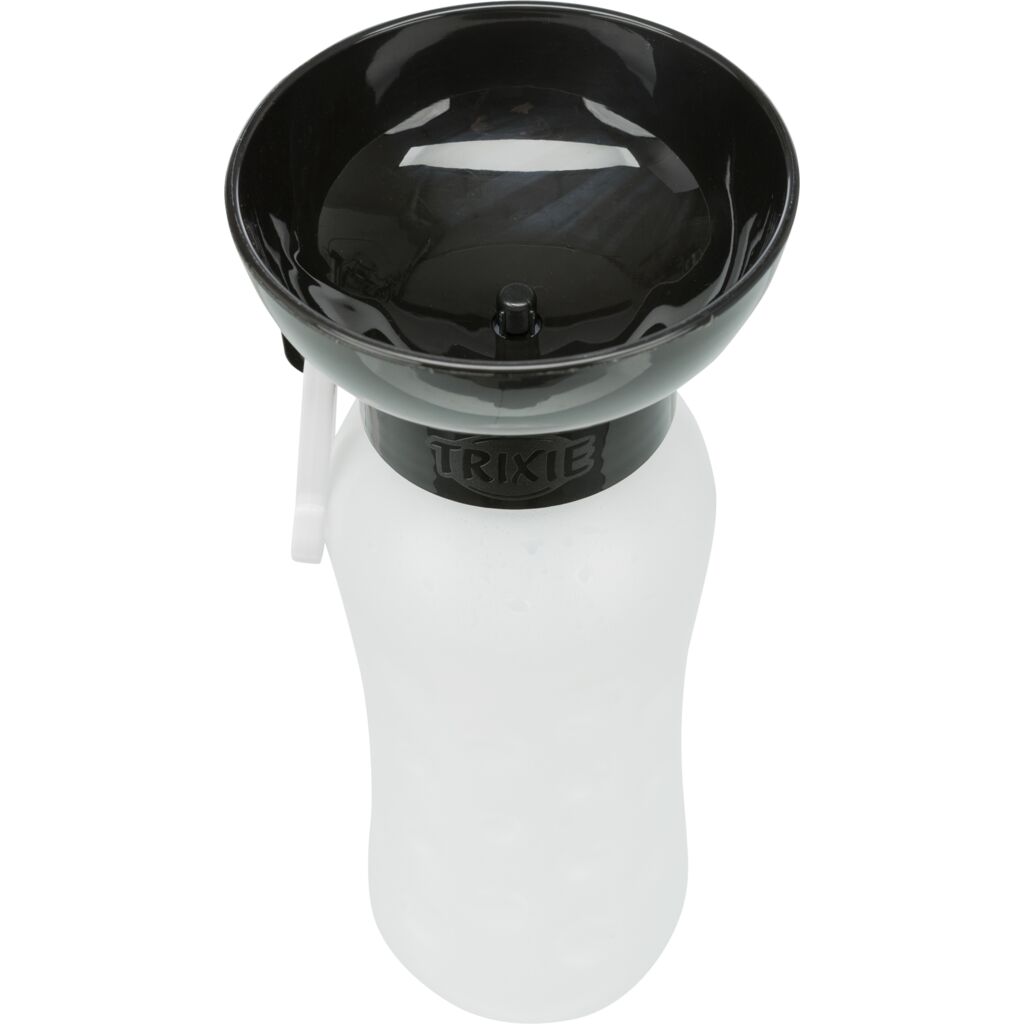
The minimalist — Trixie Bottle with Drinking Bowl
At under 100 grams the Trixie is one of the lightest bottles in the test and the cheapest of them. It is plastic, though no closer detail about that plastic could be found, and it comes with a firm drinking dish that folds in and wraps around the bottle.
Filling the bowl means folding it out and then squeezing the bottle so the water runs into the dish. With the bowl folded in, squeezing the bottle does not push any water out.
This is the drinking bottle reduced to its basic principle: water bottle, drinking bowl, done. The opening is fairly narrow at 2.3 centimetres, though a bottle brush still does its job in there. Where, as here, there is no statement about dishwasher suitability, hand washing is the answer.
It does at least come with a carabiner, but that carabiner feels very cheap and not very durable, and it opens the opposite way round to normal carabiners. It is best swapped out straight away.
Search Amazon UK · Search Amazon US
For hot or cold contents — Milu 3in1 dog water bottle
If the contents need to stay warm or cold for a while, the Milu 3in1 is the one. Because of the vacuum flask construction and its accessories it weighs considerably more than the other bottles even when empty — at nearly 600 grams it is the heaviest in the test. With a 950 millilitre capacity, a full one comes to around 1.5 kilograms. That probably makes it better suited to longer car or train journeys, where the luggage is not on somebody's back the whole time.
At first glance it looks like an ordinary vacuum flask for people. The second glance finds a drinking bowl at the foot of the bottle and a second container for treats, both of which unscrew. If the drinking bowl has been stood on the ground, it is worth wiping its underside before screwing it back on with the treat container, or the dirt ends up in the treats.
Hot water in the Milu was about body temperature after twelve hours. Straight after filling, the lid became very warm, which shows that heat escapes there. A dog does not need hot water, of course, but the test shows how well the bottle holds the temperature of what is inside it.
The lid is a cup with a handle, so a drinking vessel for the owner comes as part of the package. To pour water into the drinking bowl, only the top end — effectively the base of the cup — is unscrewed, leaving a narrower opening. The main opening once the cup is removed is 5.5 centimetres across and allows thorough cleaning by hand, which is just as well, because this bottle must not go in the dishwasher.
As a particular flourish, the Milu 3in1 can be engraved with the dog's name at the point of purchase.
Search Amazon UK · Search Amazon US
Also tested
Nordfolt HF2D001 — a vacuum flask bottle with 950 ml capacity, at the top of the field for weight because of both its size and its insulated construction. A drinking bowl and a treat dish are built into the foot, so it is clearly intended for longer outings and for dog and owner to share the water. Unscrewing the top lid gives a 5.5 cm opening that is very easy to clean. With the lid screwed down, a slider on the upper part moves to the right as the embossed arrow indicates, then a tab marked "Push" flips a cap open to reveal a narrow pourer. Anybody who does not need that uses the second supplied lid, whose handle doubles as a carabiner for hanging the bottle on a rucksack. It passed both the leak test and the insulation test with flying colours: both lids held absolutely tight, and hot water was still well above lukewarm after 36 hours. It was, however, no longer available online once testing finished. Search Amazon UK · Search Amazon US
Lumoleaf stainless steel water bottle — exactly the same construction as the Gizzy. It has the same large silicone leaf that folds up, the button on the lid that opens the water supply and the button on the side that stops it again, plus a silicone loop with a carabiner for carrying. The bottle may go in the dishwasher; the lid may not. Search Amazon UK · Search Amazon US
Kurgo Gourd — stands out for its curved shape and its coloured, transparent plastic; the test sample was blue, with red and green also available. It is one of the models with the drinking bowl at the base, and here the bowl is pushed on rather than screwed on, which makes taking it off slightly awkward. The closure departs from the usual designs too: a blue slider set into the grey lid opens a small pouring aperture when pulled back. No instructions are included, and the only guidance is an English-language video on a retailer listing. The lid unscrews completely to give an opening of about five centimetres. The manufacturer states the bottle is dishwasher-suitable, but the video shows only the bottle itself going into the machine, so as with similar models the lid is best cleaned by hand. Search Amazon UK · Search Amazon US
Hunter outdoor water bottle with silicone bowl — another silicone-leaf closure, with the opening sealed by a silicone stopper. The striking part is that the closure also screws onto ordinary shop-bought drinks bottles. It looks like a small drinks bottle, and the opening is correspondingly narrow. The transparent plastic allows the level to be checked at any time. Dishwasher cleaning is not provided for, according to the manufacturer. Search Amazon UK · Search Amazon US
Emmi-Pet dog water bottle — the second Emmi-Pet bottle in the test is a little smaller than its big sister but still refuses to give up the large silicone leaf as a drinking bowl. It is filled by removing the silicone stopper. The opening is as narrow as an ordinary drinks bottle's and it is not suitable for the dishwasher. Search Amazon UK · Search Amazon US
Leyof Buddy Pup — the cutely small Buddy Pup has the smallest capacity in the test so far. It is rated at 285 ml and measured at 300 ml, which a large dog will clear with one sweep of the tongue; the target here is plainly small dogs on a stroll around town. The bottle is spherical with a very narrow opening, which makes filling and cleaning rather difficult. The bowl is a silicone dish that sits tight against the bottle and folds over to be filled, and moulded into that bowl is the stopper that seals the bottle. Opening and closing it is a little fiddly but manageable, and both work better with the drinking bowl folded down. Search Amazon UK · Search Amazon US
Trixie T24606 — largely stainless steel, with a firm plastic drinking bowl doubling as the screw cap. Closer detail about that plastic is missing, including whether it is BPA-free. The lid and bowl unscrew, water goes in and the dog can drink. The shape of the bowl is a little impractical, because the water sits very shallow in the dish; tipping the dish to get more water into the open front section simply runs it out again. A dog could drink from the closed rear section, but it gets tight in there and is probably only workable for smaller dogs. Search Amazon UK · Search Amazon US
Pecute water bottle with folding cap — has a silicone drinking bowl like many here, but not in the common leaf shape. Instead the bowl is a silicone sleeve that wraps around the top of the bottle when closed. Pulling the sleeve up forms the drinking bowl, and water is then pumped into it by squeezing the bottle, using the green button marked "Push/Open" that the sleeve has just uncovered; the opposing red button marked "Push/Close" shuts it again. Operation is largely self-explanatory even without any English. After pumping, the bottle stays pressed in and loses some of its stability, and the residual water flowing back is usually not enough to restore its original shape, so it has to be pushed back out by hand. When folding the sleeve back down, take care not to catch the opening button, which is once again underneath the sleeve — a quick check before packing it away is worth the trouble. The Pecute is cleaned by hand, and at only 2.6 centimetres the opening makes that rather awkward. Search Amazon UK · Search Amazon US
Soicta dog water bottle — has a firm plastic bowl attached to the lid that folds up for drinking and down for transport. Folded down, it wraps around the bottle and takes up no extra room. Water reaches the bowl through one-handed operation: a button on the front is pressed and water runs into the dish. Folded down, the bowl protects the button from being pressed by accident or by other objects. In the leak test — full bottles stood upside down overnight — the Soicta lost two to three droplets of water, so some care is needed for longer journeys in a bag or a rucksack. With a capacity of 350 ml it is more of a bottle for a wander round town in any case, and carried on its fabric strap or clipped to a bag it should not be an issue. Search Amazon UK · Search Amazon US
How they were assessed
Sixteen dog water bottles were tested. The technical data were recorded first: weight, dimensions, material and bottle type. The stability of each model was then checked both full and empty.
Leak-tightness is a central criterion. The bottles were filled and stored overnight twice each, once upright and once turned upside down. Any supplied instructions were checked for completeness and clarity.
Additional equipment was recorded where it affects practical use, and only those extras that directly make the bottle easier to use counted towards the scoring — supplied cloths for drying the drinking vessel before stowing it, for example.
Finally came the practical test, with two dogs of different sizes: a podenca who used the bottles from close to the ground, and a Malinois cross as a representative of larger dogs, which allowed conclusions to be drawn about how the bottles suit different breeds.
The short answers
Which dog water bottle is the best? The Gizzy stainless steel dog water bottle. It is very well finished and comes with practical accessories, including an additional loop and a towel.
What are the best materials for a dog water bottle? Mainly food-grade plastics, which are light, break-resistant and neutral in taste. Stainless steel is also common, being particularly robust and free of plasticisers. Drinking bowls and flexible closures usually use food-grade silicone, which is flexible and easy to clean. These are the materials manufacturers state; this page attaches no health claim to any of them.
How should a dog water bottle be cleaned? Take all the parts apart, then clean the body, lid, seals and drinking bowl with warm water, a mild washing-up liquid and a brush, paying particular attention to small parts and silicone inserts. Only dishwasher-rated parts should go in the machine; anything more delicate is better done by hand. Where a bottle has an activated carbon filter, it is rinsed or replaced according to the manufacturer. Let every part air-dry completely afterwards.