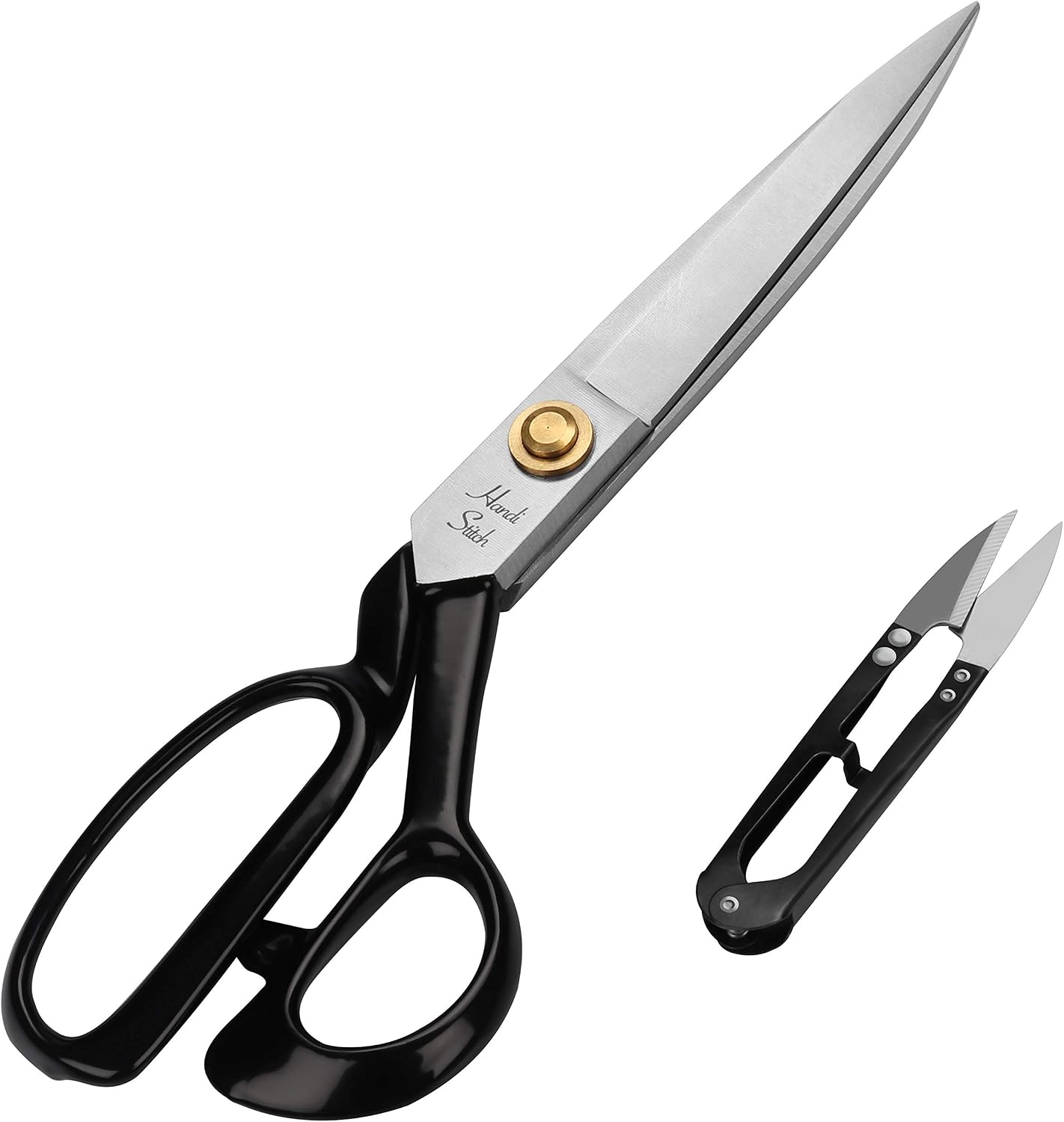
Fabric scissors are shaped for cutting cloth while it lies flat. Their offset blades lift the material less than ordinary straight scissors, helping the cut follow a clean line. Blade length and tension affect how readily a pair moves through a long run, while weight, grip size and balance decide how controllable it feels in a particular hand.
What follows is recorded testing, translated. Nobody here has used these scissors.
The comparison covered 25 pairs, ranging from small detail scissors to substantial tailor's shears. The Handi Stitch Stoffschere mit Fadenschneider remained the overall recommendation because it combined unusual weight with effortless cutting across both delicate and dense materials. Four alternatives stay in the current pick set for different hands and jobs.
What matters in fabric scissors
A grip needs to match the hand using it. Small finger loops can give close control but become awkward for larger hands; broad loops leave more room and can help guide a long blade. Dedicated left-handed scissors reverse the blade arrangement, while some double-bevel designs can be operated in either hand. Those construction details matter more than a generic claim that a handle is suitable for everyone.
Most fabric-scissor blades are stainless steel or carbon steel. Stainless steel resists corrosion and needs little attention, though the source notes that it generally loses its edge sooner. Carbon steel is harder, commonly reaching 60 HRC or more, holds a very keen edge and can be resharpened, but non-rustproof blades may arrive oiled and require more maintenance. Paper fibres gradually blunt the specialist edge of either type.
The usual precision grind is smooth. A micro-serrated edge is different: its fine teeth are intended for slippery silk, synthetic yarns and highly elastic textiles, although it is less well suited to thick stacks. An adjustable pivot screw can alter blade tension for different fabric thicknesses and lets the blades come apart for cleaning or sharpening. Not every screw-looking pivot is adjustable, as several models demonstrated.
How the scissors were assessed
Handling was assessed by guiding each pair through several metres of cloth with an average-sized hand. Construction checks covered blade and handle materials, finish quality and whether the pivot could actually be adjusted. Cutting trials ranged across cotton, jersey, wool, silk, velvet, nonwoven fabric, polyester and tulle. The most demanding materials included double layers of denim and canvas, leather and 3 mm felt.
The recommendations
Top pick — Handi Stitch Stoffschere mit Fadenschneider
The Handi Stitch is the largest pair in its range and weighs 356 g, yet its balance made that mass far less apparent once cutting began. Its long, exceptionally sharp blade travelled cleanly through several layers, double denim and dense craft material; the recorded short answer also credits it with cutting 4 mm felt without extra effort. Chiffon and silk were cut without the cloth shifting.
Large finger loops and a soft rubberised grip held securely and left room for bigger hands. The non-rustproof blade arrived oiled and can be resharpened, and a small thread trimmer is included. Finish quality is the compromise: inclusions were visible in the steel, parts of the rubber coating looked torn, and both the grip and blade oil had a noticeable smell at first. Those cosmetic faults did not alter its cutting result, which is why it remains the winner.
Search Amazon UK · Search Amazon US
Carbon-steel alternative — Jinjian JJ-EU-B8 Scherenset
The Jinjian produced consistently clean results, with leather and jersey among its strongest materials. At 200 g, its black-lacquered carbon-steel blades had useful weight behind the cut and were extremely sharp. A gold-coloured pivot screw and rubberised grip complete the understated design, while a thread ripper comes with the shears.
Its finger loops are notably small, so it is a poor match for large hands. The rubber also had a strong initial smell, and excess oil had to be removed from the non-rustproof blade before the first cut. Regular oiling adds maintenance, but the cutting performance earns its place among the recommendations.
Search Amazon UK · Search Amazon US
For long cuts and larger hands — Fiskars Profi-Stoffschere FI9863
The Fiskars delivered excellent results on every test fabric. Its long blade was ground very sharply, its construction was first-rate and the large shock-resistant plastic loops accommodated both large and small hands. The broad lower loop also provided a stable place for part of the thumb pad during long runs.
Blade tension can be changed with a flat-bladed screwdriver. Dense material required more force than with the Handi Stitch, but the cuts themselves remained clean. The source conflicts over whether this model's blade is stainless or carbon steel, so no material claim is made here.
Search Amazon UK · Search Amazon US
For detail work — Premax Schneiderschere Typ 6917
The compact Premax is the recommendation for small shapes and close detail. Its short, sharply ground blades passed through almost every fabric, with only occasional light fluff left at the edge. Milled holes reduce blade weight and helped stop cloth clinging to the metal. The pair can be used in either hand.
Its small loops require an unusual hold with the index finger outside, which gave precise control but may not suit larger fingers. The patented Ringlock pivot looks adjustable but is fixed, limiting the pair's versatility. It works best as a detail companion to longer shears rather than as the only pair on the table.
Search Amazon UK · Search Amazon US
Value pick — Damita Stoffschere
The Damita pairs black titanium-coated stainless-steel blades with a hard plastic handle. It is light, short-bladed and straightforward to guide with either hand, including at the tip. Every test fabric was cut accurately; only thick or multilayered material such as denim and dense felt called for more pressure.
The low weight makes laying the blade steadily on the table more difficult, and the short blade slows long cuts. Its pivot allows only modest adjustment because the screw is so short that the blades soon separate as it is loosened. Even with those limits, its finish and cutting result justify its position as the sensible saving.
Search Amazon UK · Search Amazon US
Also tested
Victor CUT-SC-BL — a 134 g pair usable in either hand, with mostly good results but more difficulty on denim, canvas and leather; the apparent tension screw could not be turned even with substantial force. Search Amazon UK · Search Amazon US
Prym 8 Professional Schneiderschere — a solid, reliable hobby pair whose relatively large shaped grip sat well in bigger hands and whose cutting results were consistently good. Search Amazon UK · Search Amazon US
Prym 610542 Love Micro Serration — delivered solid cuts, but its edge was not sharp enough for frequent high-volume work and the micro-serration made no noticeable difference on slippery silk or synthetic fabric. Search Amazon UK · Search Amazon US
Pamara Schneiderschere inkl. Etui — came in a card box with an imitation-leather case, but even simple cloth often needed considerable pressure or a particular angle, the edge dulled quickly and tension adjustment was stiff. Search Amazon UK · Search Amazon US
Scherenmanufaktur Paul 907 schwarz — this small, light pair is marked Made in Germany and has a sharp blade, yet it needed substantial force and did not pass cleanly through every fabric. Search Amazon UK · Search Amazon US
NTS Solingen Schneiderschere Black Edition — smart styling and carbon-steel blades could not compensate for poor handling, and the pair barely managed double denim in the fabric-only cutting trials. Search Amazon UK · Search Amazon US
Schwertkrone Schneiderschere 8 — well finished with a flower-patterned metal grip and a sharp carbon-steel blade, but it failed on thick cloth, felt and leather, while the small handle restricted larger hands. Search Amazon UK · Search Amazon US
Kuoniiy K-gtcfj10 — despite a sharp 26 cm blade, the cloth snagged repeatedly and no length was cut without interruption; construction quality also made blade adjustment almost impossible. Search Amazon UK · Search Amazon US
Asdirne a/ctj — its rainbow titanium-coated stainless-steel blades arrived so tightly set that they scraped together when opened, could be adjusted only after several attempts and lost noticeable sharpness after a few cutting passes. Search Amazon UK · Search Amazon US
Zwilling Superfection Classic — now an also-tested model, this well-built 98 g pair has short stamped rustproof special-steel blades and small loops, but it still produced excellent cuts. Search Amazon UK · Search Amazon US
Scherenpalast Schneiderschere — sharp stainless-steel blades and an all-steel handle cut almost every fabric precisely with little force; leather was harder, but tip control and tension adjustment were both good, and a thread cutter is included. Search Amazon UK · Search Amazon US
Fiskars Razor Edge Stoffschere — weighed 90 g and remained under 100 g with its supplied cover; its short blade and small rubber-lined loops suited smaller hands, though occasional fraying and extra effort cost it ground. Search Amazon UK · Search Amazon US
Victorinox Schneiderschere — at more than 350 g, this massive pair combined very sharp carbon-steel blades with unusually stiff tension; loosening the pivot helped briefly, but it then loosened further every time the blades opened and harmed both control and cutting. Search Amazon UK · Search Amazon US
Verdict
The Handi Stitch Stoffschere mit Fadenschneider remains the best all-round fabric scissors here: heavy but well balanced, exceptionally sharp and capable from silk to several dense layers. Choose the Jinjian JJ-EU-B8 Scherenset for another weighty carbon-steel option, the Fiskars FI9863 for long cuts and spacious loops, or the compact Premax Typ 6917 for detailed shapes. The Damita Stoffschere is the value choice when a shorter, lighter pair is preferable.