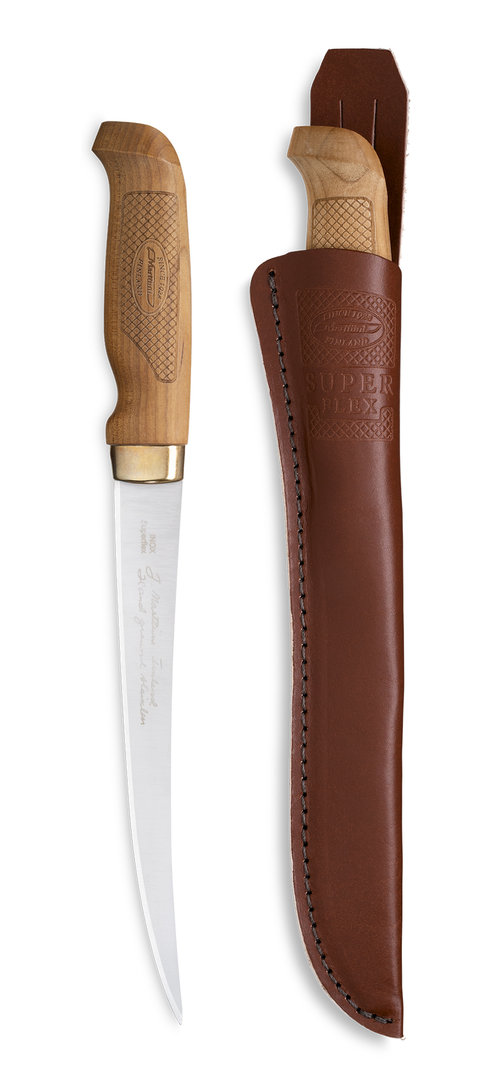
Fillet knives differ sharply in length, flexibility and handle design, and the recorded comparison found no single pattern equally suited to every size of fish. Eleven models were assessed, from compact 15 cm blades to a long 21 cm all-metal knife. The Marttiini Superflex Filetiermesser 19 cm finished first overall by combining a pointed, flexible blade with a large waxed-birch handle, a leather sheath and a sharpening tool.
What follows is recorded testing, translated. Nobody here has used these knives.
What separates one fillet knife from another
The comparison divided the field principally by fish size. For small and medium fish, its reference shape was a thin, low and pointed blade around 13 to 14 cm long, with enough flex to follow the skeleton while still returning clear feedback. Larger fish called for more blade and more backbone: a second knife around 17 to 18 cm covered most of the heavier work described in the source, although even these longer blades still benefited from some flexibility.
Blade height mattered as much as length. A low blade turned more readily after the first cut and met less resistance along the central bone. A defined point supported accurate entry cuts, while excessive softness made the cutting line harder to control. The result was a genuine split in this group: some knives were agile enough for skin removal and fine trimming, whereas the taller or stiffer examples were more convincing on robust bone structures and larger fish.
Handles and build were assessed separately from the blade. Grip was recorded with dry, wet and fish-slick hands, and handle size was checked against glove size 8. The shape of the pommel and finger guard, the fit where blade met handle and any movement in separate components were all noted. Supplied equipment also varied widely: several knives came alone, while others included a sheath, a filleting guide or a sharpening tool.
How the knives were assessed
Cutting work used purchased sea bass of about 800 g each, plus two smaller rainbow trout. Across 16 criteria, the recorded work considered how readily the point entered firmer structures around the breast fins, how the blade turned at the central bone, whether it cut stronger bones without snagging, and how much feedback its flex returned. Fine work included cleaning up a fillet and separating flesh from skin. Those observations, rather than the unlabelled comparison-table bullets in the scrape, support every product description below.
Main recommendations
Top pick — Marttiini Superflex Filetiermesser 19 cm
The 19 cm Marttiini was the narrow overall winner and the most complete package. Its leather sheath has a belt loop and an internal plastic reinforcement, while a small sharpening tool hangs from the sheath on a metal chain. The knife itself felt light and balanced. Its blade is low, narrow and sharply pointed, with substantial flexibility but enough resistance to communicate where it is running.
The large waxed-birch handle kept a strong grip when dry, wet and fish-slick, and its rear pommel was effective. At the blade end, however, the finger guard is only lightly formed. A brass-coloured cap covers the blade-to-handle junction, where gaps were observed on both sides; that fit is the main build blemish.
On a sea bass of roughly 900 g, the edge worked through firm structures, turned neatly after the opening cut and followed the central bone with useful feedback. The low front section also made exact skin-removal cuts. Although the maker positions this blade length for fish around 2 to 3 kg, the smaller test fish was handled well. That balance of cutting control, grip and supplied equipment secured the top position.
Search Amazon UK · Search Amazon US
Kitchen alternative — Victorinox Fibrox Filetiermesser 20 cm
The Victorinox is a long 20 cm kitchen-focused option with no sheath, sharpening tool or filleting guide. Its large, textured plastic handle has a pronounced pommel and finger guard, remained firm in dry and slick conditions, and encloses the blade flush at the join. The long, narrow blade is pointed and flexible without becoming overly soft. It passed through the firmer breast-fin and gill areas readily, turned along the central bone, cut thicker bones with little pressure and separated skin precisely. Its exceptional sharpness also meant small changes in pressure or angle could take the edge through skin or the central bone, an observed cutting characteristic that rewards fine control.
Search Amazon UK · Search Amazon US
Premium all-metal pick — Global G-30 Yoshikin
The 21 cm Global appears to be made as one continuous piece of metal, including its generously sized handle. Circular indentations gave very good dry grip but only moderate grip when wet, and the finger guard is understated. Its long, slim blade has a sharp point and most of its flexibility towards the front, suiting larger fish and kitchen work. On sea bass it moved easily through skin and firmer structures, rotated cleanly at the central bone and gave clear feedback towards the tail; fillet trimming and skin separation were also handled accurately. The refined construction and consistently precise cutting earned its premium recommendation.
Search Amazon UK · Search Amazon US
Value pick — Balzer Camtec Filetiermesser
At 15 cm, the Balzer is the compact recommendation for fish around 1 to 2 kg. Its sheath includes a loop and an opening at the tip, and the handle has an eyelet for a line. Two textured handle materials produced good wet and dry grip, with enough length for glove size 8, though rough moulding burrs were present on the harder plastic and the finger guard is shallow. The narrow, coated blade is pointed, sharp and moderately flexible. It cut the breast-fin area without difficulty, turned accurately over the central bone and maintained control during skin removal. No sharpener or filleting guide is supplied.
Search Amazon UK · Search Amazon US
Also tested
Buck 223 Silver Creek Filetiermesser — The titan-coated 16 cm blade is sharp, pointed and stable while retaining useful flex, with extra height near the handle giving it more authority on thick sections; the large rubber-like handle held well when wet or dry, the pommel and finger guard are strongly formed, and a lanyard plus a plastic sheath with clip and tip opening are included, although gaps and slight movement were found around the separately fitted guard and there is no guide or sharpening tool. Search Amazon UK · Search Amazon US
Fiskars Essential flexibles Filetiermesser — Its sharp 17 cm blade is low and comparatively stiff, so it dealt readily with hard bone structures in smaller fish but returned less feedback than the more flexible knives; the large handle offered good dry grip and moderate wet grip, a pronounced finger guard, and no sheath or other accessories. Search Amazon UK · Search Amazon US
F.Dick Fischfiletiermesser ErgoGrip 18 cm — This robust 18 cm design targets larger fish, pairing a large textured handle that remained grippy wet and dry with a strongly formed finger guard; the sharp blade is only moderately flexible, grows relatively tall towards the front and has a broad point, making it effective on heavy kitchen work but unsuited to the finer turns required by small and medium fish, and no sheath or sharpener is included. Search Amazon UK · Search Amazon US
Opinel Nr. 221 Filetiermesser Intempora — The 18 cm Opinel is a kitchen-oriented knife for medium and larger fish, with a low, pointed blade that is relatively stiff and therefore light on feedback but easy to direct with little resistance; its handle gripped well when dry, became very smooth when wet and has no finger guard, while the package contains no accessories. Search Amazon UK · Search Amazon US
F.Dick 1905 Filiermesser 18 cm — A large handle, pronounced rear pommel and balanced weight make this 18 cm knife substantial in the hand, although wet grip was poor and the finger guard is only suggested; the extremely sharp blade is pointed but unusually high and almost soft in its flexibility, so it was less agile on small and medium fish, and no sheath, sharpener or guide accompanies it. Search Amazon UK · Search Amazon US
Rapala Fish’n Fillet 15 cm — This 15 cm option cut smaller fish capably: its sharp, pointed and flexible blade turned through tight radii at the central bone, returned useful feedback and separated skin cleanly; the lacquered handle gripped well dry but poorly wet, was too short for glove size 8 and had only a shallow finger guard, while gaps were visible at the brass-coloured sleeve and the package includes a leather sheath, filleting guide and sharpening tool. Search Amazon UK · Search Amazon US
Zwilling Gourmet Filetiermesser 18 cm — The 18 cm Zwilling combines elegant finish with a narrow, pointed and extremely flexible blade that made precise curved cuts and fine skin-separation work; against that cutting performance, its handle was comparatively small, weak on wet grip and entirely without a finger guard, and no accessories are supplied. Search Amazon UK · Search Amazon US
The short answer
The Marttiini Superflex Filetiermesser 19 cm is the strongest all-round choice in the recorded field: its 19 cm blade balances flexibility with feedback, its waxed wooden handle performed consistently in every grip condition, and its sheath and sharpening tool make the package unusually complete. The Victorinox is the sharper, longer kitchen alternative, the Global brings precise all-metal construction, and the Balzer is the compact value option for smaller fish. The remaining seven models preserve useful distinctions — particularly blade stiffness, front-end height, wet grip and accessory provision — but each gives up more of the winner’s balance somewhere along the way.