Fitness trackers are, in the end, clever wristwatches. They all have a display and tell you the time and date — but they also record how you move, and the point of them is to nudge you into moving more. What the testing shows is that they are excellent at relative measurement and much weaker at absolute numbers, which is the single most useful thing to understand before buying one.
The short version
The winner: Huawei Band 10
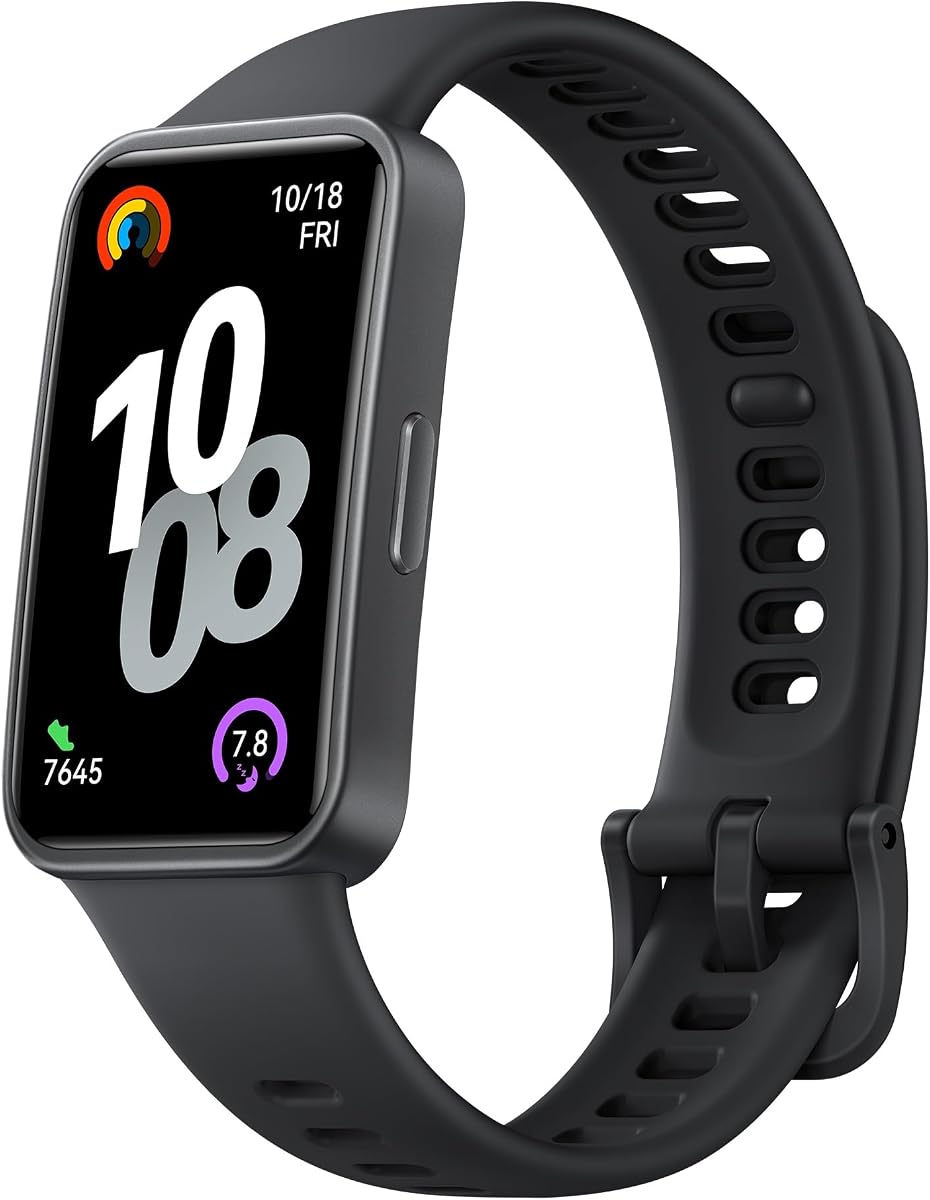
The Band 10 is the favourite because it has everything daily use requires and nothing that inflates it: heart-rate and blood-oxygen measurement, sleep analysis, a pedometer and a range of sport programmes.
The 1.47-inch AMOLED display is comfortable to read and shows a sensible amount of information at a glance. Comfort is excellent and the band can stay on to swim. Measurement accuracy convinced in testing — a meaningful distinction in this category — and the accompanying app has an attractive interface with plenty of analysis behind it.
It is also barely there: 28 g, on a soft plastic strap with a quick-release catch operated by two buttons on the back of the case. Replacement straps come in several colours, and the sizing splits by colour — white, violet and rosé suit wrists of 120 to 190 mm, while green, blue and black run from 130 to 210 mm.
It is water-resistant to 50 m, which covers swimming in a pool or shallow coastal water though not faster currents, and it opens roughly 100 training modes from a single button. It distinguishes jogging from walking by itself and recognises the four main swimming strokes, with Huawei claiming 95 % accuracy on stroke count and lengths. Extras run to a running-ability index, a weekly training load and a personal recovery rate.
Battery life is the clincher: 13 days in testing without the always-on display, a full charge in 45 minutes, and five minutes on the charger enough for up to two days.
The bold-screen alternative: Xiaomi Smart Band 10
Very hard to beat on what it offers. The Smart Band 10 now carries a 1.72-inch AMOLED, the largest screen here, and the band is a featherweight that does not intrude on the wrist.
It has an automatic brightness sensor, which the Amazfit lacks, an extensive feature set, good battery life, and — unusually for the category — additional case variants and straps if you want to change its look.
The strong alternative: Amazfit Band 7
You would not be making a mistake with the Band 7 either. It has a convincing display and scores on simple operation, supports numerous sports, and measures heart rate, sleep and blood oxygen. Individual visual customisation is possible.
Its one recorded shortcoming is the absence of an automatic brightness sensor, so the screen does not adapt to the light around you.
The other budget pick: Honor Band 10
Another tracker that meets every requirement of an inexpensive helper on the wrist. It has an attractive 1.4-inch AMOLED display, setup is child's play and operation just as simple.
A glance at the watch, or at the clearly laid-out app, gives you the important details on sleep, heart rate and blood oxygen. The case is finished with a metal-powder colour coating, it is waterproof, and the battery lasts a long time.
The accuracy problem, honestly
This is the part most buying guides skip, and it matters more than any feature list.
Trackers do not produce exact data. Steps are not always registered as steps, and movements are not always correctly classified. Push a pram and your arms do not swing — so most fitness trackers record no steps at all. Running, cycling and swimming are likewise not always recognised correctly.
Calorie figures are approximations, and cannot be anything else. How many calories a person actually burns during a given activity is extremely difficult to establish and depends on many individual factors. A tracker estimates roughly, from age, weight and height, the type of movement and your heart rate.
Even heart rate is not laboratory-grade. Fitness trackers do not measure it anywhere near as precisely as a chest-strap monitor does.
So what are they good for? Relative data. Anyone expecting exact figures on their sporting fitness will be disappointed; anyone using the numbers to compare this week with last week, and to be nudged into moving more, is using them for what they actually do well.
How to choose
Start with the screen. It is what you interact with dozens of times a day. The sizes here run from 1.4 inches on the Honor through 1.47 on the Huawei to 1.72 on the Xiaomi, and only the Xiaomi has automatic brightness — the Amazfit specifically does not.
Check the health sensors you will actually use. All four cover heart rate, blood oxygen and sleep. That is the standard set at this level, so it is not a differentiator.
Battery life is the feature that decides whether you wear it. The Huawei's 13 tested days is the figure to beat, and its 45-minute full charge means topping up never becomes a chore.
Swimming and water. The Huawei can stay on in the pool and the Honor is waterproof — worth confirming for your own use rather than assuming.
Do not pay for precision you will not get. Given the accuracy limits above, spending heavily to chase exact numbers is the wrong instinct in this category. Every recommendation here is an inexpensive band.
Frequently asked questions
Which fitness tracker should I buy? The Huawei Band 10 for most people — a 1.47-inch AMOLED, heart-rate and blood-oxygen measurement, sleep analysis, around 100 training modes, convincing measurement accuracy, 28 g on the wrist and 13 days of battery.
Which has the biggest screen? The Xiaomi Smart Band 10, at 1.72 inches, and it is also the only one here with an automatic brightness sensor.
Are fitness trackers accurate? Not in absolute terms. Steps can go unrecorded — pushing a pram is the classic case, because your arms do not move — and running, cycling and swimming are not always classified correctly. Calorie counts are estimates from age, weight, height, movement type and heart rate, and heart rate itself is measured far less precisely than by a chest strap. They are good at relative trends.
Can I swim with one? The Huawei Band 10 is water-resistant to 50 m, which covers a pool or shallow coastal water but not faster currents; it recognises the four main strokes, with a claimed 95 % accuracy on strokes and lengths. The Honor Band 10 is waterproof.
Do I need to spend more for a better one? No. All four recommendations are inexpensive bands, and the accuracy ceiling of the category means extra spending does not buy exact measurement.
What does a tracker actually do beyond counting steps? Step counting is now only the base function. From personal data such as age, height and weight, these small computers calculate a range of fitness values — and the test noted how quickly you get used to glancing at the watch or the app to see how far you have gone.
Research sources
Sources recorded for this page are linked below. Reported third-party testing belongs to the original publisher; it is not testing performed by Truthful Reviews.