A GPS tracker is bought for one moment: the one where your car is not where you left it. Everything else about the specification only matters insofar as it decides whether the device is still working, still connected and still telling you the truth at that moment. A tested field of car trackers makes the four decisions that determine this unusually clear.
Decision one: do you want a subscription?
This is the fork that shapes everything else, and it is worth settling before comparing hardware.
Most trackers sell cheap and then charge monthly or annually for the SIM and the tracking service. A minority charge once for the hardware and never again. The tested winner takes the second route: a single hardware payment, a SIM already installed, and no subscription decision to make afterwards. It costs more up front than many rivals, and that figure is the final one.
Neither model is automatically better. If you want a tracker on a vehicle for a season, a subscription is cheaper. If it is going on a car you intend to keep, the arithmetic reverses, and there is no risk of the tracker quietly going dark because a payment failed.
Decision two: power
Trackers either run from the vehicle's electrical system or from their own battery, and each has a failure mode.
For battery-powered units, capacity is the specification to check. The guidance from testing is a minimum of 5,000 mAh — at one location check per day, that lasts roughly a month between charges. More is straightforwardly better, and the best of the tested field stretch far beyond that: one runs up to 90 days on a charge.
For hardwired units, the thing to insist on is a backup battery, and the reason is theft rather than convenience. A thief who finds the tracker will cut its power; a backup cell means the device keeps reporting the vehicle's position for a period afterwards. One tested model holds out for up to 12 days on its reserve. A hardwired tracker without a backup battery is a tracker that stops working at precisely the moment it is needed.
Decision three: 2G or 4G
This is the specification most likely to date a purchase, and it is worth understanding rather than guessing at.
Plenty of trackers still use 2G, which has been adequate for years — the data volumes involved are tiny. But the networks are being retired. Deutsche Telekom announced in October 2024 that it will switch off its 2G network in June 2028, and Vodafone intends to phase 2G out in Germany progressively by the end of 2030. Those are German operators' timetables rather than a global schedule, but the direction is the same everywhere: 2G is a sunsetting technology.
The practical conclusion from the test is simple. There are still some years left, so a 2G tracker is not useless today — but if you are buying now and expect to keep the vehicle, buy 4G and remove the question entirely. All three recommended models below are 4G.
Decision four: the alarms
A tracker that only answers "where is it?" when asked is doing half the job. The alarms worth having are:
- Motion or shock alarm — an immediate SMS the moment the vehicle moves, which is the alert that actually catches a theft in progress.
- Radius alarm — fires when the vehicle leaves an area you have defined, useful for a car that should not be going anywhere.
- Speed alarm — triggers above a threshold you set in the system.
A note on size and placement
Counter-intuitively, the smallest tracker is not the best one. Accuracy is generally better when the GPS module is not miniaturised, so unless absolute compactness matters, the slightly larger unit is the better buy. External antennas for GPS and mobile signal also tend to help. If the tracker is going somewhere on the outside of the vehicle rather than in the cabin, weatherproofing becomes a requirement rather than a bonus.
The picks
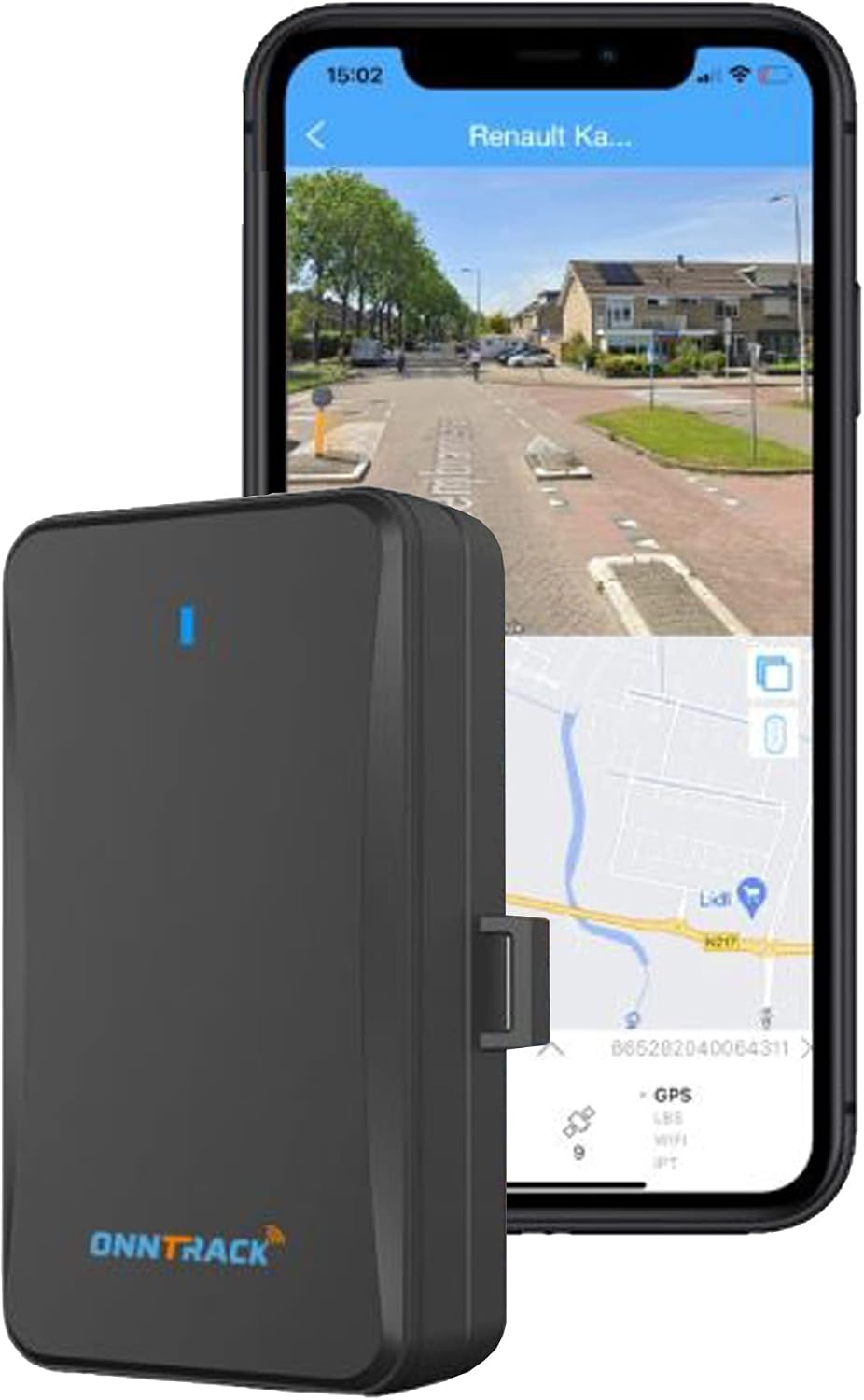
No running costs — Onntrack Portable Pro+. The test winner, and the one to buy if you want to unbox a tracker and use it immediately. The SIM is already installed with 2G and 4G LTE coverage, setup runs from two QR codes that install the iOS or Android app, and tracking worked within seconds in testing. Live tracking was rated excellent, and the built-in battery means it works without any wiring. The housing measures 108 x 60 x 29 mm and is splash-proof, and the battery is quoted at up to 90 days. Two genuine annoyances: the web portal is cluttered, and the printed manual ships only in Dutch — though the app itself is not. We have a full review of the Onntrack Portable Pro+ with more detail.
Longest battery life — Salind GPS Tracker 11 4G. Up to 90 days on its own battery, accurate positioning, a broad feature set, a mature app and a workable web portal, and it recharges over USB from a PC or a plug. It is future-proofed on 4G and usable in 100 countries. The quoted figures are worth reading carefully, because they measure different things: 60 to 90 days is the standby time, while everyday tracking at around an hour of use per day gives roughly 40 days per charge. Route history goes back 365 days. The box is 109 x 76 x 26 mm and weighs 256 g. The trade-off is that it carries monthly costs.
Always-on, hardwired — PAJ Vehicle Finder 4G 2.0. Permanently wired to the car battery, so it is never flat, with a reserve battery good for up to 12 days if power is cut. Compact, easy to operate, very precise positioning and notably fluid live tracking. Route history covers the previous 100 days. One installation note: the vehicle battery should have discharge protection, because the tracker draws roughly 10 to 20 mAh at rest. The trade-offs are the recurring costs, additional charges from the second year, and the fact that it is not suitable for older vehicles.
Frequently asked questions
Do I need a subscription for a GPS tracker? No. Most models charge monthly or annually for the SIM and service, but subscription-free trackers exist where a single hardware payment covers the device for good. The winner above is one of them.
How long does the battery last? Look for at least 5,000 mAh, which gives roughly a month at one location check per day. Longer-life models reach up to 90 days. Trackers wired into the vehicle do not run down, but should still carry a reserve battery.
Is a 2G tracker still worth buying? It will work for some years yet, but 2G networks are being retired — the German operators have named June 2028 and the end of 2030. If you are keeping the vehicle, buy 4G.
Where should I hide it? Inside the cabin is simplest. If you mount it externally, it needs to be weatherproof, and bear in mind that a slightly larger unit usually locates more accurately than a miniaturised one.
Search current listings: GPS car trackers on Amazon UK | GPS car trackers on Amazon.com. Subscription-free option: Onntrack on Amazon UK | Amazon.com. Long battery life: Salind on Amazon UK | Amazon.com.
Research sources
Sources recorded for this page are linked below. Reported third-party testing belongs to the original publisher; it is not testing performed by Truthful Reviews.