The most expensive mistake in graphics cards is not buying too small — it is paying a large premium for factory overclocks and triple-fan coolers that deliver a measured 2 to 3%.
Here is the field's value picture, and the framework behind it.
How to judge a card in 2026
Forget teraflops: the measure has aged to the point that makers often no longer quote it. What determines gaming power now is the chip architecture and its clock speeds — NVIDIA counts CUDA cores, AMD counts compute units, and those are the numbers to compare within each maker's range. Power translates directly into the settings tier you can run (low to ultra), the resolution (1080p, 1440p or 4K) and the frame rate.
The VRAM rule
Video memory is where the card holds textures, shadows and geometry, and running short shows up as stutter and late-loading textures. The tiers map cleanly onto resolution:
- 8 GB — today's recommended minimum for 1080p, where it runs everything with strong settings; it stretches to 1440p only with graphical sacrifices.
- 12 GB — the 1440p sweet spot, as that resolution becomes PC gaming's reference point.
- 16 GB — the minimum worth buying for 4K, and currently enough for every released game at ultra.
Raw power versus upscaling — both, honestly
Raw chip performance is the foundation, but AI upscaling is now central to value: NVIDIA DLSS 4.5 and AMD FSR 4.1 can double or triple fluidity in demanding games — performance that would otherwise mean buying a card twice the price. DLSS currently has no rival on image quality, reconstructing a picture that is close to native; FSR 4 has improved markedly but still trails it. That gap is the quiet decider in several of the picks below.
NVIDIA or AMD?
The honest split: AMD tends to give more VRAM and more raw performance for the money, which suits tighter budgets; NVIDIA justifies its pricing with the stronger technology ecosystem, leading in overall performance and above all in upscaling. Neither answer is wrong — the resolution you play at and the games you run decide which trade suits you.
The picks
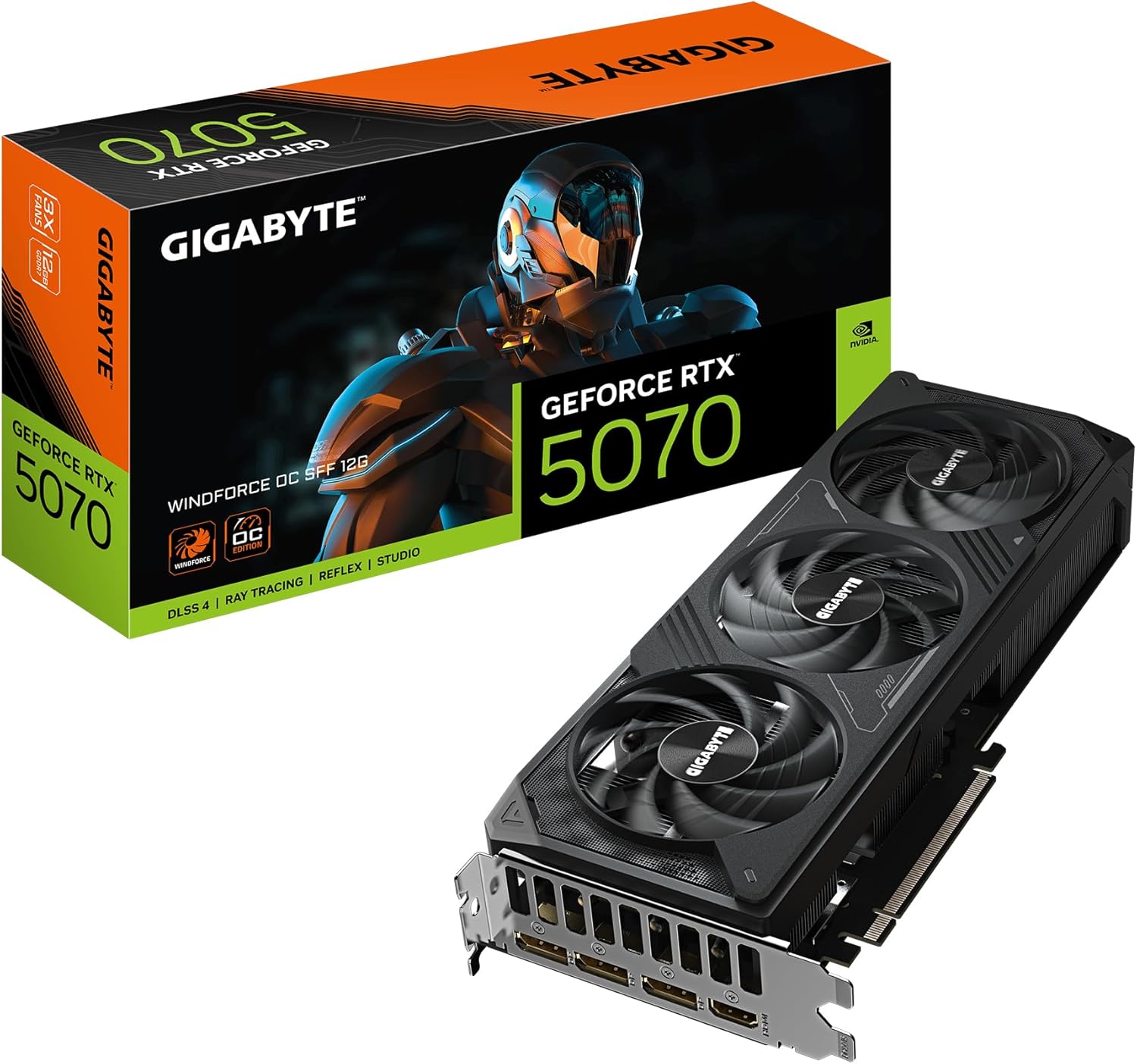
Best overall — Gigabyte GeForce RTX 5070 WindForce OC SFF. The value pick of the whole field, and the UK listing carries the exact tested configuration: 12 GB of GDDR7 on a 192-bit bus, PCI-E 5.0, a 2,542 MHz core clock, three DisplayPort 2.1a outputs and HDMI 2.1b. It is built for 1440p at maximum settings with high frame rates — and it is the RTX 5000-series card with the largest Steam market share, ahead even of the 5060. The 12 GB serves 1080p and 1440p comfortably and reaches a good number of 4K games, with DLSS 4.5 underwriting the longevity argument: this is the card you buy to still be playing 1440p happily in several years. The triple-fan cooler sheds heat efficiently in a sober design; the nearest thing to a complaint is the absence of RGB lighting. Its 12 GB will feel short only in the most punishing 4K titles.
The step down — PNY GeForce RTX 5060 Ti Overclocked Dual Fan. The in-between option: Full HD at high frame rates, with DLSS 4.5 letting it genuinely shine at 1440p too. This build adds a factory overclock over base models and stays compact enough for all case types. Its honest limit is 8 GB of VRAM — a 16 GB version exists, but its price moves close enough to the RTX 5070 that the field's advice is to make that jump instead.
The 4K route — Gigabyte Radeon RX 9070 XT Gaming OC. The highest raw power on the list — above the RTX 5070 — and with 16 GB of GDDR6 it is the cheapest sensible way to play at 4K. The cost is exactly that: a larger outlay, and AMD's FSR 4 rather than DLSS.
AMD's mid-range answer — ASUS Dual Radeon RX 9060 XT. The counterpart to the RTX 5060: everything at 1080p, with excursions into 1440p made viable by FSR 4.1. It offers a strong balance of price and raw performance in a compact two-fan, 2.5-slot build with a fan-stop mode for silent idling; connectivity shifts to two DisplayPort 2.1a outputs plus HDMI 2.1b. The trade remains the upscaler: FSR 4, for all its progress, still sits behind DLSS.
Budget pick — Palit Infinity 2 OC GeForce RTX 5060. The cheapest card on the list, from the XX60 family that tops the popularity charts every generation — because it delivers fantastic Full HD performance. At the sharpest graphical settings its power caps it at 1080p; within that resolution it is the value reference.
Fans, cables and factory overclocks — where not to spend
Cooling. Two- and three-fan designs are the norm and all cards pass exhaustive durability testing; a single-fan card belongs only in a microATX build. If your room runs genuinely hot, prefer three fans.
The 16-pin question. Some current cards use the new 16-pin PCIe connector, others the classic 8-pin. Adapters exist, but native cables are the safe route — and a 16-pin card may justify a new power supply outright, avoiding the connector-burn problems the adapter era produced. Otherwise, current entry and mid-range cards are efficient enough that a quality 550 to 650 W supply serves.
The premium trap. Factory-overclocked and triple-fan variants typically cost 10 to 20% more for that 2 to 3% performance gain. At price parity, take them; at a meaningful gap, the base model is the value answer.
Design. RGB lighting and dressed backplates change nothing about performance — buy them if the window in your case matters to you.
Before you buy
Four questions. Which resolution, honestly? Entry cards excel at 1080p; 1440p means mid-range money; native 4K means a serious budget. Does the VRAM match? 8, 12 and 16 GB map to those three resolutions. What connector does your power supply speak? Check before the card arrives, not after. And are you paying the overclock premium? — the numbers above say it is rarely worth it.
The other half of the build lives in our best desktop processors guide, and if a whole machine makes more sense, our best gaming laptops guide covers the portable route.
Research sources
Sources recorded for this page are linked below. Reported third-party testing belongs to the original publisher; it is not testing performed by Truthful Reviews.