An instant camera hands you a physical photograph seconds after you press the shutter — a tangible keepsake in an age when almost every picture vanishes into a phone. From a tested field of 32 instant cameras, here is what actually separates them.
What to look for
Analogue or hybrid. This is the fundamental choice. A pure analogue camera is point-and-shoot: whatever you frame is printed, with all the charm and the happy accidents that brings. A hybrid adds a digital sensor and a screen, so you can review a shot, apply effects and print only the keepers — and reprint favourites later. Hybrids cost more but waste far less film.
Film format. Fujifilm's Instax Mini gives credit-card-sized prints, Instax Wide produces big landscape photographs — each one 8.5 x 10.8 cm including its white frame — and Polaroid's square format has that classic retro frame. Development is quick enough not to be a consideration any more: the maker quotes 90 seconds for the picture to appear.
Film is the real expense, and pack sizes differ. A cassette holds eight pictures on Polaroid and ten on Fujifilm, Canon and Kodak. That gap matters more than it looks, because it applies to every pack you will ever buy — so choose a format whose refills you are content to keep buying rather than the camera alone.
Parallax at close range. Cheap analogue cameras frame through a separate viewfinder, so what you see is not quite what the lens records, and close-ups come out annoyingly off-centre. Parallax correction is the feature that fixes it.
The picks
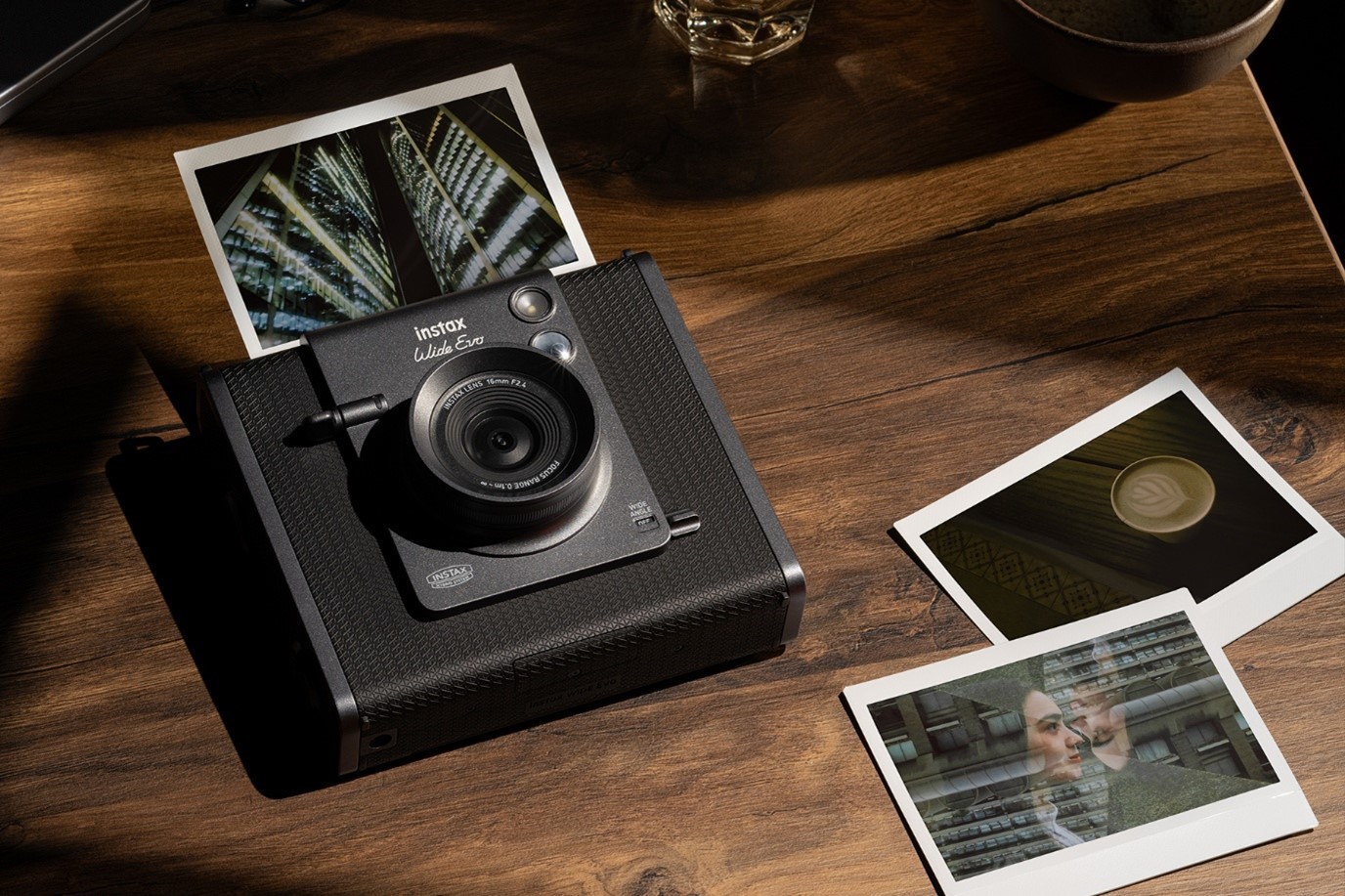
The winner — Fujifilm Instax Wide Evo. The best instant camera for anyone who wants the most from the format, and the first hybrid built for the large-format Instax Wide film. It shoots through a 15.9 megapixel CMOS sensor, saving to internal memory or a card, with an angle of view equivalent to a 28 mm lens on full frame. The 3.5-inch display keeps framing and creative settings in view, and it offers up to 100,000 different image-effect combinations, so you can work on a shot before committing it to film. The built-in lithium-ion battery holds 740 mAh, enough for around a hundred instant pictures. Autofocus and Bluetooth smartphone connection round it out. Because you choose what to print and can reprint the good ones, it also tames the running cost that defines this category.
Best budget — Fujifilm Instax Mini 12. The cheap, cheerful, do-anything instant camera: a pure analogue point-and-shoot anyone can pick up and use. Its headline improvement is a new parallax correction, which spares it the off-centre close-range framing that afflicts so many inexpensive instant cameras. It produces the classic credit-card-sized Instax Mini print, and comes in a range of pastel colours.
Best compact — Polaroid Go Generation 2. For the unmistakable square Polaroid look in the smallest possible body. The second generation replaces the first Go's side-mounted micro-USB with a modern USB-C port. The lens changed too, in a way worth understanding: focal length stays at 51.1 mm, while the aperture range improves from the first generation's f/12 to f/52 to f/9 to f/42. More light reaches the sensor in principle — but testing found no real practical advantage from the wider aperture, and every shooting function carries over unchanged from the predecessor. Square prints with the iconic white frame have a retro character all their own, and Polaroid film gives eight shots a pack rather than ten.