The kettle is the hardest-working appliance in most British kitchens, boiling water for tea, coffee, a hot-water bottle or a quick pan of pasta many times a day. Yet they are far from identical: wattage, safety, temperature control and noise vary widely. An extensive group test put fifteen models through the same measurements — from compact travel kettles to models with precise temperature selection — and these are the ones worth buying.
The short version
What to Look For
Power decides speed. The higher the wattage, the faster the kettle boils — worth paying for if your mornings are rushed. Speed and consumption were measured with 500 millilitres of water: the quickest kettle in the field brought that to the boil in just 78 seconds, and no model used more than 66 watt-hours to do it, so efficiency differences are small next to the convenience of speed.
Safety comes next, especially in a house with children. A well-insulated body stays cooler to the touch and cuts the risk of scalds; the best models keep their housing to around 50 degrees Celsius while cheaper ones get markedly hotter. Look, too, for the essentials the test treated as non-negotiable: a kettle that switches off reliably when it boils, will not run with the lid open, and has both dry-boil and overheating protection. Missing overheating or dry-boil protection is treated as the most serious fault of all.
Temperature control and keep-warm are the comfort upgrades. Green and white teas taste better brewed below boiling, so a kettle that lets you dial a precise temperature — anywhere from 40 to 100 degrees Celsius on the best models — is a genuine boon, as is a keep-warm function. These features usually appear only on pricier kettles, and a kettle is not credited simply for having them: what counts is whether they genuinely help in daily use.
Operation and upkeep. A simple flip-switch is the easiest control but rarely offers temperature selection; push-button and one-touch designs stay manageable, while fiddly multi-step temperature menus are the most awkward. Since no modern kettle exposes its heating element, cleaning is generally easy — but a removable limescale filter and a wide opening make filling and descaling far simpler, and narrow openings cost marks. Finally, match the capacity to your household: a 1.2 litre compact suits one or two people, a 1.7 litre model a family.
Best for Most: Philips 3000 Series HD9318/20
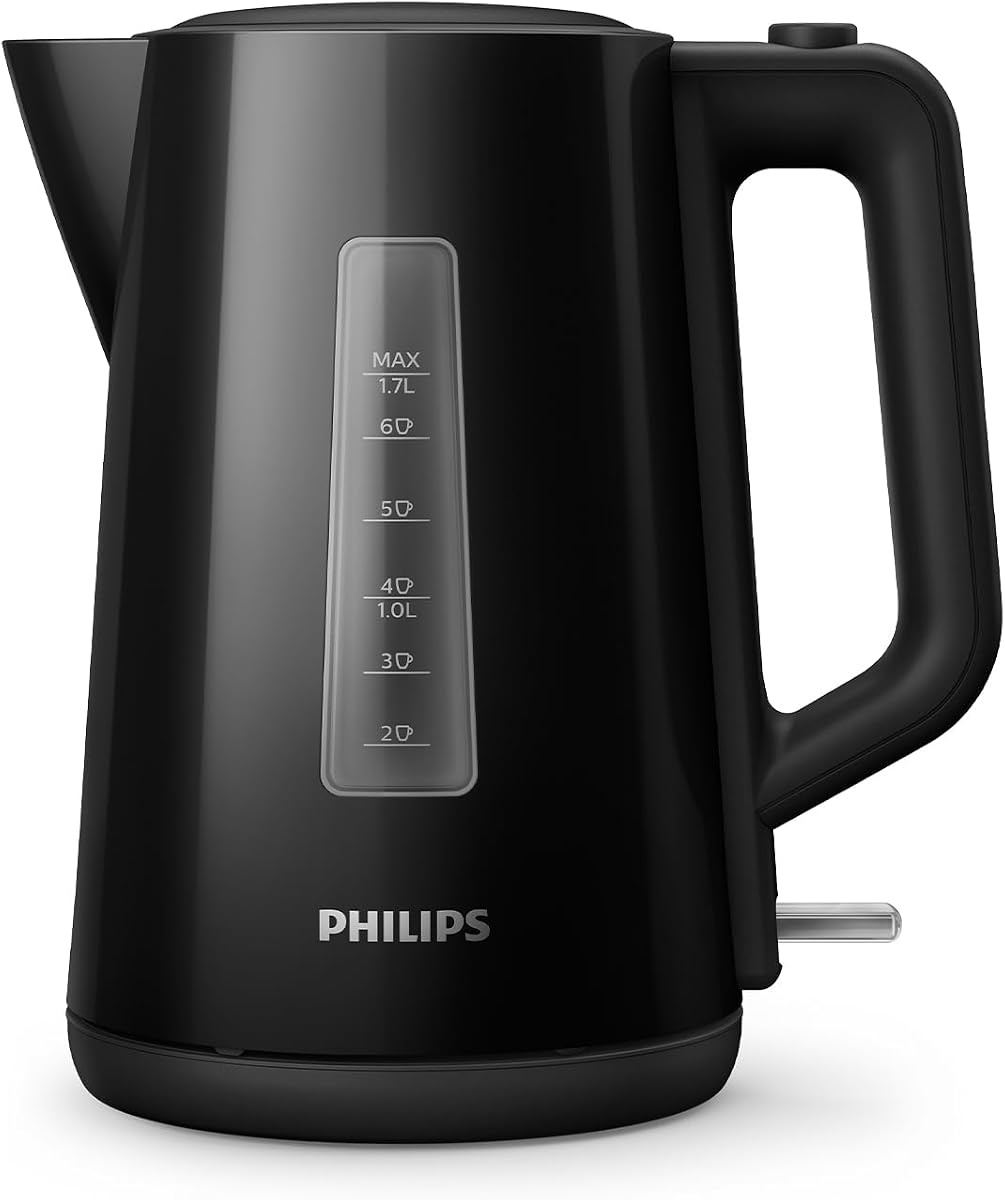
The value champion is the Philips 3000 Series HD9318/20. With 2,200 watts it boils half a litre in 104 seconds — solidly mid-pack — and its real strength is safety: the housing stays comparatively cool at just under 50 degrees Celsius, where many rivals get uncomfortably hot. It forgoes temperature selection, but the flip-switch makes operation especially simple. The plastic body keeps it light and did not affect the taste of the water in testing, and at up to 1.7 litres it copes with larger quantities. It rounds out with an operating light, cord storage and a removable limescale filter, plus dry-boil and overheating protection. For a straightforward, safe and affordable everyday kettle, this is the one to buy. Check the price on Amazon UK · Search Amazon US
Best with Temperature Control: Bosch Styline TWK8613P
If you want precise brewing and a more premium feel, the Bosch Styline TWK8613P is the pick. Rated at 2,400 watts, it pairs good speed with genuinely uncomplicated button controls that work even with wet fingers, and — like the Philips — its body and handle stay pleasantly cool after boiling for extra safety. Two grumbles are worth knowing before you buy: its signal tones cannot be switched off, and it was the loudest model in the test. Otherwise it convinces on efficiency and everyday usability, and it is the all-rounder of the temperature-controlled group. Check the price on Amazon UK · Search Amazon US
Best Compact: Tefal BI8125
For travel, camping or a small kitchen, the Tefal BI8125 Mini is the mobile choice. Light and low-capacity, it works efficiently, and a dust guard at the spout reliably stops splashing as you pour. Be aware of its travel-kettle compromises, though: testing noted a faint plastic smell when new, and the lid opens only right at the body, which can grow unpleasantly hot after several boils. For a primary kitchen kettle a full-size model is better, but as a compact companion it does the job. Check the price on Amazon UK · Search Amazon US
Also Tested
The test's overall winner was the Caso WK 2100 Compact, which unseated the previous champion. It impressed with a simple design and solid performance — heating half a litre in 102 seconds while drawing a low 52 watt-hours — and, unusually for a compact 1.2 litre kettle, offers precise temperature selection from 40 to 100 degrees Celsius plus a keep-warm function, operated by grippy push-buttons that proved intuitive. At just 670 grams it travels well, to a holiday cottage or a caravan. It is marked down for a small display that is hard to read if your eyesight is poor, and its stainless-steel body gets rather hot, above 80 degrees, although the lid stays below 50 thanks to a plastic insert. The catch for UK buyers is availability: Caso is a niche brand here and the WK 2100 Compact has no clean Amazon UK listing, so there is no merely-similar model substituted in its place.
Second place went to the Rommelsbacher WK 3000, the model the Caso displaced, which combines very short boiling times with efficient energy use and accurate temperature setting; its quirk is that switching on and choosing a temperature share one button, which takes some getting used to. Elsewhere, the Russell Hobbs 26300-70 Quiet stands out for very low noise — ideal for open-plan kitchens and early mornings — though it offers neither temperature selection nor insulation. The WMF Lono, with its borosilicate glass body, is among the fastest on test but gets very hot to the touch and has a small lid opening that makes cleaning awkward. The Krups Café Control BW9238 is the specialist's choice for filter coffee thanks to its swan-neck spout, at the cost of long boiling times and a hot exterior, while the Cosori S152 keeps things simple with a button-release lid and a controlled pour, marked down for a level indicator visible only from inside.
How to Choose
Start with how you drink. If you only ever make tea, coffee and the odd hot-water bottle, a fast, safe, simple kettle like the Philips 3000 is all you need. If you brew delicate teas or want a smarter kitchen centrepiece, pay up for the temperature control and cool-touch body of the Bosch Styline — but not if a quiet kitchen matters more to you than speed. If you travel or have a tiny kitchen, the compact Tefal earns its place. Whatever you pick, prioritise a reliable auto cut-off and dry-boil protection, favour a cool-touch body if children are about, and choose a capacity that matches your household rather than the biggest jug on the shelf.
Verdict
For most people the Philips 3000 Series HD9318/20 is the kettle to buy: quick enough, notably safe and genuinely cheap. Step up to the Bosch Styline TWK8613P for temperature control and a cool-touch body, accepting that it is the noisiest of the group, or the Tefal BI8125 if you need something compact. The test's winner, the Caso WK 2100 Compact, is a fine kettle if you can find it, and the runner-up Rommelsbacher WK 3000 is the one to seek out if speed and precise brewing temperatures matter most — but for Amazon UK buyers the Philips is the smart, safe default.
Frequently asked questions
Which kettle boils fastest? Speed differences across the tested field are smaller than marketing suggests: the quickest machine brought half a litre to the boil in 78 seconds, while our value pick manages 104 seconds — a difference of under half a minute.
Does an expensive kettle save electricity? Barely. No model in the test consumed more than 66 watt-hours for the same half-litre, and the compact winner used just 52 watt-hours — so running costs are not the reason to spend more. Temperature control and build are.
Which kettle is best for tea and coffee at the right temperature? The ones with genuine temperature selection: the compact test winner offers 40 to 100 degrees plus a keep-warm function, and the Bosch Styline brings variable temperature in a premium body — the difference between scalding green tea and brewing it properly.
Do kettles get dangerously hot on the outside? It varies more than you would expect. The Philips stays at a comparatively cool 50 degrees, while a stainless-steel body in the same test exceeded 80 degrees — worth knowing in a household with small children, where a cool-touch plastic body earns its place.
Research sources
Sources recorded for this page are linked below. Reported third-party testing belongs to the original publisher; it is not testing performed by Truthful Reviews.