A kitchen scale only has one job, and the test that produced these results weighted it accordingly: accuracy counts for 40 per cent of the grade, with equipment and handling taking 30 per cent each. Eight digital scales were checked against reference weights at 1, 2, 5, 10, 100 and 500 grams, then tested again by adding 1, 2, 5 and 10 grams on top of the 500-gram weight to see whether precision survives a loaded platform. The differences that emerged are not the ones the marketing points at.
The short version
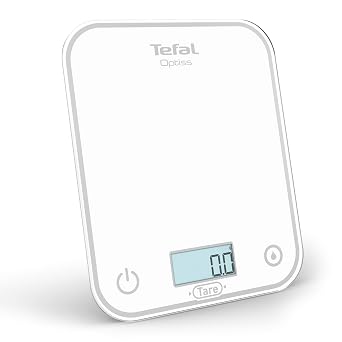
Best Overall: Tefal Optiss BC50U0
The Optiss took the test with an overall 1.4 (very good), built on 1.0 for accuracy — the best available. In the low gram range it shows exactly the right figure, and only at larger weights of 100 and 200 grams do slight inaccuracies creep in, which for everyday cooking is usually forgivable.
It scores on equipment too. It runs on two AAA batteries rather than a sealed rechargeable pack, which is both practical and less wasteful: when performance drops you change the batteries instead of throwing the scale away. Stability is good and the auto-off works properly both with and without a load.
The reservations are about using it. There is no dedicated on/off switch, and the backlight goes out after a minute of inactivity, which hurts contrast just when a busy cook wants to glance at the number. The platform is comparatively small, which makes it space-saving but less suited to bulky ingredients, and its 5 kg maximum is lower than several rivals. Check the price on Amazon
Most Accurate, and the Value Pick: Beurer KS 19
If precision is the only thing you care about, this is the scale to buy: no other scale in the field matched it. Whatever weight it was given, it returned the figure exactly to the gram — the top mark in the test. Overall it finished on 1.9 (good).
The compromises are all in the equipment, which scored only 2.8. The display is small and low in contrast, there is no backlight at all, and although you can switch between units, the active unit is tucked away in the edge of the display where it is easy to miss. The design is very compact, welcome in a small kitchen, but that means a small weighing surface. It also runs on button cells, which the test marks down against AAA batteries — those are easier to buy and can be rechargeable. Check the price on Amazon
Best Equipped: Soehnle Page Profi 100
The most thoroughly equipped scale here, with a perfect 1.0 for equipment. It is the only one in the test rated to 15 kilograms, which makes it usable for parcels as well as pastry, assuming you can still read the display with a box on it. Unusually for a kitchen scale it has a built-in timer, with a countdown set in hours, minutes and seconds that replaces an egg timer. Like the winner it takes batteries rather than a sealed pack, so it need not become electronic waste when the charge fades.
Two criticisms. The instructions are confusing — many pictures, little explanatory text — and the controls are English-language touch elements, which the testers found less practical in daily kitchen use. Check the price on Amazon
Cheapest That Is Still Good: Amazon Basics
The cheapest scale in the field, and it does not behave like it: an overall 1.9 (good), with 1.3 for handling and 1.8 for accuracy. It stands out visually too, being circular rather than rectangular, with a bevelled outer edge. The trade-off is in the name of its category here — the usable weighing area is small. Check the price on Amazon
Also Tested
Four more scales completed the field. The GEFU SCORE was the test's alternative to the winner and the best of all on handling (1.0) and equipment (1.1), with easily replaced AAA batteries, a built-in loop for hanging it away, a notably fast display and an auto-off that waits around three minutes before the display dies — but its accuracy was only 2.5, and it is the one scale in the test with a Bluetooth app for logging weighed ingredients in a food diary, which did not work properly. Search Amazon UK · Amazon US
The WMF digital scale finished on 2.0 with "good" in every category — no real highlights, but no blunders either — and is marked down for fiddly button cells. The SilverCrest rechargeable scale, Lidl's own brand and the cheapest of the lot, took 2.1 with a smart black design and a large glass surface that wipes clean; it is sold under Lidl's own brand. Search Amazon UK · Amazon US The Etekcity EKS-L221 came last on 2.2 despite 1.4 for equipment and 1.5 for handling, because its accuracy scored only 3.4 — the weakest of the group, and a reminder that a well-appointed scale is not automatically a precise one.
How the Testing Works
Accuracy carries 40 per cent of the grade, measured against reference weights at 1, 2, 5, 10, 100 and 500 grams, then re-checked by stacking 1, 2, 5 and 10 grams onto the 500-gram weight to see whether the scale stays exact under load. Equipment takes 30 per cent: whether there is a tare function to zero the display when a container sits on the platform, whether the display is lit, whether a timer replaces an egg timer, whether there is protection against liquids, a hanging loop or an app connection, what the maximum weight is, and whether the batteries can be replaced. Handling takes the remaining 30 per cent, covering stability and the quality of the controls in actual use.
What to Look For
Decide first how much precision you actually need — the spread between the best and worst performers here was wider than the price gap, and the most accurate scale in the test was one of the cheapest. After that, the practical details are what you live with: a tare button, a display you can read at a glance in a busy kitchen, and a platform big enough for the bowls you use. Prefer replaceable AAA batteries to sealed rechargeable packs, since a scale whose battery has died is otherwise landfill, and check the maximum weight if you plan to weigh anything heavier than baking ingredients.
Research sources
Sources recorded for this page are linked below. Reported third-party testing belongs to the original publisher; it is not testing performed by Truthful Reviews.