Most laminating disappointments come from one of two mistakes: using the wrong pouch for the process, or laminating something that should never have been heated at all.
Both are avoidable in about a minute of reading, so here is how these machines actually work before we get to which one to buy.
Hot versus cold, and why it matters
Hot lamination heats the rollers so the two sides of the pouch weld together around the document. It is the only process that genuinely preserves a document in a water-repellent seal — and it is irreversible, so it should never be used on heat-sensitive materials such as thermal paper.
Cold lamination uses special adhesive-coated pouches that are only pressed together, never heated. Choose it in two situations: when the result needs to be especially durable, a luggage tag being the classic example; and when you may want to free the document from the pouch later, such as an identity card. Cold lamination also produces no unpleasant fumes.
The pouches are not interchangeable. Cold-laminating pouches should never be run hot. Hot-laminating pouches simply will not stick if they are not heated. Buying the wrong box is the single most common reason a machine appears to have failed.
Do you need the manufacturer's own pouches?
Every maker recommends its own, naturally. The testing's position is that any standard commercial pouch should work — but it also found that some machines coped poorly or not at all with no-name pouches, and those machines were excluded from the recommendations for exactly that reason. So the honest answer is that you should not need branded pouches, and a machine that demands them is a machine to avoid.
How these were tested
Build quality and what is in the box come first, including the instructions — a badly written or poorly translated manual causes real problems in this category. Safety carries particular weight, because laminators get used for craft projects with children: they should not get too hot, should stand firmly, and should not give off unpleasant burning or chemical smells. Warm-up time is measured with a stopwatch, then laminating speed, repeated across different formats and pouch thicknesses, with recommended machines additionally put through an endurance run. For calibration, the machines here warm up in well under 1 min and push an A4 sheet through in roughly 40 seconds to 64 seconds depending on model and pouch thickness. All testing happens with the window closed so odour is properly assessed. One practical note from that endurance work: home laminators are not meant to run continuously for long stretches, and a good manual will say so.
The picks
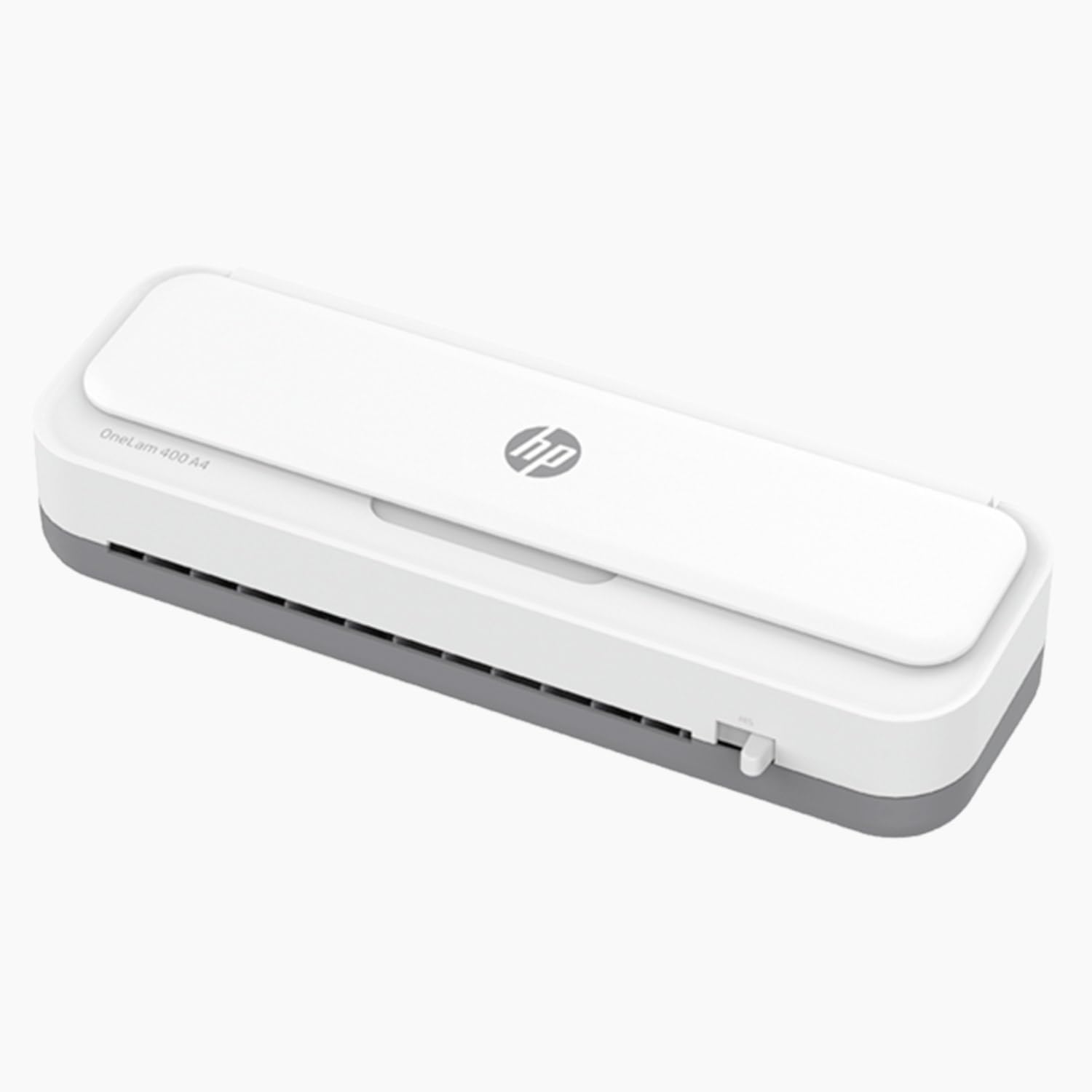
Best overall — HP OneLam 400. The winner of a 23-machine field. The design is unusual, but the results settle the argument: it laminates cold as well as hot across two settings, and returns pages without the ripples that betray a cheap machine. The surface barely gets hot and it develops very little odour — both directly relevant if children are involved. It heats quickly and laminates briskly, taking a little over 40 seconds per sheet — only the very first use snagged. Pouch thickness is adjustable, an A3 version exists, and build quality is high enough to recommend without reservation. Two honest costs: it is large and heavy, and the instructions are poor. The UK listing is the A4 model rated for 75/80–125 micron pouches with accessories included.
Best for A3 — Fellowes Saturn 3i. The number one choice when A3 is the requirement. It is inevitably larger and dearer for it, but it laminates considerably faster than cheaper rivals and holds up in an office or small business. Available in both A3 and A4.
Best affordable A3 — Olympia A 330. A3 at a modest outlay: solid engineering that laminates reliably, with a specific technique that protects the item being laminated. The savings show in design and build quality, which are middling, and the input tray has no format markings. Thickness is set by front-panel buttons, cold lamination among the options, and you do not wait long for heat: 50 seconds to reach temperature for the thickest pouch, after which an A4 sheet runs through in 64 seconds, accompanied by a faint internal clacking. It handles pouches up to 330 mm — that is A3 — silently and with almost no odour, arriving ready to use in just 90 seconds and taking under a minute for A4, a little more for A3, with no creases or bubbles. For occasional laminating across a range of pouch sizes, it does the job.
Also tested — Leitz. Worth knowing as the good-looking option: the best-looking machines in the field, with rubber feet giving secure grip and a pleasingly long 1.5-metre cable. It works very fast and is ready in about 3 minutes, taking under a minute for an A4 sheet and a shade over 20 seconds for a business card, with faultless results — though they are at their best with the maker's own expensive pouches, which is exactly the dependency the section above warns about.
Best compact — Bonsaii Thermal Laminator L421-A. This maker's machines have stood out for excellent results across several test rounds, and the compact L421-A is no exception: very good laminating quality in a very small body at a very low price. The equipment list is minimal and there is no on/off switch, so plug it into a switched extension lead — do that, and you have an excellent little machine.
Before you buy
Four questions. Hot or cold — or both? Cold is for anything reversible or maximally durable; hot is for water-repellent sealing, and never for thermal paper. A4 or A3? Two picks here are A3, and both are correspondingly bigger. Where will it live? The best machine here is large and heavy; the compact pick is neither. And will children be using it? — then surface temperature, stability and odour matter more than speed.
Our best label printers guide covers the adjacent job, and our best printers guide the rest of the home office.
Research sources
Sources recorded for this page are linked below. Reported third-party testing belongs to the original publisher; it is not testing performed by Truthful Reviews.