Most mini fridge disappointment comes from one mismatch: buying a silent, cheap, thermoelectric model and then expecting it to keep food safe through a hot week. The group test behind this guide is unusually clear on that point, so this guide is organised around the decision that actually determines whether the thing works, rather than around a ranking.
Start with what you intend to store
Cooling requirements are not a matter of preference. Milk, yoghurt and cold meats need a steady 4 to 7 degrees Celsius or they spoil. Butter, margarine and cheese sit a little higher, at 6 to 8 degrees. Fish and raw meat, mince included, want 2 degrees.
That single list decides the technology. If anything on it is going in the fridge, you need a compressor model — and the test is blunt about why. A thermoelectric fridge could not hold its internal temperature as the room warmed: at roughly 30 degrees ambient, the inside climbed to 11 degrees. That is comfortably outside the safe range for everything above, and it happens precisely in the weather when you most want a second fridge.
If the contents are drinks only, the calculation changes completely and a thermoelectric model becomes a reasonable buy.
The two cooling systems, and what each one costs you
Thermoelectric cooling uses a Peltier element — a principle discovered by Jean Peltier in 1834. Two ceramic plates sandwich pads of dissimilar semiconductor materials; apply current and heat migrates from one side to the other. The cold plate faces the interior and draws heat out, the hot plate sits outside and sheds it through cooling fins. In the tested design a coiled-tube heat exchanger circulating R600a refrigerant is bonded to the hot side, which improves heat removal and means the element does not have to run flat out continuously.
The advantage is that there is no compressor, so it is genuinely silent. The limitation is the one above: it cannot fight a warm room.
Compressor cooling is the same heat-pump physics as a domestic fridge — evaporation and condensation, with the cold side facing inwards. Because the refrigerant is actively circulated, efficiency is far higher and the internal temperature stays stable even when the room does not. Compressor models carry at least climate class N-ST, meaning they perform as specified in ambient temperatures between 16 and 38 degrees.
There is a further efficiency point that is easy to miss: once a compressor reaches its target temperature it switches off and draws nothing until the temperature drifts back up. Over a summer, a compressor mini fridge is the cheaper machine to run, not the dearer one.
The trade-offs are weight, and the fact that the compressor housing intrudes into the lower third of the interior, so usable space is less than the external dimensions suggest.
What it costs to run
This is the most-asked question in both the UK and the US, and the numbers are more lopsided than most buyers expect.
A thermoelectric mini fridge draws up to 60 watts. From that 60 watts the Peltier element produces a maximum of about 30 watts of actual cooling — the remainder is waste heat. A compressor is at least five times more efficient: from the same electricity it delivers roughly 150 watts of cooling, because it moves heat rather than simply converting electricity into a temperature difference. And when the room is hot, the thermoelectric unit does not modulate; it simply runs flat out at 60 watts continuously, which is exactly when it is also failing to hold temperature.
Scale matters too. Small fridges are markedly less efficient than the large one in your kitchen, which has better insulation and a more generously sized compressor. A modern 200-litre fridge holds roughly five times as much as a 45-litre mini fridge but uses only about twice the electricity.
Three things reduce the bill, and none costs anything. Hang a cheap thermometer inside and check whether the thermostat is set colder than the contents actually require; it very often is. Keep the fridge out of direct sunlight in summer and away from radiators in winter, since both force it to work harder. And do not overfill it — packed shelves stop cold air circulating, which makes the compressor or Peltier element cycle far more often than it needs to.
The last point is worth stating plainly: if there are only one or two cans in it, they would have fitted in the kitchen fridge, and running a second appliance for them is the most expensive way to chill a drink.
The picks, by what they are for
For drinks, with a glass door — Klarstein Beersafe M. The test winner. A transparent glass door and LED interior lighting make it the presentable option, and the quiet compressor cools reliably even as the room warms, so it will hold food safely as well as drinks. Interior space is generous for bottles and cans. Against it: the internal layout is not very adjustable. Availability: Klarstein sells the Beersafe range in the UK, but in 80-litre and 171-litre sizes rather than the M tested here, so the exact model is not directly purchasable and the larger siblings are different products, not substitutes. In the United States Klarstein lists a glass-door beverage cooler, again not this model. Browse the range: Klarstein Beersafe on Amazon UK | Klarstein beverage cooler on Amazon.com.
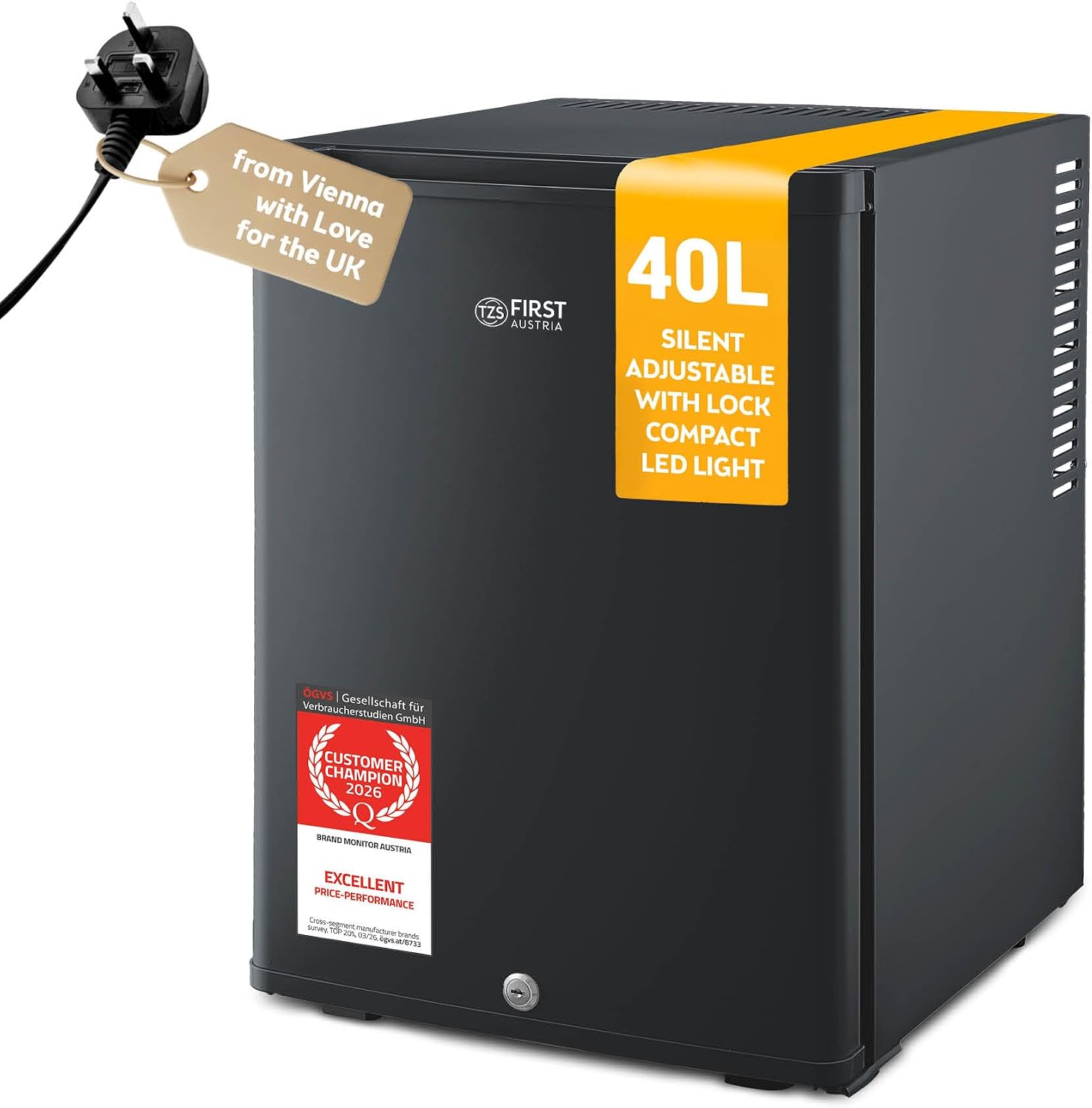
For silence, drinks only — TZS First Austria 40L. A retro-styled thermoelectric model that runs absolutely silently and has a genuinely variable internal layout. It is the right answer for a bedroom, a study or a guest room where compressor noise would be intrusive, provided you accept its main limit: cooling becomes unreliable in high summer. The tested unit also had a door hinge that could not be swapped to the other side, though current UK listings for the 40-litre model describe a reversible door — so that particular complaint may apply only to the version on test, and is worth checking against the specific listing. This is the one pick straightforwardly available in the UK at the tested capacity; it is not listed on Amazon.com. Find it: TZS First Austria 40L on Amazon UK | compact mini fridges on Amazon.com.
For heavy or commercial use — Liebherr FKv 503. Firmly premium: a stainless steel case, dimmable interior lighting, a lock, and Liebherr's proven compressor technology, which makes it suitable for hospitality as well as domestic use. The costs are equally clear — a high purchase price, high electricity consumption, and a constant low hum from the circulating-air cooling. Neither Amazon UK nor Amazon.com lists this exact model; the US catalogue carries full-size Liebherr refrigerators instead. Search: Liebherr glass-door fridge on Amazon UK | Liebherr on Amazon.com.
For the most usable space — Stillstern E 45L. The value option, and the one that stores the most: 45 litres of usable volume with a small icebox and automatic defrosting, cooled by a compressor that performed well. Compromises are no interior lighting and a flimsy bottle rail in the door. It is not listed on Amazon UK or Amazon.com. Comparable compressor models: 45L compressor mini fridge on Amazon UK | 45L compressor mini fridge on Amazon.com.
A note on buying these. This was a European group test, and it shows in what you can actually order. Of the four, only the TZS 40-litre unit is listed at its tested capacity on Amazon UK, and none of the four appears on Amazon.com under the exact model tested. Every link above is therefore a search rather than a direct product page, and no prices are quoted anywhere in this guide — a mini fridge price moves constantly, and a figure written into an article is out of date the week after it is published. Where a model is unavailable, the search is aimed at the equivalent specification rather than at a substitute we are pretending is the same product.
Frequently asked questions
How much does a mini fridge cost to run? Less than the size difference suggests, and more than you would like. A 200-litre kitchen fridge holds five times as much as a typical mini fridge but draws only around twice the power, so the small machine is the less efficient one per litre. A compressor model is cheaper to run than a thermoelectric one over a warm season, because it switches off once it reaches temperature.
How many watts does a mini fridge use? A thermoelectric model draws up to 60 watts and turns that into roughly 30 watts of cooling. A compressor produces around 150 watts of cooling from the same input, making it at least five times more efficient. In a hot room the thermoelectric unit runs continuously at its full 60 watts.
Can I keep food in a thermoelectric mini fridge? Drinks, yes. Dairy, meat and fish, no. In testing, a thermoelectric unit reached 11 degrees inside at around 30 degrees ambient, well above the 2 to 7 degrees those foods require.
Where should I put it? Out of direct sunlight, and not beside a radiator. Both raise the work the cooling system has to do, and therefore the running cost.
Do they defrost themselves? Mostly not. Of the models here, only the Stillstern E 45L and the Liebherr FKv 503 have automatic defrosting; the rest need doing by hand.