A digital multimeter is the one tool that turns "I think the fuse has gone" into a definite answer. Whether you are chasing a dead car battery, checking a plug, testing a continuity fault or fixing an appliance, it measures voltage, current, resistance and more, and a good one is safe, accurate and easy to read. These are the top picks, checked against current UK prices.
What to Look For
Safety rating (the most important thing). A multimeter's CAT rating tells you the electrical environments it can safely handle, and it is not worth risking your life to save a few pounds. Ratings run from CAT I up to CAT IV, each with a voltage limit — for example a meter rated CAT IV to 600 V for mains and supply work, or CAT III to 1000 V for industrial circuits, with a lower CAT IV 300 V figure on simpler models. For jobs around the home and car, look for at least a solid CAT III rating and buy from a maker that states the figure clearly.
Resolution and accuracy. "Counts" describe how fine a reading the meter can show — a 6,000-count meter reads more precisely than a basic 2,000-count one. If you work with mains electronics, also look for a True RMS meter, which reads modern, non-sinusoidal AC accurately where a cheap averaging meter would be wrong.
What it can measure. All multimeters do voltage, current and resistance, reading a huge span of voltages — from a 1.5 V or 9 V battery, through 5 V and 10 V hobby circuits, right up to 230 V mains. The more useful ones add continuity (with an audible beep), capacitance, frequency, diode testing and even temperature — handy for spotting an overheating component or checking a fridge, often accurate to within about 0.6 °C. A good meter is also precise: read a supply that is meant to be 10 V and a quality unit might show 9.997 V. Decide which functions you actually need.
Auto-ranging and ease of use. An auto-ranging meter picks the correct measurement range for you, which is far friendlier than manually guessing. A clear, backlit display, colour-coded sockets and non-contact voltage detection (which senses a live wire without touching it) all make a meter quicker and safer to use.
Build and handling. The little things matter on the bench and under the bonnet: a sturdy rubber holster that survives a drop, a fold-out stand so it can sit facing you, a decent set of probes and a sensible size. Some capable meters are bulky, while the smallest pocket models trade features and a stand for portability.
The Winner: Kaiweets HT118A
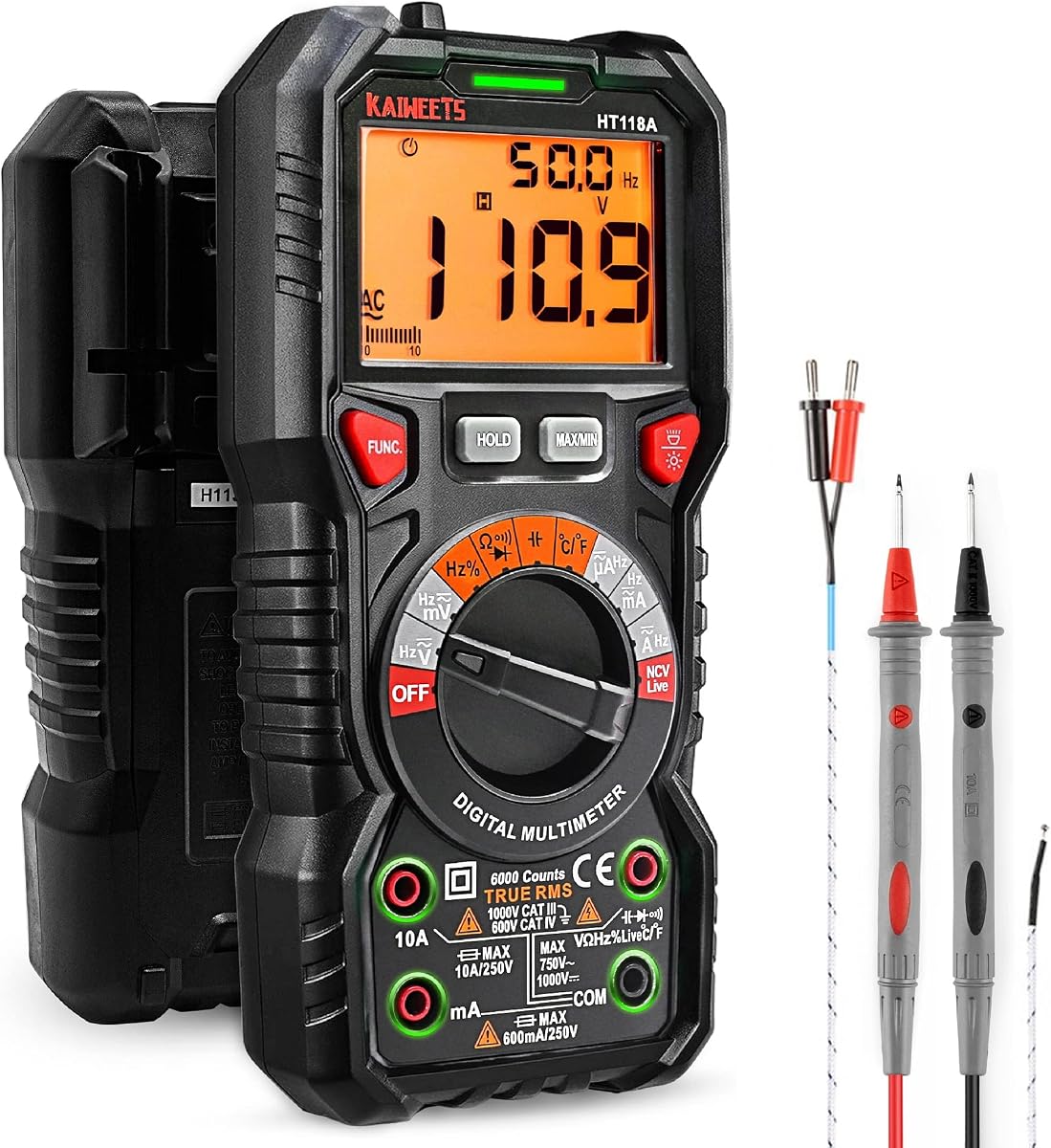
The Kaiweets HT118A is the best multimeter for most people. It offers a genuinely broad feature set for a fair price and stands out on both usability and capability: it is rated CAT IV to 600 V, reads True RMS, is fully auto-ranging, includes non-contact current detection, and even has illuminated sockets that light the correct jacks for the measurement you have selected. Its only real drawback is that it is physically very large. But for a do-everything meter that is safe, capable and keenly priced, it is the clear pick for home, car and hobby use alike. Check the price on Amazon UK · Search Amazon US