A phone photo printer turns the pictures stuck on your camera roll into something you can hand to someone. The four here divide neatly by what you want out of them: pocketability, print size, outright quality, or instant-camera charm.
The short version
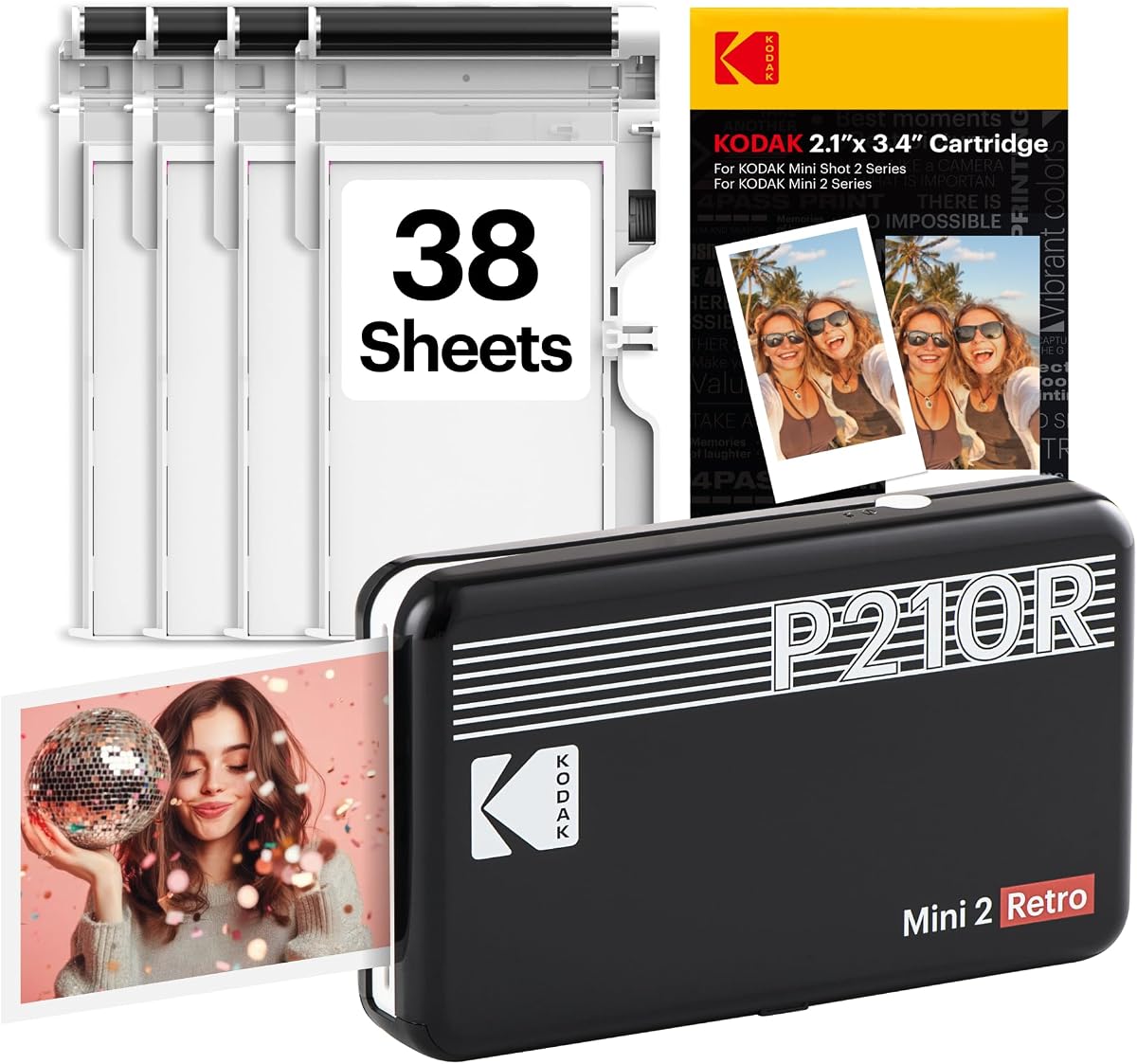
The winner: Kodak Mini 2 Retro P210R
The top recommendation among the genuinely mobile printers, and it earns the place on a simple advantage: it produces photos about 30 % larger than most other pocketable devices, while offering some of the best image quality in the test and printing comparatively cheaply.
It is ergonomic and cleanly made, and the app is mature enough to make it comfortable and simple to operate.
The compromises are worth knowing. You are limited to a single format, the popular standard photo ratio of about 3:2 — if you prefer square, the otherwise identical Kodak Mini 3 Retro P300R is the one to look at. It produces a lot of plastic waste, there is no USB-C, and the app does not display the crop correctly.
Best compact quality: Canon Selphy QX20
Already too large for many pockets, the QX20 convinces above all on image quality. Thanks to dye sublimation it comes close to the backpack-class Canon Selphy CP1300 and CP1500, and is broadly comparable with cheaper photo printers in general.
The pleasantly large prints come in the fashionable square format, and the Polaroid-style frame gives them genuine retro appeal. The app displays the crop correctly, which the Kodak's does not.
Two drawbacks: it is too big for many pockets, and running costs are high.
Best quality overall: Canon Selphy CP1500
At over 1,100 grams without its battery but with the paper cassette, the very popular CP1500 is no longer a pocket device — it asks for a rucksack.
What you get in return is postcard-sized photos at 10 cm × 15 cm plus two other formats, the best print quality in the test, and by a distance the lowest cost per photo. It is also versatile in connection options, has dedicated buttons and its own colour display, and offers a choice of surface finishes.
The catches are practical rather than technical: too large for a pocket or jacket, the paper cassette has to be carried separately, the power supply is heavy and bulky, and the battery is not included. The app is the weakest part of the package.
Best retro charm: Fujifilm Instax Link Wide
The Instax Link Wide arrives with real cult appeal, combining the fashionable instant-photo look and its frame with a practical wide format.
It offers some of the best image quality in the test alongside a nicely made app, and the housing is solid and ergonomic. The reservations: it is voluminous — a jacket pocket rather than a trouser pocket — there is a magenta cast to the output, and the cost per photo is anything but cheap.
ZINK or dye sublimation?
This is the decision underneath all the others.
ZINK printers use heat-activated crystals embedded in the paper, with no separate ink or ribbon. That makes the printers small and simple, which is why the pocketable models use it.
Dye sublimation transfers dye from a ribbon in successive passes. It is what gives the Canon Selphy machines their quality advantage — and it is also why they are bigger, since the mechanism has to move the paper back and forth.
If print quality is the priority, dye sublimation wins. If the printer has to live in a pocket, ZINK is the trade you make.
How the printers were tested
Photographs are produced under consistent conditions and assessed on image quality, along with the printer's handling, its app and its connection behaviour. Print sizes across the field range from small ZINK formats up to the 10 cm by 15 cm and 7.6 cm wide outputs of the larger machines, which is the practical difference most buyers notice first.
The wider field shows how much the format varies. The Polaroid HI-Print produces borderless dye-sublimation photos in an unusually wide 9.6 × 5.4 cm; the Fujifilm Instax Mini Link 2 prints frameless at 6.2 × 4.6 cm; and the Instax Mini Link 3 takes about 15 s to deliver a picture before the development process begins and the image gradually appears.
How to choose
Decide the print size first. It drives everything else. Postcard-sized 10 × 15 cm prints mean a machine that needs a bag; a pocket printer means smaller photos, though the Kodak's are about 30 per cent bigger than the pocket norm.
Then decide on format. The Kodak Mini 2 Retro is fixed at roughly 3:2. The Selphy QX20 does square with a Polaroid-style frame, and the Instax Link Wide does the instant-film look in a wide ratio.
Weigh the running costs, not just the printer. The Selphy CP1500 has by far the lowest cost per photo in the test; the QX20 and the Instax Link Wide are both expensive to feed.
Check the app. It is a bigger part of the experience than it sounds. The Kodak's is mature but shows the crop incorrectly; the QX20's shows it correctly; the CP1500's is the weakest here despite the machine being the best.
Remember the consumables and the waste. The CP1500's paper cassette travels separately from the printer, and the Kodak generates a considerable amount of plastic waste.
Frequently asked questions
Which phone photo printer should I buy? The Kodak Mini 2 Retro P210R for most people — pocketable, with prints about 30 % larger than the pocket norm, among the best quality in the test and comparatively cheap to run.
Which produces the best prints? The Canon Selphy CP1500, which took the best print quality in the test and the lowest cost per photo, at 10 cm × 15 cm plus two other formats. It weighs over 1,100 grams, so plan on carrying a bag.
What is the difference between ZINK and dye sublimation? ZINK activates crystals already in the paper, so the printer can be tiny; dye sublimation transfers dye from a ribbon in passes, which produces better images but needs a larger machine.
Which does square photos? The Canon Selphy QX20, with a Polaroid-style frame — and for a pocket printer, the Kodak Mini 3 Retro P300R, which is otherwise identical to our winner.
Which has the most retro look? The Fujifilm Instax Link Wide, which pairs the instant-film frame with a wide format — though it has a magenta cast and is expensive per photo.
Is any of them genuinely pocket-sized? The Kodak is. The Selphy QX20 is already too big for many pockets, the Instax Link Wide suits a jacket, and the CP1500 needs a rucksack.
Research sources
Sources recorded for this page are linked below. Reported third-party testing belongs to the original publisher; it is not testing performed by Truthful Reviews.