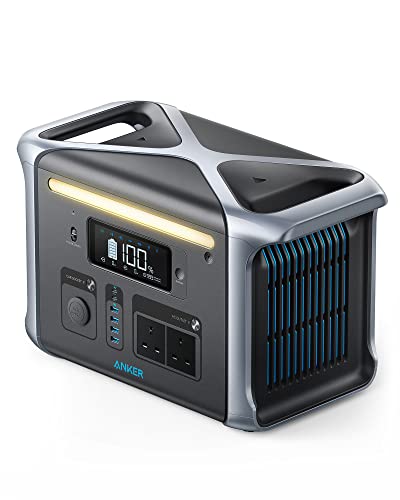
A portable power station is a big battery in a box — a power bank grown up, with proper mains sockets alongside the USB ports. When the lights go out, or you are camping, working in the garden or running a stall, it keeps phones, laptops, fridges and tools running. A recent group test measured twelve of them and recommended six, grading each on four things: performance carries 50 per cent of the score, with equipment, portability and noise making up the rest.
The measurement that matters most is one manufacturers rarely advertise. Charging and discharging through an inverter loses a slice of energy as heat, so the test divides the usable mains energy by the energy taken from the wall to get a round-trip efficiency — and across this field that figure lands between 69 and 79 per cent. A nominal capacity figure is not what you get out.
The short version
- Best overall: Jackery Explorer 2000 Plus — the most capable here, if you accept it is not really portable.
- Best all-round alternative: EcoFlow Delta 2 Max — 2,400 W continuous, enough for an induction hob.
- Fastest to charge: Anker Solix C1000 Gen 2 — full in about an hour.
- Most portable: EcoFlow River 3 and Anker Solix C300 — small, silent, and limited to modest loads.
Best Overall: Jackery Explorer 2000 Plus
Graded 1.4 (very good) overall, with 1.1 for performance and a perfect 1.0 for equipment. It yielded 1,610 Wh through the mains socket, 1,692 Wh over USB-C and 1,732 Wh from the 12-volt output, recharging fully in about an hour and a half for a 71 per cent round-trip efficiency. A 3,000 W continuous output means it will run genuinely heavy mains loads, and the app puts every function on your phone.
Two caveats decide whether it suits you. Solar input is via two 8 mm barrel connectors, which without soldering ties you to Jackery's own panels. And at nearly 28 kilograms this is a machine for a fixed spot: it scored only 4.1 for mobility, and while it has transport wheels and a handle, both are undersized. Search Amazon UK · Amazon US
Best All-Round Alternative: EcoFlow Delta 2 Max
Graded 1.5 (very good) with a perfect 1.0 for performance. It delivered 1,617 Wh through its AC outputs, and its 2,400 W maximum continuous load is enough to run an induction hob — the practical dividing line between a power station that covers your gadgets and one that covers your kitchen. Over USB-C it gives 1,583 Wh at up to 100 W. The internal supply refills it in 79 minutes, drawing 2,320 Wh to do so, which works out at 70 per cent efficiency.
Two XT60 inputs accept up to 1,000 W of solar. Sockets are generous: four mains, four USB-A, two USB-C and a car socket, with full app control. At a little over 23 kilograms it scored 4.3 for mobility, so like the winner it is a two-handed lift. Search Amazon UK · Amazon US
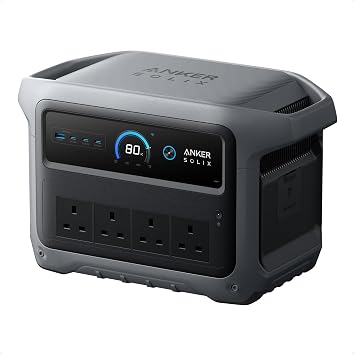
Fastest to Charge: Anker Solix C1000 Gen 2
Graded 2.2 (good), and its stand-out quality is speed: an average 1 hour and 1 minute to full at up to 1,236 W, which puts it among the quickest in its class. Charging its nominal 1,024 Wh battery draws 1,168 Wh from the mains, and the socket returned 839 Wh, a 72 per cent round trip.
The inverter sustains 2,000 W, enough for demanding appliances, and two of its three USB-C ports support 140 W Power Delivery, which covers modern laptops directly. Performance graded 2.8 and mobility 2.4 — middling on both counts, which is the price of that charging speed and output. Search Amazon UK · Amazon US
Most Portable: EcoFlow River 3
Graded 3.3 (satisfactory) overall but 1.0 for both mobility and noise — the joint quietest and most portable machine in the test. Compact, with a well-considered app and near-silent running, it suits camping or powering low-draw devices such as phones and lamps, and its 79 per cent round-trip efficiency is the best figure in this field.
Its limits are real and worth stating plainly: maximum output is 300 W, and the USB performance is modest at 12 W on USB-A and 20 W over Quick Charge 2.0 on USB-C. That noticeably narrows what it can run. Search Amazon UK · Amazon US
Also Recommended
The Anker Solix C300 is the test's value pick, graded 3.2 overall with 1.2 for mobility and 1.1 for noise. At 16 × 24 × 17 cm and 4.2 kilograms, with a carry strap, it is genuinely luggable. Against a nominal 288 Wh it returned 240 Wh through the mains socket, 266 Wh over USB-C and 254 Wh from the car socket; a full charge took 346 Wh, giving 69 per cent efficiency — the lowest here. Maximum continuous output is 300 W, so it is for smaller loads only, and it charges at up to 329 W, full in 1 hour 9 minutes. It is close to silent in use.
The Jackery Explorer 500 v2 is the budget alternative: 500 Wh nominal, 6 kilograms, 31 × 15 × 21 cm, and 1.4 for mobility. It gave 439 Wh through the mains, 495 Wh over USB-C and 481 Wh from the car socket, needing 603 Wh for a full charge — 73 per cent efficiency. Continuous output is 500 W, adequate for smaller household appliances, and it charges at 540 W in an average 1 hour 18 minutes. At a 100 W draw it measures a quiet 0.5 sone. Search Amazon UK · Amazon US
Which Battery Chemistry?
The cells fall into two groups. Lithium-ion runs at 3.6 to 3.7 volts per cell with a high energy density of 150 to 260 Wh/kg, but mostly manages only 500 to 2,000 full charge cycles before capacity falls to 80 per cent of nominal. Lithium iron phosphate — LiFePO4, or LFP — sits lower at 3.2 to 3.3 volts and stores less per kilogram at 90 to 120 Wh/kg, but takes 3,000 or more full charges before reaching that same 80 per cent.
The practical rule follows from that: if portability is your first priority, lithium-ion carries more energy for the weight; if the machine will mostly sit as a buffer store, choose LFP. LFP is theoretically somewhat safer thanks to its lower energy density, though in practice that depends heavily on the quality of the design and construction of the particular unit.
How the Testing Works
Four categories make up the grade, weighted differently, with points converted to school marks for legibility. Performance carries 50 per cent: repeated runs measure how quickly each machine charges through its AC input, then discharge it at defined constant loads through the mains, 12-volt car and USB-C outputs. Because a substantial part of the energy is lost as heat during AC charging and discharging, the round-trip efficiency divides the usable mains energy by the energy consumed. Equipment, portability and noise make up the remainder.
How to Choose
Work out the load first: multiply an appliance's wattage by the hours you need it, then buy more capacity than that figure, because the round-trip efficiencies here mean between a fifth and a third of the stored energy never reaches your device. Check the continuous output against your most demanding appliance — anything with a heating element is thirsty, and a 300 W machine will not run it. Then be honest about weight, because it is the specification people regret most: the two most capable machines in this test weigh 23 and 28 kilograms and scored barely above adequate for portability, while the ones you can actually carry top out at 300 W.
Research sources
Sources recorded for this page are linked below. Reported third-party testing belongs to the original publisher; it is not testing performed by Truthful Reviews.