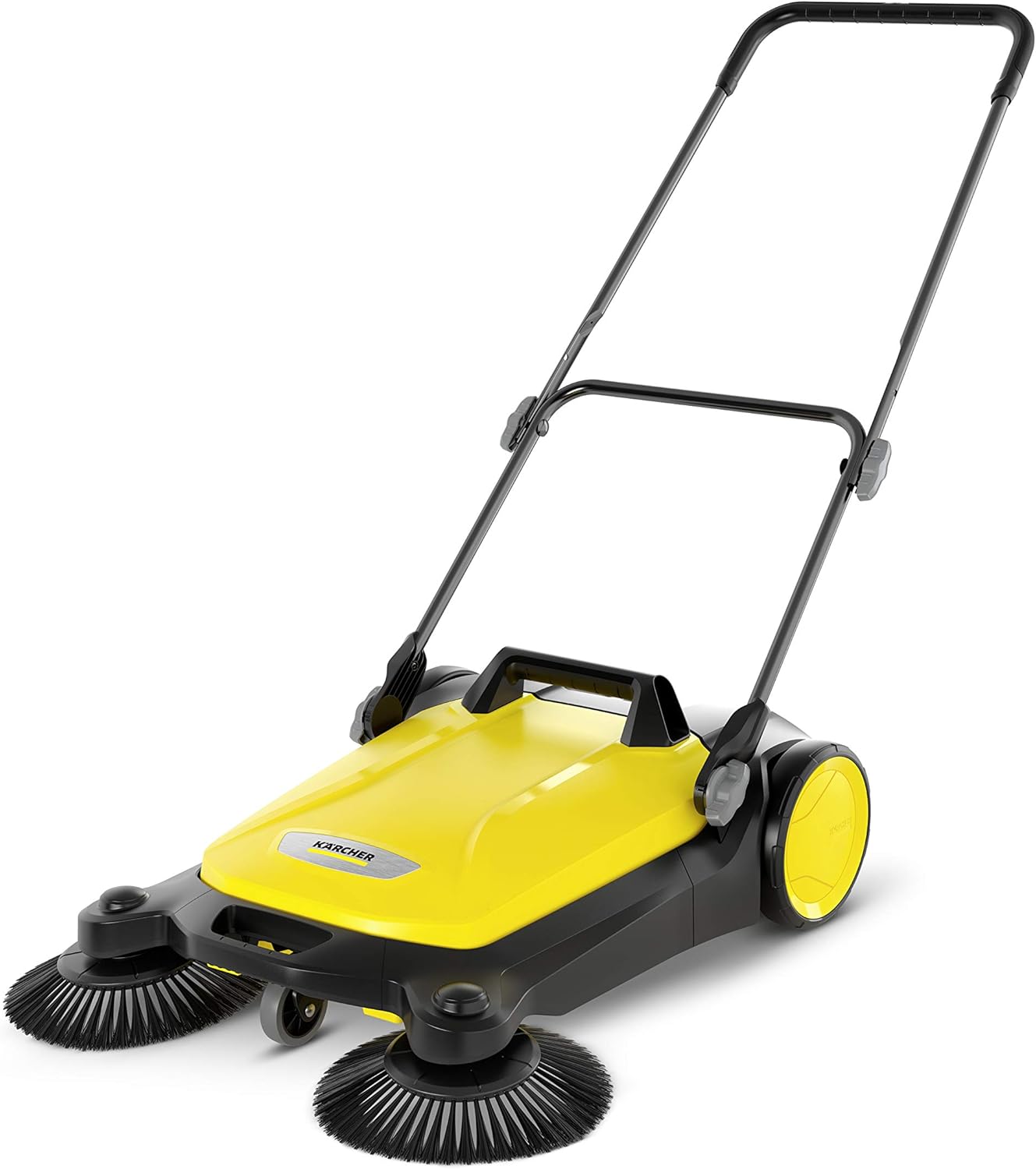
A push sweeper is a wheeled alternative to the yard broom: you walk it up the drive, and rotating brushes flick sand, grit, dust, leaf litter and stray twigs into a hopper instead of into the air. On a long drive, a paved yard or the strip of pavement outside a house, it turns a slow job into a short one. This guide covers a test of 15 push sweepers, both hand-driven and battery models, judged on sweeping performance across different surfaces, build quality, assembly, handling and noise.
What follows is recorded testing, translated. Nobody at Truthful Reviews has pushed any of these machines.
How a push sweeper works
Plate brushes — flat circular brushes, sometimes called feed brushes — sit at the front corners and sweep debris inwards to the centre line, where a rotating roller fitted with bristles or rubber lamellae lifts it into the hopper. On domestic machines only the plate brushes are usually height-adjustable; not one machine in this test had a height-adjustable roller.
On a hand-driven machine the front wheels do the work: pushing turns them, a gear or belt drive spins the brushes, and the faster you walk the faster they turn, with no power source at all. On a battery machine a motor drives the plate brushes instead, which makes large areas far less tiring and — because the brushes turn whether or not the machine is moving forwards — makes corners and wall edges much easier. The trade-offs are charging and the battery's gradual loss of capacity. Petrol machines exist but are commercial kit, too large for a domestic drive.
One limit is worth knowing first: these machines are built for dry debris. Some take wet leaves, some tangle on them, none replaces a leaf blower for a full autumn fall, and none will sweep snow.
The picks
Top pick — Kärcher S4 Twin
The best broom replacement in the compact class, and the machine that swept a mixed surface most convincingly. Assembly is tool-free and took five minutes: the hopper handle pushes on, the plate brushes fit once their grey caps are unscrewed and refit to lock them, and the push handle screws on with the supplied hand grips. Both height and angle adjust steplessly on large plastic screw grips, and the grip section is sleeved rather than bare metal — many rivals here offer only a plain tube.
At 10 kg with a 68 cm sweeping width, it is easy to push and unusually easy to steer, circling forwards, backwards and through tight turns almost as though remote-controlled; only the Einhell matched it for effort. On the test's spread of damp sand, grit, pulled weeds, dusty soil, leaves and bark mulch it collected the lot in one pass on flat ground, needing a second run only on the tightly set slalom. On an uneven cobbled channel it needed several passes — but so did every other machine in the field, height-adjustable brushes or not. Its own plate brushes are not adjustable; they are mounted to follow the ground contour instead, which proved enough.
The claimed area rate is 2,400 m² per hour, which the testing found realistic, and on the test's own loudness scale of 1 (very quiet) to 10 (very loud) it scored 2. The flat body slides under benches and even under a motorhome step. The one real complaint is the 20-litre hopper, which could stand to be around five litres larger. Against that: a carry handle moulded into the housing, a hopper that stands steadily once removed, separately orderable harder-bristled side brushes, good spare-parts availability, and a handle that folds so the machine parks flat against a wall.
Search Amazon UK · Search Amazon US
The battery pick — Einhell TE-SW 18/610
If you want the sweeping done for you, this is the one. Two 30 cm plate brushes are driven by an 18 V battery and start rotating the moment you pull the red lever on the push handle towards you — without the machine moving forward at all. That makes it the best in the test at corners, kerbs and the base of house walls, where hand-driven machines have to be shoved repeatedly.
It is among the lightest machines here at 10.3 kg despite carrying a battery, and steers one-handed. Sweeping width is 61 cm, the hopper holds 20 litres, and the claimed area rate is 1,800 m² per hour; a single charge of the 4 Ah battery covered roughly 1,700 m², with no recharge needed during testing. Larger 5.2 Ah and 6 Ah packs are available, and the same pack fits the maker's other 18 V tools.
There is no roller brush under the body, so on fine debris it sometimes leaves a narrow strip that a second pass clears, and the spinning brushes throw a little fine material outwards — after a few runs the casing is coated in dust. It is audibly louder too, scoring 4 on that 1-to-10 loudness scale. Two build gripes: the perspex battery flap does not latch open and falls shut on its own, and folding the handle for storage means backing off or removing the two lower quick-release clamps.
Search Amazon UK · Search Amazon US
For large flat areas — Kränzle Colly 800
The best sweeping performance in the test, and the pick for a big, level yard cleared often. It arrives essentially built, needing only its two 35 cm plate brushes bolted on — three screws each, under three minutes — and the manual includes a spare-parts list with order numbers, so any component can be replaced.
The side arms fold upwards, which no other machine here does, so brushes can be fitted easily or the machine run with just one. Handwheels on those arms set brush height steplessly, tuning contact pressure to the surface — an adjustment changed repeatedly during testing to optimise pick-up. Working width is 80 cm, and the roller carries alternating hard and soft bristles, a double bristling, in a housing sealed all round with rubber lips so disturbed debris stays in the 30-litre hopper; Kärcher's machines have rubber lips too but do not seal quite as well. Two replaceable filters clean the air entering the hopper with the debris.
At 19 kg it is the heaviest machine in the field, yet it still pushes with little effort and steers well on its castor. Claimed area rate is 2,000 m² at a 2.5 km/h walking pace. It handled higher heaps and small stones without complaint and coped with wet leaves, though the hopper fills fast in a heavy autumn, and the cobbled channel defeated it as it defeated everything else. The clever detail is a freewheel: pull it backwards and the brushes and roller mechanically disengage, so nothing is swept back out — on the cheaper machines here, reversing regularly spilled collected debris. It is noisier than the top pick, though not annoyingly so, and there is no carry handle in the housing.