A rain poncho has to do two opposite things well: cover a person and their layers generously, then disappear into a small bag when the weather clears. Ten reusable models were compared for water resistance, seam construction, packed size, weight, hood adjustment and practical details.
These are translated results from recorded testing. Nobody at Truthful Reviews wore the ponchos, and every product remains in the guide whether or not an exact direct listing exists.
The picks at a glance
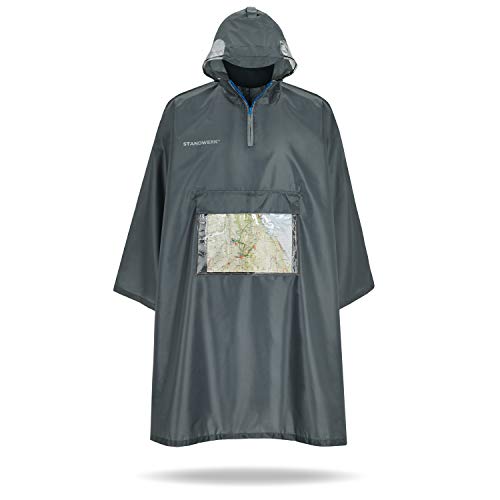
The Standwerk Hiking Rain Poncho is the best all-rounder. It kept the test clothing dry, packs down neatly, covers a backpack and adds a transparent front pocket that can hold a phone or paper map while leaving it visible.
The Anyoo Lightweight Rain Poncho is the versatile rectangular option, with side poppers and corner eyelets. The Ela Mo Rain Poncho is closer to a loose raincoat, with shaped sleeves, adjustable cuffs and a built-in front pouch.
Best overall: Standwerk Hiking Rain Poncho
Standwerk gets the basics right before adding clever details. Its wide, short sleeves make it quick to pull over ordinary clothing, the back is longer than the front to accommodate a backpack, and the sides are closed rather than relying on a row of exposed fasteners. Welded seams were neatly finished and the material stayed dry through the recorded water test.
The hood combines a small peak with adjustment at the head. Clear side panels preserve peripheral visibility when the hood is drawn in, and a small hook-and-loop tab between the legs reduces billowing in wind. The model is intended primarily for walking and town use rather than cycling, because it has no handlebar loops and its closed sides restrict the shape needed over a bike.
Its defining feature is the front navigation pocket. The outer face is transparent, the compartment is accessible from inside with dry hands, and an internal zip keeps the contents from slipping out. A map remains readable through the panel, while a phone can be operated without exposing it directly. The poncho has a separate supplied storage bag rather than packing into that pocket.
The result is light, pleasant to wear and compact without feeling compromised when opened. It is the most balanced option for walking, festivals and everyday travel.
Search Amazon UK · Search Amazon US
Most versatile: Anyoo Lightweight Rain Poncho
The Anyoo uses a simple rectangular cut in lightweight ripstop material. Poppers close the sides, the back extends far enough to cover a pack, and the hood has a peak plus a drawcord. It stayed dry in the heavy-water check.
Eyelets at the corners allow the flat rectangle to be pegged down as a groundsheet or rigged as a basic overhead sheet. Those are secondary uses arising from its shape, not replacements for purpose-built camping equipment. As a poncho, the cut leaves plenty of room and the fabric keeps the packed weight low.
The catch is the supplied pouch. The poncho does fit, but only after careful folding to its intended dimensions; stuffing it in loosely does not work well. Once packed properly, the bundle is notably small.
Search Amazon UK · Search Amazon US
Best city style: Ela Mo Rain Poncho
Ela Mo sits between a conventional poncho and a loose raincoat. It has defined sleeves with adjustable cuffs, a closed body and a hood with a fixed peak, front ties and rear hook-and-loop adjustment. The material drapes more softly than the stiffer cycling models.
The shoulder seams are welded; the seams below the sleeves are not, but that difference did not let water through during the test. The front pouch doubles as the storage pocket, and the garment can be pushed back into it without the precise folding demanded by the Anyoo.
Black, dark blue, turquoise and a leopard print were recorded. The range of finishes, smaller packed shape and coat-like sleeves make this the most natural option for routine town use, while its closed sides still suit walking in wind.
Search Amazon UK · Search Amazon US
Also tested
Btwin City 560 Cycling Rain Poncho
The City 560 is large, heavy and stiff, although its construction is sound and its welded seams held water out. The broad cut covers the sides well when seated on a bike, and hand loops hold the front towards the handlebar. Its hood is small, cannot fit over a helmet and has no useful adjustment. A strong smell on unpacking faded after a day.
Search Amazon UK · Search Amazon US
Vaude Valdipino Poncho
Small when packed, comparatively light and easy to stuff into its integrated front pocket. The Valdipino combines handlebar loops with hand openings, and the seams are welded cleanly. Its short back is the trade-off: there is too little extra length for a substantial backpack beneath it.
Search Amazon UK · Search Amazon US
Exped Bike and Hike Poncho
The lightest item in the field used exceptionally thin material and looked well made. Reinforcing tape sits behind the poppers so they do not pull directly against the fabric, although the fasteners remained difficult to open and inspired little confidence. It has closed sides and handlebar loops. Numerous functions were not immediately self-explanatory, and neither the package nor the product information supplied enough explanation.
Search Amazon UK · Search Amazon US
Cyclehero Cycling Rain Poncho
This bright yellow PVC model is the heavyweight of the group at 770 g. It feels stiff, packs into a large bundle and uses a basic hood tie rather than full adjustment. Handlebar loops are present, but there is no body strap to control excess movement. The seams are welded, yet the materials and finish do not feel as refined as the stronger alternatives.
Search Amazon UK · Search Amazon US
Reisenthel Mini Max Poncho
The Mini Max is very light and folds into a tiny integrated chest pocket, but it failed the central test. After five minutes of intense water, the cotton layer beneath was wet. Unwelded seams were the main entry point, and the storage pocket itself collected water into a sagging pouch. Its description as water-resistant, rather than waterproof, proved meaningful.
Search Amazon UK · Search Amazon US
Alpenmüller Cycling Rain Poncho
Well-welded seams and a firm material gave the Alpenmüller a substantial feel. Its rectangular body closes with side hook-and-loop strips, its hood tightens at the front but not around the head, and handlebar loops are fitted. Corner eyelets reflect the same flat, multipurpose construction as the Anyoo. It is heavier than the leading walking ponchos and packs less neatly.
Search Amazon UK · Search Amazon US
Stynice Rain Poncho
The Stynice is a long, light ripstop design with side poppers, welded seams and quick-drying fabric. It kept water out and covers much of the legs. Like the Anyoo, its main frustration is a storage bag cut so closely that packing requires careful folding and compression. The reward is a compact bundle once the job is done.
Search Amazon UK · Search Amazon US
How the comparison was run
Water resistance was tested with each poncho fitted over a long-sleeved cotton top on an inflatable form. The setup was exposed to an intensive shower for five minutes, after which the shirt and the seam lines were checked for water ingress.
Each poncho was then folded or stuffed into its intended pouch. Packed dimensions and weight were recorded, and the ease of getting it back into the bag formed part of the result. Hood adjustment, pack coverage, welded seams, hand openings, side closure and any model-specific features were assessed separately.
The source's comparison table contains loose feature bullets without product headings. None is attributed here. All product claims above come from the named sections.
What matters when choosing
For walking with a backpack, look first at rear length and body volume. A poncho can be generous on an unladen wearer yet pull short once a full pack sits beneath it. Closed sides resist wind-driven rain better, while poppers make a flat-cut model more adaptable.
For frequent carrying, packed size is only half the story. Check how the pouch works: an integrated pocket is hard to lose, but a tiny separate sleeve may demand careful folding every time. Hood adjustment matters too. A peak controls drips at the face, rear adjustment changes volume, and front drawcords narrow the opening.
Welded seams proved more important than elaborate add-ons. The only product to fail the full water exposure had unwelded seams, despite being light and compact. Conversely, a heavier or stiffer fabric was no guarantee of better overall usability.
Water-column figures are useful for comparing declared fabrics, although they do not replace the finished-garment test because seams and openings still matter. The source treats 5,000 mm as a practical baseline and cites 10,000 mm and 15,000 mm fabrics for more prolonged or heavier rain. Those are comparison points, not a promise that every garment carrying the number will keep water out in every circumstance.
Verdict
The Standwerk Hiking Rain Poncho is the best combination of weather performance, pack coverage, comfort and genuinely useful design. Choose the Anyoo Lightweight Rain Poncho for a lighter rectangular design with secondary flat-sheet uses, or the Ela Mo Rain Poncho for sleeves, an integrated pouch and a more city-friendly cut.