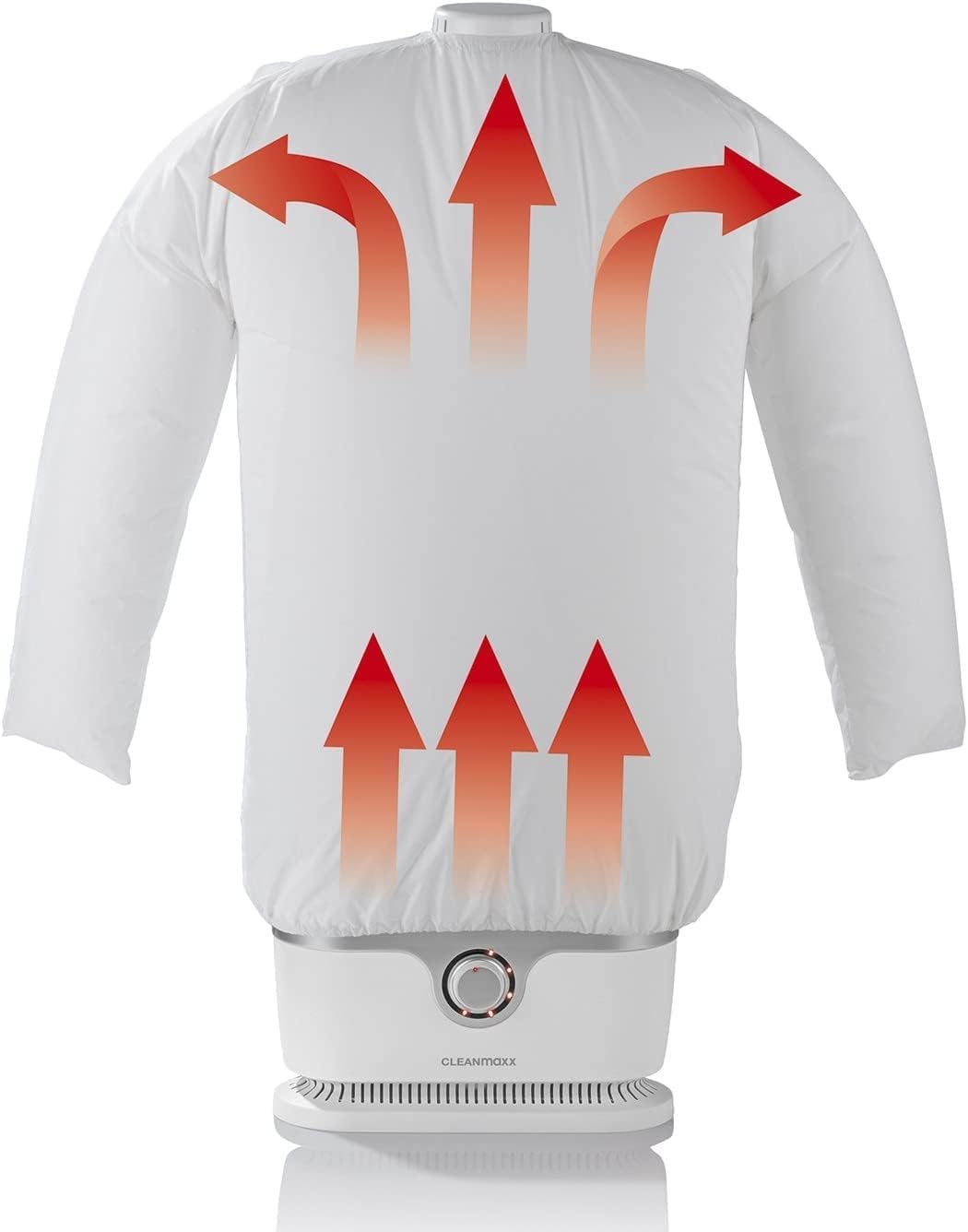
A shirt ironer — a heated ironing dummy — is one of those appliances that sounds faintly absurd until you have stood in front of a wardrobe at half past seven with a creased shirt and no intention of setting up an ironing board. It does the job automatically. You pull the damp shirt over an inflatable body, close it up, switch on, and warm air fills the balloon so the fabric is pulled tight and dried smooth at the same time. Seventeen machines were put through an extended practical test, and the results say something useful: the best ironing was not done by the most elaborate machine on the list.
What follows is recorded testing, translated. Nobody at Truthful Reviews has ironed a shirt on any of these.
How a shirt ironer actually works
Whatever the brand, the principle is the same. The machine is built from a motor unit, a telescopic pole, a shoulder frame that behaves like a coat hanger, and a nylon balloon body that slides over the frame. You put the shirt on the balloon rather than on a board: close the top button, pull the sleeves down over the arms of the cover, and straighten the open button placket with the supplied clips or small weighted clamps.
Switch on and warm air floods the balloon. The garment inflates, the fabric is stretched taut, and creases are pulled out while the shirt dries. It is effectively a tumble dryer and an iron in one operation. Depending on fabric thickness and how wet the garment is, a shirt takes somewhere between four and twelve minutes. Several machines then run a cold cycle at the end, which sets the fabric so it does not immediately crease again. After that the shirt is lifted carefully off the cover and hung up.
The advantages are the obvious ones: it works on its own, so it saves the ten to fifteen minutes a decent hand-ironed shirt usually takes; the pressure and heat are applied evenly, which is why the results look consistent; and it generally runs cooler than an iron, which is easier on the fabric.
The drawbacks are just as plain. The better-equipped machines are not cheap. They take up far more room than an iron and a board, and the tested field ranged from about 150 grams for a folding travel unit to a full 20 kilograms at the heavy end, so storage genuinely needs thinking about before you buy.
What separates a good one from a poor one
Range of garments. The best machines handle more than shirts. Some take a second balloon for trousers, a few add attachments for hats and shoes, and several let you clip socks and underwear onto the frame inside the balloon so they dry at the same time.
Sizes. Most balloons cover roughly XS to XXL, adjusted by side zips. If a household's laundry runs to unusual sizes, check what covers the manufacturer sells, because the fitted balloon supplied in the box is the one you get.
Speed and power. Rated power runs from about 800 W to over 3,000 W across the field. Higher power generally means a shorter cycle: shirts typically need three to ten minutes on a quick machine, trousers ten to fifteen because the fabric is heavier. A powerful machine that finishes in six minutes is not necessarily the greedier one, because it runs for a fraction of the time.
Steam. Only a handful of these can treat dry clothing. If you want to freshen a shirt that has been hanging in the wardrobe rather than one straight out of the drum, you need a steam function — or a spray bottle.
Noise. Most sit between 60 and 75 dB. For scale, a washing machine on its spin cycle is around 75 dB, and 60 dB is roughly the level of ordinary conversation. The loudest machines here measured well above both.
Timers and automatic shut-off. A machine that stops itself at the end of a set time saves you standing over it, and stops the garment being cooked while you are elsewhere.
There is also a niche of manual travel dummies. Instead of a built-in fan they have a mount under the cover that takes a powerful hairdryer, which then does the blowing.
The picks
Top pick — CLEANmaxx 2968
The strongest all-rounder here, and the one that does two jobs rather than one. Assembly is quick and needs no tools: the extending telescopic pole pushes into the motor unit, the shoulder frame clips onto the pole, and the nylon balloon pulls over the collar section and locates on a fixing rim. The instructions are clear and the whole thing goes together in a few minutes. Assembled it takes more room than an iron, but it stands happily in a corner, and at 3.4 kg it is light enough to shift when you need the space.
It handles shirts, jumpers, T-shirts and blouses, in sizes XS to XXL, with zips down the sides of the balloon that open out for the larger end of that range. The mains lead is pleasantly long, so it does not have to live beside a socket. A touch display selects between the two programmes: hot air for damp clothing, or steam for garments that are already dry. For steaming, distilled water goes into the tank — up to 700 ml, though the maker's advice is 350 ml per steam cycle for the best result — and each bar on the control panel represents a minute.
In practical use the plain hot-air programme was tested first. The manufacturer's claim is about ten minutes for a spin-dried shirt. That held. With the shirt pulled over the balloon, the weighted clamps fitted and the fabric smoothed at the corners, only the button placket was still damp after eight minutes, and the machine shut itself off automatically at ten. The result was the point: the shirt came off dry and genuinely crease-free, collar included, with no need to go over it afterwards with an iron. The 1,800 W rating is a large part of why.
The steam programme was then tried on a creased, dry T-shirt from the wardrobe, set to the manufacturer's suggested 15 minutes, with distilled water in the tank. The garment is steamed first and the ironing action follows. The changeover is startling the first time, because the steam phase runs at about 75 dB and then the level jumps by 3.6 dB when the machine moves on. The finish was again excellent, with no creasing left.
The one real complaint is noise: on the hot-air programme it measures 80 dB, which is loud. The steam phase, at 75 to 78.6 dB, is marginally better. Beyond that the practical test found nothing to hold against it — easy build, good materials, two working programmes and an ironing result at the top of the field, without the outlay the best-finishing machine here demands.
Search Amazon UK · Search Amazon US
Shirts and trousers, quietly — Klarstein ShirtButler
This one proves that looks are not the deciding factor. It is a combination machine: shirts, T-shirts and blouses on one balloon, trousers on another, and a separate attachment can be bought for drying shoes. Assembly involves some compromise — the frame feels rattlier than the others here and the materials are not as good — but the ironing result does not suffer for it, and it is inexpensive by comparison.
Putting it together is a matter of pushing the sections into each other and pulling the appropriate nylon balloon over the top. The control panel is old-fashioned, a single rotary timer, but it works: choose 30, 60, 90, 120, 150 or 180 minutes and the machine switches itself off at the end.
It is slower than the top pick. A spin-dried shirt was completely dry after about 20 minutes, collar included and crease-free, on a draw of only 1,250 W. The compensation is noise. At 68 dB it is genuinely quiet — no louder than a normal conversation, and a clear step down from most of this field.
It covers XS to XXL through the side zips, and fastening clips pull the shirt taut so it does not set creases as it dries. The garment does need to be damp going on. For trousers you swap the balloon for the trouser sack, pull it over the telescopic pole and set the timer; jeans were ready after 25 minutes.
Search Amazon UK · Search Amazon US
Most temperature control — Wëasy IRO320
The argument for this one is fabric care. Unlike most of the field it offers five temperature settings, chosen on a display: room temperature, 30, 40, 50, 60 or 70 degrees, so a shirt, a blouse or a T-shirt can be dried at a level that suits it. That range is why creases came out of thick cotton shirts as well as thin ones. Running time is adjustable between 15 and 180 minutes, after which it stops on its own.
A thin cotton shirt took 15 minutes and came off crease-free and cupboard-dry. It is also reasonably quiet at around 72 dB.
Assembly is straightforward: the collar piece and two hanger arms click together, mount on the telescopic pole, and the whole construction slides into the machine before the nylon balloon goes over it. Two side zips size the balloon, so it copes with S to XXL. The mains lead, though, is short — the clearest mark against it.
Once the shirt is on the balloon, four weighted clamps pull it tight. The top pick has five, and a fifth would be welcome here too. As with every machine of this type the garment should be damp and fully buttoned, and it pays to take the shirt off promptly once the cycle ends, or creases reappear at the body and collar. A two-year manufacturer's guarantee comes with it.
Search Amazon UK · Search Amazon US
Best ironing result — Tubie Original
If the finish is all that matters, this is the machine. It is also the largest, the heaviest and by some distance the most expensive here, and the size is obvious the moment the carton is opened. Assembly is simple enough thanks to clear instructions. Amusingly, the finished machine looks rather like an office chair, castors and all — which it needs, because at 14.5 kg it is the heaviest in the test.
Loading is where the time is saved. On other machines you button the shirt up the whole placket; here the shirt goes over the supplied inflatable body, the arms are threaded through, and only one button is closed. Tension clamps go on the hem and that is it. Only one fitted balloon is included, in your own size, and the range runs XXS to 6XL; further balloons, mesh covers that stop stretchy items such as T-shirts pulling out of shape, and a trouser attachment are all available to order, but all of them cost extra.
The finish comes from the blower, which draws a full 3,200 W. The manufacturer quotes four to six minutes for a convincing result, and in practice a damp shirt straight from the machine needed no more than five minutes to come out completely dry and crease-free, with the collar sitting perfectly. For dry garments the maker's advice is to dampen them with a spray bottle first.
It is also the most versatile: jumpers, T-shirts, shirts, polo shirts, sweatshirts, jackets, blazers, tunics and coats can all be done with the right attachments. And it is gentle, working at only 50 degrees, followed by an automatic cold run that stops the shirt creasing again the moment it comes off — the fan drops to just 120 W for that phase. At 71 dB it is not as loud as several cheaper machines.
The build quality and the materials make it clear this could be used commercially. As a domestic buyer, you have to be willing to spend a great deal to get it.
Search Amazon UK · Search Amazon US
Simplest to live with — CLEANmaxx 00384
Unpacked and assembled in no time. The extending telescopic pole fixes to the motor unit and the hanger frame pushes onto the pole — no tools needed, and despite that the frame does not feel wobbly or flimsy. The drip guard on this 4.36 kg machine arrives already fitted, so all that remains is pulling the nylon balloon over the frame and onto its fixing rim. A clip on the telescopic pole sets the height for the garment, and the mains lead is agreeably long.
Turning the timer clockwise lights a red lamp, and each LED represents five minutes. The five weighted clips pull the shirt fabric straight, and they do it surprisingly well: the practical test produced no creasing at all under the arms, and the button placket came out smooth. A spin-dried shirt was dry within eight minutes, after which the machine shuts off by itself. The hot-air function is the reason this one earns its place.
It is fairly loud, at 76.5 dB. Otherwise the ironing result is very good for what it costs, and it measures 58.5 × 16.2 × 100 cm assembled.
Search Amazon UK · Search Amazon US
Also tested
Ufesa SV1200 — quick to build, compact, and rated for S to XXL with a zip in the balloon to open it out; a separate trouser attachment can be bought. The problem is speed. At only 1,200 W it takes an age: the timer runs from 30 minutes to three hours with no way to set a short cycle, and after 20 minutes the freshly washed shirt was still damp at the shoulders and the pocket area. Creasing remained under the arms and along the placket, and the collar finish was the weakest here. The mains lead is extremely short and the materials do not feel of a piece with the rest of the field. At 80 dB it is very loud. Search Amazon UK · Search Amazon US
Sichler NX7732-944 — very quiet and frugal at 850 W, easy to assemble, with clear instructions. Everything else counts against it. It was the wobbliest machine in the practical test — the dummy and its stand do not feel robust, and carrying it about is not advisable. It does have one neat feature: socks and underwear can be hung on a rack inside the balloon and dried at the same time. But the dummy is short, so the bottom of shirts, T-shirts and blouses stayed noticeably creased, and the collar did not come out entirely smooth. Search Amazon UK · Search Amazon US
Clatronic HBB 3734 — cheap, simple to assemble and rated for both tops and trousers, but the materials are visibly low-grade; a tip switch shuts the machine down if it topples past 45 degrees. There are no fastening clips or small weights to pull the hem taut, so creasing in the lower half of garments barely improved. At 80 dB it is very loud, and it is slow: reckon on at least 17 minutes for a spun shirt, more depending on fabric weight. Trousers came out reasonably, though with the odd crease, and the collar was not clean either. Search Amazon UK · Search Amazon US
Sommertal Gentleman — at 58 dB the quietest machine in the whole test, and it takes shirts, blouses, T-shirts and trousers in one step. The materials are not the best, and the perforated Oxford nylon balloon relies on tension clips to hold damp clothing flat — which it does not do well. Only four clips are supplied where many more are needed, so visible creases were left in the lower part of garments, and the clips themselves pressed marks into shirts and jumpers. Drying took a good 20 minutes. The collar, at least, came out crease-free. It suits S to XXL and the timer runs to 180 minutes before shutting off. Search Amazon UK · Search Amazon US
Basetech BMXID-1 — pleasantly quiet at 61 dB on 850 W, but that low power means tops take considerably longer to dry through. The roughly 2 kg machine goes together quickly. There is no extending telescopic pole, and only two elastic bands with clamps, where far more clips are needed to keep creases from forming under the arms; the finish at the back and collar was not convincing either. Four clamps inside the air sack will dry socks or underwear. It measures 19 × 40 × 98 cm, is made from ABS, PPS, nylon and stainless steel, and the timer offers 30, 60, 90, 120 or 180 minutes with automatic shut-off. A zip in the balloon opens it out for larger sizes. Search Amazon UK · Search Amazon US
Klamer Hemdenbügler Pro 95047 — the most versatile of the cheaper machines: hats, shoes, shirts and trousers each get their own attachment or balloon. It weighs 3 kg, stays comparatively slim and stores away easily. Assembly is simple — telescopic poles push together into the motor unit, shoulder hangers clip on top, four small clamps inside the sack take socks or underwear, and the balloon goes over the lot. Leave the shoulder hangers off and fit the trouser sack for trousers or skirts: jeans came out fully dry after 23 minutes on the highest setting, though not perfectly smooth, with creasing still visible at the crotch. The telescopic poles slide out readily once a pair of trousers is pulled over the sack, which takes patience. It runs at 1,400 W with four temperature settings — cool, 50, 60 and 70 degrees — and the maker lists viscose, cotton, silk, linen, polyester and denim as suitable. Every function defaults to a ten-minute run, adjustable with time buttons, and the sack deflates slowly when the time is up. That ten-minute claim for a shirt did not hold: the collar of a thin cotton shirt was still damp and needed a further seven minutes. The placket came out clean but the nape and collar area did not, which no other machine here managed to get wrong. Two more weighted clamps and a slightly longer lead would help. It is quiet, though — the sound meter read 65.9 dB at one metre. Search Amazon UK · Search Amazon US
Wëasy IRO330 — the successor to the IRO320. It adds trousers to the repertoire, but it is louder and heavier than the model it replaces, and those are not its only drawbacks. Assembly is quick: the telescopic pole goes into the machine, the water guard sits over the fan, and the hangers and collar piece are fixed with screws; a second adjustable pole and an adjustable, angled attachment handle trousers. It measures 45 × 100 × 17.5 cm at 3.3 kg. After the practical test, shirts and T-shirts still showed clear creasing at the armpits, only four weighted clamps are supplied, and the collar points and button placket stood proud instead of lying flat as they did on better machines. The trouser attachment dried jeans in 20 minutes, again with crotch creasing left behind. The sound meter read 76.7 dB, a little louder than its predecessor. On 1,200 W, thin shirts and T-shirts were dry after 15 minutes at 70 degrees, with five settings between 30 and 70 degrees and a 15 to 180 minute timer. The mains lead is far too short and badly needs attention from the manufacturer. Search Amazon UK · Search Amazon US
CLEANmaxx Automatischer Hemdenbügler Pro Kompakt 14991 — a 1,000 W travel machine that unfolds and hangs on a door, so it takes up almost no floor space in use and stows in a small black bag afterwards along with the balloon and its five weighted clamps. Operation is one button and a timer offering 15, 30 or 45 minutes. A thin cotton shirt needed about 20 minutes to dry properly, and while light creases came out of the cotton weave, clear creasing was left around the armpits. It has a single temperature setting of 45 degrees, which is why the maker lists blouses, tops and jumpers in polyester, viscose and linen alongside cotton shirts. A zip sizes the balloon for S to XXL. The side hangers are the weak point: as the balloon deflates at the end of the cycle, wide-necked tops slide off and land on the floor, creased again. And it is loud — the sound meter showed 84.8 dB, which over a run of fifteen minutes or more is hard to ignore. Search Amazon UK · Search Amazon US
Maxxmee Hemdenbügler Kompakt — another door-hung travel machine, well supplied with accessories and packing into a small black bag with the balloon and five weighted clamps. At 28.5 × 13.5 × 23.5 cm and 1.71 kg it is far easier to store than an ironing board and fits in a suitcase; it hangs on any door up to four centimetres thick. A button sets the timer to 15, 30 or 45 minutes before hot air inflates the sack. In use the arms of the balloon could be longer, and the sack does not sit well on every top even with the zip that sizes it for S to XXL. The fabric never pulled properly taut despite the clamps and repeated tugging, so creases were left or newly formed on the sleeves and especially at the armpits. Wide-necked T-shirts, jumpers and blouses slide off the hanger as the sack deflates. The heaviest criticism is noise: 84.3 dB on the meter. It runs at 1,000 W, dries a thin cotton shirt in 20 minutes, and its single 45-degree setting makes it gentle on fabric. Search Amazon UK · Search Amazon US
How they were assessed
Seventeen ironing dummies have been tested so far. The criteria were consistent throughout. A good machine should dry and iron both tops and lower garments, so the range of clothing each one suits was checked, along with the choice of attachments for shirts, trousers and shoes, and whether socks and underwear could be dried inside the balloon as well.
Because households rarely wear one size, the spread of garment sizes each machine covers counted in its favour. Speed was measured directly: the time each machine needed to get a spun shirt, a T-shirt and a pair of trousers dry and crease-free was taken with a stopwatch and compared against the manufacturer's own figure. Power draw and consumption mattered too, since a lower-powered machine often needs much longer to reach a satisfactory result.
Noise was recorded with a sound meter. An automatic shut-off and a timer were treated as desirable, and build quality and material grade were examined closely during assembly and use, as was whether the supplied instructions were clear.
For the practical test itself, shirts, T-shirts and blouses in sizes XL and M were pulled over every machine, since that is the only way to judge ironing performance properly. Most of these machines are designed for damp garments. The few with a steam function were additionally tested with dry, creased T-shirts and shirts, with particular attention to whether the collar came out smooth or still needed an iron afterwards. The concluding observation was that the more affordable machines did a convincing job.
The short answers
Which shirt ironer is the best? The CLEANmaxx 2968. It offers two functions rather than one: steam removes creases from dry clothing, and the hot-air ironing function smooths damp shirts and T-shirts. A cycle takes roughly ten to fifteen minutes, the results are excellent, and it does not ask a great deal in return.
How do shirts stay smooth for longer? Take the shirt out of the washing machine, pull it straight onto the ironing dummy and let it dry there. The inflated body pulls the creases out, and machines with a cold run add extra protection against them coming back. Then move the shirt carefully to a hanger and into the wardrobe.
What is the steam function for? It is useful if you also want to freshen or press clothing that is already dry. The water vapour dampens the shirt slightly so the creases release more easily. A spray bottle does much the same job.
Which is the quietest? The Sommertal Gentleman, at 58 dB. Among the recommended machines, the Klarstein ShirtButler at 68 dB is the quiet option.