Tumble dryers have quietly become one of the most efficient appliances in the house. Almost every machine sold now uses a heat pump, which recovers the warmth it has already generated instead of venting it, and that single change has cut running costs far more than any programme or app ever has. The six machines below cover both of the common drum sizes, nine kilograms and eight, with a value pick and an efficiency pick alongside the all-rounder in each.
Before the figures, it is worth being precise about what they are. These are the manufacturers' own declared European energy-label figures, and the selection behind them is an algorithmic price-performance screen rather than a hands-on trial. Roughly two hundred heat-pump dryers were assessed on declared product characteristics against their prices, using a non-linear performance pricing model that works out what a machine with a given specification ought to cost. Results were then checked for plausibility by hand. The strengths and weaknesses noted for each machine are likewise judgements drawn from declared specifications. That approach is good at catching a brand-name machine that is overpriced for what it offers, and equally good at showing that a cheap machine stuffed with features is not necessarily a bargain. What it cannot tell you is how the laundry actually comes out.
How to Read the Figures
The energy class runs A to G. It was rescaled on 1 July 2025, and the old and new letters are not interchangeable — a B awarded before that date does not mean what a B means now.
Energy per drying cycle is quoted in kilowatt-hours at full load. The spread across these six machines is wide enough to matter over a decade of use.
Condensation efficiency is the share of moisture the machine captures in its tank rather than releasing into the room. Higher is better, and it matters most if the dryer lives somewhere without much ventilation.
Run time at full load varies enormously — from just under three hours to nearly four and a half. Heat-pump dryers are slower than the older condenser type by design, because they work at lower temperatures, which is also why they are gentler on fabric.
Noise is given in dB(A). Around 64 dB(A) is typical; anything meaningfully under 60 dB(A) is genuinely quiet.
The refrigerant is worth a glance. R290 is a natural refrigerant with a low global warming potential; R134a is the older and less efficient option.
Best 9 kg Overall: Samsung DV90DG52A0TE/EG
The most complete package of the group. It carries a deep programme list that can be extended with further downloads through the app, which works with SmartThings, and the extras are useful rather than decorative — interior drum lighting, plus a wool basket and a shoe basket.
Nine kilograms suits a medium-sized household, and at 85 cm high, 60 cm wide and 60 cm deep it drops into a standard niche. It is rated class C, consuming 1.05 kWh per cycle, with 88% condensation efficiency, so little moisture escapes into the room. A full load takes 3 hours 40 minutes, and a half load 2 hours 20 minutes. Noise measures 64 dB(A).
Two things hold it back: that run time is on the slow side, and it uses R134a, the older and less efficient refrigerant, where most of its rivals here have moved to R290.
Search Amazon UK · Search Amazon US
Best Value at 9 kg: Gorenje DHNE93/DE
No frills, and at this price it does not need any. It declares 1.04 kWh per cycle and 88% condensation efficiency, with a full load taking 3 hours 48 minutes — slightly slow — and a half load 2 hours 6 minutes. Noise is 64 dB(A), and it uses the natural refrigerant R290.
At 84 cm high and 59 cm wide it meets standard dimensions, though at 64 cm it is deeper than most, which is worth measuring for before committing. A refresh function is the main programme extra.
Search Amazon UK · Search Amazon US
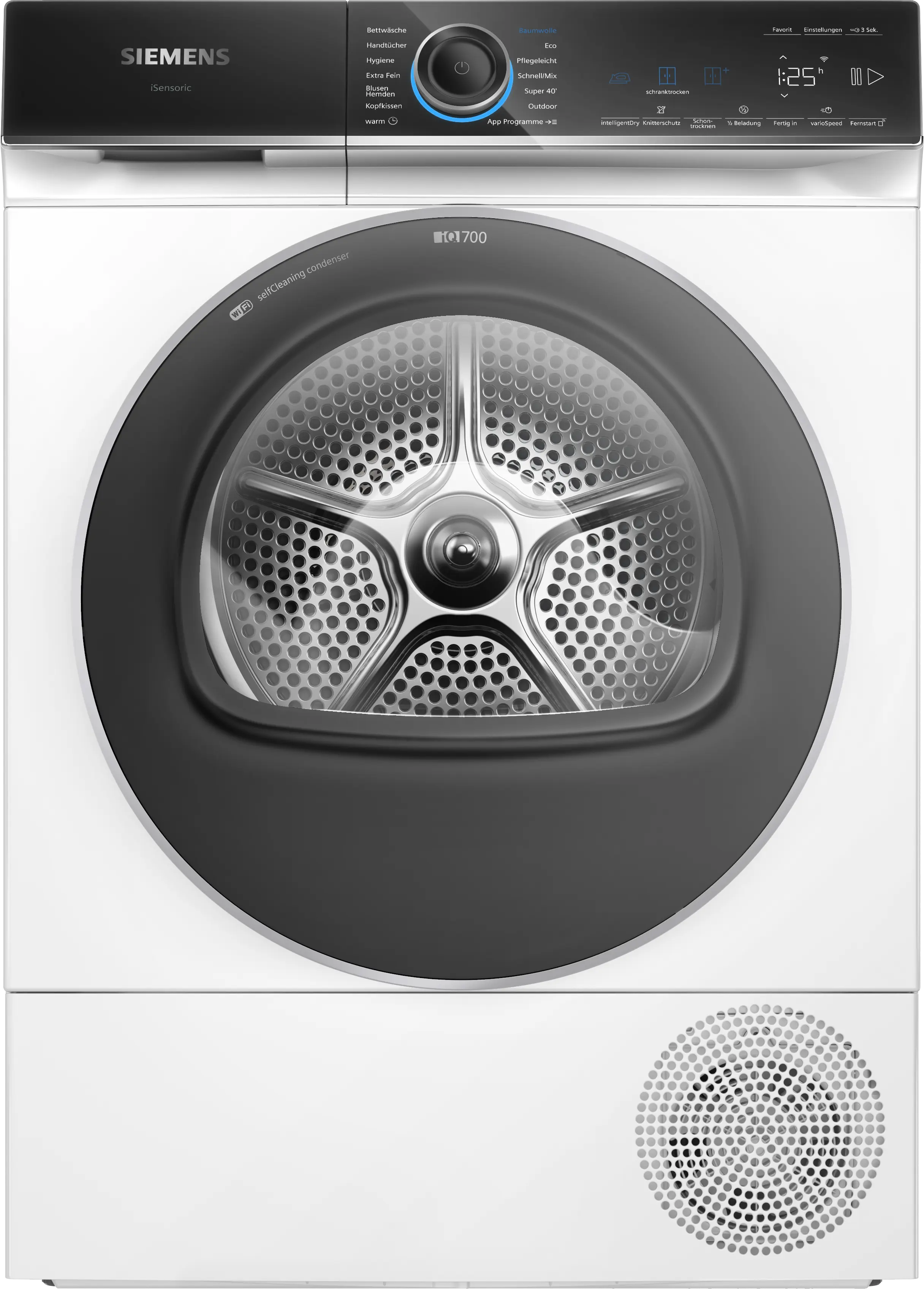
Most Efficient 9 kg: Siemens WQ46B2D41 iQ700
The efficiency pick, and the quietest machine here by a clear margin. It is rated class B at 0.92 kWh per cycle with 91% condensation efficiency, and runs at just 56 dB(A) — around eight decibels below the group norm, which is the difference between a dryer you can ignore and one you cannot.
It detects the load and adjusts, offers an add-laundry function and interior lighting, and integrates with Home Connect. Dimensions are 84 cm high, 60 cm wide and 61 cm deep, and it uses R290.
The trade-off is time: 4 hours 25 minutes at full load, the slowest of the six, dropping to 2 hours 40 minutes at half load. Efficiency and quietness are bought with patience.
Search Amazon UK · Search Amazon US
Best 8 kg Overall: Hisense DH3S802BW3
The sensible middle of the eight-kilogram field — class C, 1.02 kWh per cycle, 88% condensation efficiency, neither especially frugal nor wasteful. A full load takes 3 hours 8 minutes and a half load 1 hour 52 minutes, which is comfortably quicker than most here. Noise is 64 dB(A) and the refrigerant is R290.
Its real advantage is depth. At 55 cm it is the shallowest machine in this comparison, against the 60 to 66 cm of the others, so it leaves noticeably more room behind it — the difference between fitting a tight utility space and not. It offers a delay timer and an app. It does not have load detection.
Search Amazon UK · Search Amazon US
Best Value at 8 kg: Exquisit TWP 803 031D
The budget option, and honest about it. It uses 1.18 kWh per cycle, the highest figure here, with 82% condensation efficiency, also the lowest. A full load takes 3 hours 30 minutes, a half load 2 hours 10 minutes, and it runs at 65 dB(A) on R290. Dimensions are standard at 85 by 60 by 60 cm. One caveat on paper: the source material gives this machine's energy class inconsistently, so it is not stated here.
Missing are a delay timer, a condensate drain hose and an app. Present are drum lighting, a programme display with drying progress, and a refresh programme that cheaper dryers often omit.
Search Amazon UK · Search Amazon US
Most Efficient 8 kg: AEG TR9W75780
The efficiency leader overall, and unusually not at the cost of speed. It is rated class B, uses only 0.85 kWh per cycle — the lowest here — and reaches 91% condensation efficiency, while finishing a full load in 2 hours 59 minutes, the quickest of the six. A half load takes 2 hours.
It offers load detection, an app and a dedicated quiet programme, runs at 63 dB(A) and uses R290. At 66 cm it is the deepest machine in the group, and it has no condensate drain hose, so the tank needs emptying by hand.
Search Amazon UK · Search Amazon US
Heat Pump or Condenser?
Both types work the same way up to a point: cold air is heated and passed through the tumbling laundry, the resulting warm damp air is cooled, and the water that condenses out is collected in a tank. The difference is what happens to the heat. A condenser dryer heats all its air with electricity, every time. A heat-pump dryer recovers energy from the warm exhaust air and reuses it to warm the incoming air, which is why it uses roughly half the electricity of a conventional condenser machine.
The trade-offs are a higher purchase price and a longer cycle. Over the life of the machine the running-cost saving generally offsets the difference. Machines without a heat pump are now almost always older stock — and they may still carry the pre-rescale energy label, which is not comparable with the current one.
Other types exist — vented dryers, washer-dryers, drying cabinets and gas-heated machines among them — but the heat-pump and condenser designs are what dominate the market.
What to Look For
- Energy class and actual consumption. The class is a guide, not the whole story: two machines in the same class can differ appreciably in kilowatt-hours, and over ten years that gap compounds.
- Programme duration. Anything from under two hours to three and a half. Only compare times quoted for the same programme.
- Where it will live. Many machines can be built under a worktop, and some are stackable on top of a washing machine, which costs no floor space at all. Check depth as carefully as width.
- Noise. Important in a flat with no cellar or utility room. The dB(A) figure is on the energy label.
- Extras worth having. A remaining-time display, a delay timer and a brushless motor are the ones that earn their place. Much of the rest is decoration.
Getting Better Results for Less
- Spin the laundry hard in the washing machine first — ideally at 1,200 rpm or more. The drier it goes in, the less work the dryer does.
- Fill the drum well but not tightly. Overloading spoils the result; a near-empty drum wastes a cycle. Warm air needs room to circulate.
- Sort by fabric type. Cotton, synthetics and mixed fibres dry at different rates, which is how you end up with damp seams and over-dried shirts in the same load.
- Untangle everything before loading and close zips. Knotted bedding dries unevenly.
- Choose the programme made for the textile, and use an extra-dry setting for thick or layered items.
- Clean the lint filter after every cycle, and the heat exchanger or condenser as your model requires. A blocked filter costs you whole extra runs.
- Dryer balls help air circulate and stop items clumping, which shortens the cycle and softens the load.
Why a Dryer at All?
Line-dried laundry takes hours or days; a dryer takes one to two depending on programme and machine. Drying indoors on an airer raises humidity and with it the risk of mould, which means more ventilation. An airer also occupies floor space and blocks doorways, where a dryer can sit in a cellar, under a counter, or stacked on the washing machine. Towels come out noticeably softer. And there is the time you get back from not hanging anything up.
A Note on Model Codes
These are the exact machines the comparison ranked, and they are identified by their European model codes. British ranges from the same manufacturers frequently use different codes for equivalent machines, so a code here may not return a match in a UK retailer's catalogue. Nothing has been substituted: each entry links to a search for that exact model name rather than to a similar British machine, and because no exact listing was verified, no price or purchase link is quoted for any of them. If you are shopping in the UK, treat the specification pattern — class, kilowatt-hours per cycle, condensation efficiency, depth and noise — as the thing to match, rather than the code itself.
For the machine that fills the drum in the first place, see our guide to the best washing machines of 2026.