Vinyl's revival shows no sign of slowing, and a good turntable is what separates a warm, detailed spin from a flat, wobbly one. The heart of the decision is how the platter is driven — belt or direct drive — and how good the tonearm and cartridge are that ride the groove. An extensive group test of 32 turntables ranged from stripped-back budget decks to serious hi-fi machines, and these are the best you can actually buy in the UK today, checked against current prices.
What to Look For
Drive type is the first fork in the road. Direct-drive decks, where the motor axle feeds straight into the platter, hold their speed rock-steady and get up to speed instantly — which is why they rule in clubs and among DJs. Belt drive, where a rubber belt isolates the platter from motor vibration, is the traditional hi-fi route and tends to run quieter for pure listening. Neither is inherently "better"; they suit different jobs.
The tonearm and cartridge do the delicate work. The arm must follow the cartridge friction-free while absorbing a surprising amount of mechanical energy: the vibrations cut into vinyl at 10,000 Hz deflect the stylus by less than two micrometres, so stiffness and low resonance matter enormously. A quality factory-fitted cartridge — an Ortofon 2M Red is a common benchmark on good decks — saves you an immediate upgrade.
Connections trip up more first-time buyers than anything else. A turntable outputs a tiny "phono" signal that must be boosted by a phono preamp before your amplifier can use it. Some decks build that preamp in and can switch between phono and line output, so they plug into any stereo; others, like many purist models, have no preamp and need either an amplifier with a dedicated phono input or a separate phono stage. Check this before you buy, or you will hear nothing.
Platter mass, feet and features. Heavier is generally better: a weightier platter stores more flywheel energy and holds pitch more steadily. Many budget decks share nearly identical thin aluminium platters weighing 500 to 600 grams, and their thin felt mats add little; a rubber mat, as Audio-Technica fits, can add 200 grams and helps. Height-adjustable feet, a dust cover, and adjustable tracking force and anti-skating at the arm all count. Finally, decide between manual and fully automatic: automatics lower and lift the arm for you at the press of a button, which suits anyone who wants fuss-free play.
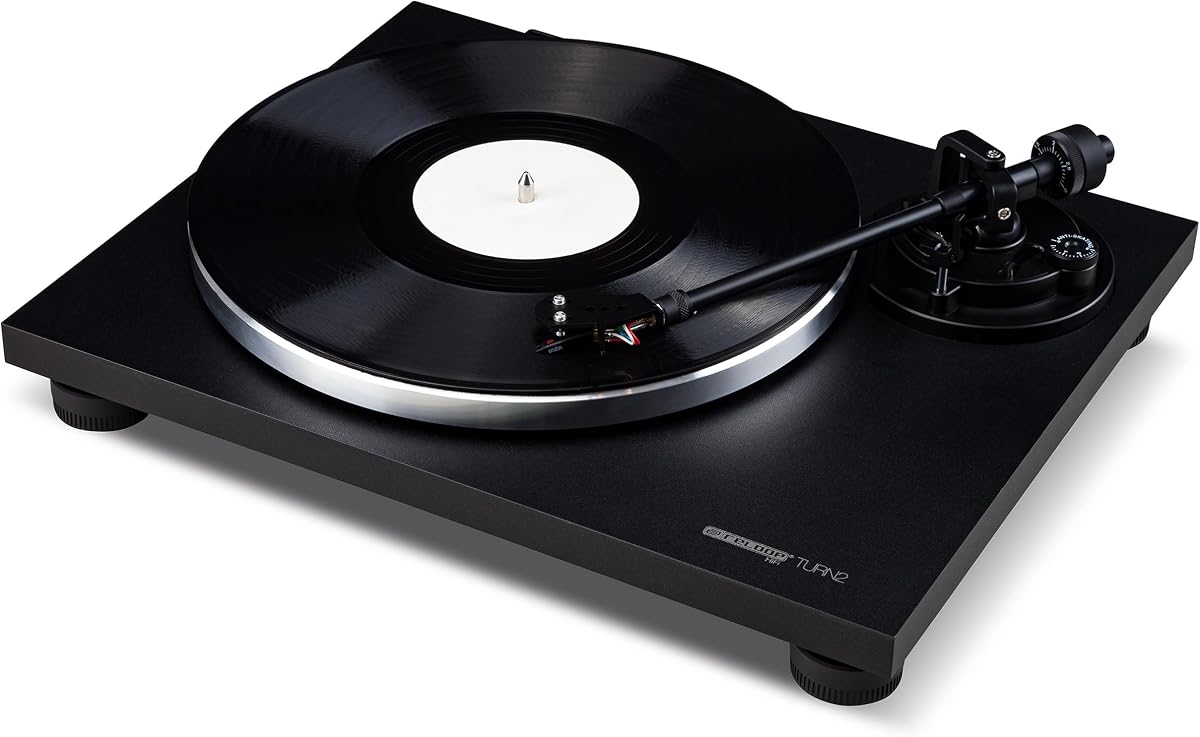
Best for Most: Reloop Turn 2
The value champion here is the Reloop Turn 2. It is successfully pared back to the essentials: there is no built-in preamp, so you will need an amplifier with a phono input, but it avoids the worst budget compromise by letting you switch speed from a hidden side control rather than moving the belt by hand. What lifts it above its price is the tonearm — genuinely very good for the money — paired with a comparatively high-quality fitted cartridge. The drive runs quietly and unobtrusively, and the sound is balanced, powerful and clean in a way few rivals near its price manage. For most people starting a serious vinyl setup, this is the one to buy. Check the price on Amazon UK · Search Amazon US
Best Step-Up: Pro-Ject Debut E Carbon
Pro-Ject's Debut is a long-running classic of affordable hi-fi, and the current carbon-arm version — sold in the UK as the Debut E Carbon — is the refined pick for listeners who want more. Its standout is the one-piece carbon tonearm, stable and beautifully bearinged, topped with a factory-fitted Ortofon 2M Red cartridge that punches above the price. The motor sits in a collar of highly damping polymer and is fed a synthesised AC supply for a smooth, quiet run, so motor vibration is practically inaudible. Build quality is clean and the whole deck feels a cut above budget rivals. If the Reloop is the sensible starting point, this is the natural upgrade. Check the price on Amazon UK · Search Amazon US
Best Direct-Drive: Technics SL-1200 MK7
For rock-steady speed and DJ-grade durability, nothing here matches the Technics SL-1200 MK7. Technics pioneered the direct-drive turntable, and this is the current incarnation of the deck that has ruled club booths for decades: instant start-up, unwavering pitch, and a build made to be leaned on. It is overkill for casual listening and it costs accordingly, but if you scratch, beatmatch or simply want the last word in speed stability — and a Technics you can actually order today — this is it. Check the price on Amazon UK · Search Amazon US
The Test Winner: Technics SL-1500C
The group test's overall winner was the Technics SL-1500C — effectively the "civilian" version of the SL-1210 MK7 DJ deck, trading the pitch fader and display for a very good Ortofon 2M Red cartridge and a tight, clean, clearly detailed hi-fi sound. The catch for UK buyers is retail: it is stocked by specialist hi-fi dealers rather than on Amazon UK, so you will need to seek it out through those channels rather than the mainstream picks above. There is no merely-similar Technics substituted in its place here — if the SL-1500C specifically is what you want, buy it from a hi-fi specialist.
How to Choose
Start with your system. If your amplifier lacks a phono input you either need a deck with a built-in preamp or a separate phono stage — sort that first. Then match the deck to your use: for straightforward home listening on a budget the Reloop Turn 2 is hard to beat; for a better arm, cartridge and finish the Pro-Ject Debut E Carbon is the step up; and for DJ use or absolute speed stability the Technics SL-1200 MK7 is the icon. Prioritise a good tonearm and cartridge over cosmetic extras, remember that a heavier platter helps pitch stability, and add a dust cover if one is not included — vinyl and dust are old enemies.
Verdict
For most buyers the Reloop Turn 2 is the smart choice: a fine tonearm, clean balanced sound and none of the usual budget compromises, provided you have a phono input. Step up to the Pro-Ject Debut E Carbon for its carbon arm and Ortofon cartridge, or to the Technics SL-1200 MK7 for unbeatable direct-drive stability. The test's outright winner, the Technics SL-1500C, remains a superb hi-fi deck if you buy it from a specialist. Get the drive type and the phono connection right, and any of these will do vinyl justice.
Research sources
Sources recorded for this page are linked below. Reported third-party testing belongs to the original publisher; it is not testing performed by Truthful Reviews.