Alloy wheels are the first thing on a car to look neglected and the last thing to come clean. Road film and winter salt settle on them within a few drives, and dark brake dust does worse than settle: over time it bakes into the finish. A sponge and a bucket of water will not shift it, and neither will a trip through an automatic wash, which leaves the wheels grubby while the paintwork comes out gleaming. Almost nothing on a car clings as stubbornly as brake particles.
That is what a dedicated wheel cleaner is for. A good one loosens the dark grey deposits on its own, so the job is spray, wait, rinse, rather than a long session on your knees with a brush. This guide covers a test of 25 of them, and it is mostly a story about one measurable thing: how much scrubbing is left once you have rinsed the product off.
What follows is recorded testing, translated. Nobody at Truthful Reviews has sprayed any of these on a wheel. This page describes cleaning results and materials behaviour only, and it makes no health or safety claim about any product in it.
What to look for
Whether your wheels are steel, aluminium or chrome, the recorded advice is to choose an acid-free specialist cleaner wherever possible. It should not be alkaline either. A pH-skin-neutral formulation is the best of the lot.
The reason is materials compatibility. Alkaline and acidic cleaners always carry a risk of attacking parts of the car — the wheel itself, the wheel bolts, the paintwork, plastic trim and the tyres. That is why the test ran a separate materials programme alongside the cleaning work, and the headline finding there is reassuring: nearly all of the cleaners tested left aluminium, stainless steel, rubber and car paint untouched. There are exceptions, and they are named below.
The second thing to look at is the dwell time, because it is the number that decides how the job feels. It runs from 15 seconds at one extreme to 3 to 10 minutes at the other, and it has to be observed properly — neither cut short nor stretched out. Many products take the guesswork away with an indicator: the liquid turns reddish or violet once it has reacted with the dirt, and that colour change is the cue to reach for the pressure washer.
Third is how the liquid behaves once it is on a vertical surface. Thin, watery cleaners run straight down the face of the wheel and spend their dwell time somewhere near the tyre bead rather than on the dirt. The foams and the slightly gel-like formulas cling, and in the test that difference showed up directly in the results.
How the cleaning actually goes
The recorded routine is straightforward. Knock the loose dirt off first with a pressure washer, then dry the wheel with a cloth or paper towels so the cleaner is not immediately diluted. Apply the product as the maker directs — for all of these that means spraying it onto the wheel — and always onto a cool wheel, never a hot one. Let it work for the stated time, or until the indicator changes colour.
After that, a wash mitt or a sponge does the mechanical part, and an old toothbrush is the tool for the gaps between the spokes. Rinse everything off with a pressure washer or a hose. One thing the test is firm about: do not use a scouring pad on brake dust, because aluminium wheels scratch very easily. Dry the cleaned wheel with a soft cloth. If you want to make the next clean easier, a wheel sealant sprayed or wiped on at the end will keep the finish protected until then.
One shared trait is worth knowing before you buy: almost every wheel cleaner in this test smells strongly unpleasant. There is a chemical reason for it. Most of these products contain sulphur as part of the indicator system, and sulphur is what gives them their rotten-egg character.
Another oddity that has nothing to do with a faulty product: a wheel cleaner can occasionally leave brown marks on the tyre. Tyre rubber contains carbon black and UV-protection waxes, and a strong cleaner can in rare cases draw some of that out, leaving the brownish wax visible on the sidewall. A tyre dressing removes it, and it fades on its own after a few washes.
The picks
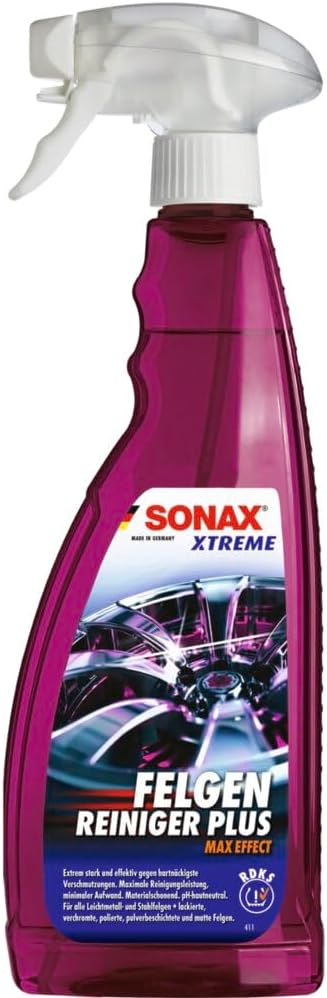
Top pick — Sonax Xtreme Wheel Cleaner Plus
The best wheel cleaner in this test, and the one that asks least of you afterwards. It makes short work of baked-on brake dust and stubborn grime: spray it on, let it dwell briefly, rinse it off, and wheels in a wide range of finishes come back to life. In most cases you can leave the brush and the sponge in the bucket entirely, because it does the dirty work by itself.
It is not fussy about what it goes on. The maker lists it as suitable for steel, aluminium and light-alloy wheels alike, as well as painted, chrome-plated and polished ones, and states that it attacks neither the wheel surface nor the wheel bolts. Wheels with tyre-pressure monitoring sensors are no obstacle either. The liquid starts out transparent and is pH-neutral.
Sonax describes a citrus note. Arriving at citrus takes a good deal of imagination — like most of the field, the Xtreme smells sharp and unpleasant.
The dosing head opens and closes with a quarter turn. When the word STOP is showing on top, the trigger is blocked and nothing can escape the bottle. The plastic bottle is not among the sturdiest here, though nor is it flimsy enough to worry about deforming. It was tested in the 750 ml bottle; 500 ml and 1 litre bottles exist, and there is a 5 litre container for anyone getting through a lot of it.
Dwell time is 3 to 5 minutes per wheel. Like almost every maker in this field, Sonax has fitted an indicator, and it turns violet once the liquid has been on the wheel long enough. Spraying an even coat on is quick and effortless and the cleaner clings to the surface well.
In the practical run it took just 3 minutes for the cleaner to go dark violet. The pressure washer took the residue off, and the result stood up immediately with no follow-up work at all: a newer aluminium wheel came out gleaming as though it were new, and the older wheel of a 34-year-old Mazda MX-5, with brake dust and dirt eaten well into the surface, came back looking markedly fresher and properly clean.
The material samples — aluminium, stainless steel, car paint and rubber — came through a soak in it undamaged. Excellent cleaning power, uncomplicated handling and high materials compatibility, with the unpleasant smell as the only real objection.
Search Amazon UK · Search Amazon US
The equal on cleaning power — Dr. Wack P21S High End Wheel Cleaner
Whether the wheels are aluminium, chrome or steel, this one dissolves even the coarsest dirt effortlessly and makes manual follow-up unnecessary in most cases. It combines high cleaning power with a simple application, and the maker lists it for every type of wheel, painted or anodised aluminium included, with no ill effect on tyre-pressure monitoring sensors either.
The cleaner is pH-skin-neutral, gluten-free and biodegradable. It arrives in a sturdy plastic bottle that does not deform even when it is nearly empty and you squeeze it. Detailed application and ingredient information is printed on the bottle, though the type is small enough that you have to look closely.
The spray head turns without effort. Dr. Wack has fitted an indicator: the whitish-transparent liquid turns violet once the dwell time is up. The stated dwell time is 3 to 5 minutes — that is how long it needs to react with the dirt and lift it off the wheel. Spraying is quick and the mist is even. It looks quite runny at first, but it clings very well and the slightly gel-like consistency means comparatively little of it drains away.
After just under 5 minutes in the test it had gone dark violet. The pressure washer removed the residue without effort, and no sponge or brush was used — the point of the test being to find out how effective these cleaners are with no manual help at all. The result was outstanding. Even under very close inspection nothing was left on what had been a dirty wheel: brake dust and grime gone, a perfectly cleaned surface behind them.
The material samples came through it as cleanly. Aluminium, stainless steel, paint and rubber all showed no surface change and no residue after 48 hours of immersion.
Search Amazon UK · Search Amazon US
The foam — Nigrin Performance Turbo Wheel Cleaner
Where almost every other cleaner here is a liquid, this one is a white foam. It lands on the dirt like a fire blanket and goes to work without compromise, and because it is foam it stays exactly where you put it.
It is pH-skin-neutral and acid-free, and the maker lists it for every type of wheel — aluminium, steel and chrome. It is sold as a set of two 500 ml bottles, which between them will clean a good number of large wheels.
The white foam sprays on quite precisely, holds firmly to the upper face of the wheel and is self-acting. After roughly 3 minutes it turns violet. A single quick pass with the pressure washer was enough for a perfect result: no dirty residue whatsoever, and follow-up work needed only in spots, if at all. The foam binds all the dirt and carries it away.
It left no marks on the material samples, so materials compatibility is very good. It does not manage without an acrid smell either. Taken as a whole, a clear recommendation.
Search Amazon UK · Search Amazon US
Also tested
Tuga Chemie Alu-Teufel Spezial — cleans a shade less well than the recommendations, and is the low-cost option in the field. The maker lists it for steel, aluminium and chrome, for polished and matt wheels and even for hubcaps. The green liquid is acid-free and pH-skin-neutral. Detailed handling information is printed on the bottle at a legible size; the plastic is fairly soft and gives, which you notice more as the bottle empties. A small black bar pushes up to lock the trigger. Application is much like the rest: spray on, wait 3 to 5 minutes or until it turns violet, rinse. The result was fine in principle — only under very close inspection were minimal deposits visible in places, and a brush or sponge removed them instantly. The material samples came away unmarked. Search Amazon UK · Search Amazon US
Liqui Moly Wheel Cleaner Spezial — usefully fitted with a dirt indicator that turns violet once the dwell time is up, which here is a longer 5 to 7 minutes. Sold in a grey 1 litre bottle. Acid-free, biodegradable and comparatively low on smell. A plastic lock has to be removed from the spray head before first use. It suits aluminium and steel wheels, clings well and forms an even film. After a 7 minute wait and a rinse there was still a light layer of dirt on the wheel, unlike the Dr. Wack and Sonax results, though a sponge and water took it off without much effort. It left no marks on aluminium, stainless steel, plastic or car paint. A decent cleaner that cannot quite match the best on cleaning power. Search Amazon UK · Search Amazon US
Armor All Wheel and Tyre Cleaner — supplied in a 500 ml spray bottle. The maker gives almost nothing away about the ingredients, so there is no telling whether it is acid-free. All that is printed is an instruction not to apply it to brake components or to other zinc- or cadmium-coated surfaces, and to contact the maker before using it on motorcycles or on uncoated, polished aluminium. The stated dwell time is a very short 30 seconds. The nozzle opens and closes easily and aiming and dosing were no trouble, but the transparent liquid runs down the wheel very quickly where several rivals cling better; it is advertised with a foaming action that does not really materialise. After 30 seconds and a rinse there was still a clear film of dirt, removable by hand with a sponge, water and a final pass with the pressure washer. It harmed neither the test sheets nor the paint and plastic samples, and came off cleanly after 48 hours. Wheels do come clean, but others work more effectively without help. Search Amazon UK · Search Amazon US
Sisbrill V60 Sport — a pH-neutral cleaner with neither acid nor alkali, in a 1 litre bottle. Annoyingly, the white plastic bottle deforms badly as soon as it is no longer full, and the liquid smells unpleasant. Reading the instructions needs very good eyesight or strong glasses: the type is tiny and the curve of the bottle does not help. Dosing and spraying are as simple as with a window cleaner. The white, foam-like liquid clings well. Sisbrill states 3 to 5 minutes, and in the test it began turning violet quite quickly; the retail listing adds that it can stay on for up to 30 minutes without drying out. After 4 minutes and a rinse it was clear there was work left to do, and manual scrubbing was required. The end result is good, but only with the owner's help if you stick to the stated 3 to 5 minutes. Nothing to criticise on materials: every sample looked exactly as before after 48 hours. Search Amazon UK · Search Amazon US
Meguiar's Hot Rims All Wheel Cleaner — the shortest dwell time in the test at 15 seconds, printed on a small leaflet stuck to the bottle, which holds a little over 700 ml. The maker states that it is not suitable for wheels that have been anodised, repainted or powder-coated after the fact, and it is not acid-free. The spray head is poorly conceived: the rotating mechanism that opens and closes the nozzle is extremely stiff and awkward. The contents cling to the wheel without trouble. After 20 seconds and a rinse the dirt had not come away on its own and the face of the wheel had to be scrubbed by hand. Plastic and paint were unaffected, but the stainless-steel sample carried clear marks after 48 hours in it — a grey veil in two broad stripes that could not be washed off — and the reaction on the aluminium sheet was worse still, with the surface properly attacked. The maker's own label states that it can be corrosive to metals. On that basis it is not recommended. Search Amazon UK · Search Amazon US
Urban Forest Premium Wheel Cleaner — you can smell this one from a distance, and the smell is extreme; even standing indoors with the spray head open it leaves a trail. A 1 litre bottle of the reddish liquid, though the plastic is very flimsy and the spray head does not look robust either. The acid-free formula is listed for aluminium, steel and chrome wheels. The dwell time of 3 to 10 minutes is above average, and the consistency is quite runny. The active indicator is meant to turn the cleaner reddish once it starts lifting the dirt, but the product's own red-violet colour makes that hard to spot. After 5 minutes and a rinse a thin layer of dirt was still visible; a sponge and light pressure produced a very good result. Dirt-lifting power is beyond reproach — the bottle, the spray head and the long dwell time are the objections. Search Amazon UK · Search Amazon US
Kärcher Premium RM 667 — sold in two versions, in a black and in a transparent plastic bottle; the black-bottle version was tested. Suitable for steel and aluminium wheels, acid-free, and meant to dwell for up to 3 minutes. The whitish-transparent substance is quite runny and carries an indicator, which took around 3 minutes to turn violet. A wipe-over is needed to lift all the dirt, but the result is impressive: where a black mass had made the wheel unsightly, it shines like new. Supplied in 500 ml. It left no lasting marks on the stainless steel, aluminium, plastic or car-paint samples, so it can be bought without hesitation. Search Amazon UK · Search Amazon US
Sonax FelgenStar — listed for steel wheels and painted aluminium wheels, and aimed at baked-on brake dust, rubber and oil residue and general road grime. Acid-free, in a 750 ml bottle. It comes in a sturdy plastic bottle of the sort familiar from glass cleaners; the spray nozzle you twist to open and close is the weak point, being too flimsy for easy handling. Pleasantly, it does not stink as badly as most of the field. The pink liquid is very runny but wets the surface evenly. Sonax quotes 3 to 5 minutes and fits no indicator here, so the test waited the full 5 minutes. It is not quite as effective as the FelgenBeast: the dirt was fully released from the wheel, but a sponge and a little hand pressure were needed afterwards to lift the last of the residue — though it does enough of the groundwork that this takes no effort. It passed the materials test easily, with no lasting marks on the aluminium or stainless sheets, the paint or the rubber. Search Amazon UK · Search Amazon US
Liquid Elements Dust Cracker — a 1 litre bottle with a spray head. The liquid is acid-free and, with a pH value of 6.3, skin-neutral, and it is listed for every wheel type: chrome, alloy, steel, high-gloss, powder-coated or painted. Liquid Elements has added high-grade surfactants to raise the cleaning power. It has the typical unpleasant smell, though several rivals are worse. Application is simple: spray onto cool wheels and allow 3 to 5 minutes. The adhesion of the runny liquid could be better. The performance indicator turned violet quickly, and after 3 minutes the wheel had changed colour. Rinsing removed the violet fast, but the cleaning result did not fully satisfy: baked-on brake dust was still on the wheel and mechanical follow-up was needed. Materials compatibility showed no deficiencies across paint, stainless steel, aluminium and rubber. For a perfect result, use a different cleaner or pick up the brush. Search Amazon UK · Search Amazon US
Nigrin EvoTec Wheel Cleaner — very similar to the Performance Turbo recommendation, and likewise an active foam with a dirt indicator, but filled into a sturdy light-metal can with a spray head rather than a plastic bottle. Before first use a transport lock has to be snapped off and the small spray tube folded up; it folds back down for transport and storage. The can holds 500 ml, and the two-bottle Performance Turbo set offers distinctly better value. The foam clings outstandingly well, and after 5 minutes the violet colour signals that the work is done. The test wheel came out completely clean. The only irritation is that the cleaner keeps dripping from the spray tube after use, so it is worth standing it on something. Otherwise it can be bought without hesitation. Search Amazon UK · Search Amazon US
Sonax FelgenBeast — Sonax does not oversell this one: its cleaning effect really is on a level with the Dr. Wack P21S, and dirt genuinely does not stand a chance. A 1 litre bottle. It is listed for all steel and light-alloy wheels and for painted, chrome-plated, polished and matt finishes, is acid-free and pH-skin-neutral, and Sonax states that neither the wheel surface nor the wheel bolts are attacked. It comes in a window-cleaner-style spray bottle with the key handling instructions printed on the back — small type, but just about legible. The mist doses reasonably. Twisting the nozzle opens and closes it with a little effort, and the printed word "Off" tells you at a glance whether the bottle is ready to use. The liquid is thin and runs down the wheel quickly at first, yet still covers the sprayed area evenly. The stated dwell time is 3 to 5 minutes, and an indicator turns it reddish to show when the loosened dirt can be rinsed away. Cleaning performance was very satisfying: the whole surface came out spotless, all the dirt removed, no residue anywhere, and no manual follow-up needed. The material samples survived permanent contact with it without a trace. A top recommendation in its own right. Search Amazon UK · Search Amazon US
Frischer Professional Alurex Blood Wheel Cleaner — sold as a complete set with a wheel brush alongside the 500 ml bottle; a 1 litre bottle without the brush is also offered. The label states that it is made in Poland. The smell does not differ much from the rest of the field. The supplied spray head has to be screwed onto the bottle first. It is listed for all types of steel and light-alloy wheel, including painted, chrome-plated, polished and matt finishes, and there is no indication of whether it is acid-free. The dosing head rotates, and in two positions no liquid comes out even if the trigger is pulled, though there is no mechanical lock to stop the trigger travelling. It spreads precisely and evenly on the wheel. The brush was deliberately left unused so the cleaner could be compared with the rest of the field on equal terms. After 3 minutes the liquid turned reddish, dwell time complete, and the residue was rinsed off. What was left was an almost entirely clean wheel — two small spots needed working by hand, and the deposits there came away effortlessly. It left no lasting marks on aluminium, stainless steel, rubber or paint, so there is nothing to argue against it. Search Amazon UK · Search Amazon US
Gentlemonkeys Wheel Cleaner — a pH-neutral cleaner that manages without acid, sold in a 500 ml bottle and a proportionally better-value 1 litre version. The black bottle has a dosing head with a lock so the liquid cannot escape unintentionally. It is listed for all types of wheel, aluminium, steel and chrome among them. The material samples — aluminium, stainless steel, rubber and paint — came through hours of immersion without residue. Handling is simple, the liquid sprays on fast and adhesion is decent. It takes a little longer than most before the indicator changes colour: the maker states 5 to 10 minutes, and the test saw the reddish tint after around 5 minutes. After the pressure washer, only isolated dark deposits remained in the corners of the wheel, and a brush lifted them without much effort. Cleaning power is marginally below the Sonax and Dr. Wack recommendations, but it has no weakness worth naming. Search Amazon UK · Search Amazon US
Tuga Tec Wheel Cleaner Premium — supplied in a sturdy plastic bottle holding 500 ml. The dosing head has a locking bar that has to be pulled down before the head is released for use. It is listed for aluminium, chrome and steel wheels, and the maker advertises it as pH-skin-neutral, from which it can be assumed to be acid-free. It stinks, and smells very unpleasant indeed. Precise dosing and even coverage are no problem, and it clings well rather than immediately thinning out towards the ground. The stated dwell time is 3 to 5 minutes; 4 minutes in, the indicator had already turned a deep violet. Rinsed off with a medium-pressure washer, and as soon as the water had dried it was clear that more work was needed — deposits still covered the wheel, though a soft cloth removed them without force, after which a final rinse and a dry left an excellent result. It left no residue on the plastic or on the test sheets. Even so, it does not earn a recommendation. Search Amazon UK · Search Amazon US
Koch Chemie Reactive Wheel Cleaner — sold as a reactive, acid-free cleaner with a performance indicator and gloss additives, in a 750 ml soft plastic bottle. The dosing head twists shut at the front to stop accidental spraying, and peeling back the label reveals the same instructions printed in further languages. It is not odourless but does not stink as pungently as many rivals. Sprayed onto a cool wheel it foams strongly and clings well, and handling is uncomplicated. The maker gives an optimum dwell time of 2 to 5 minutes; after 4 minutes the foam had turned reddish. A medium-pressure washer removed it effortlessly and completely, but the wheel was not quite as clean — dark brown deposits were still visible, though a sponge and a little water dealt with them without difficulty, after which the dried wheel shone like new. The material samples of plastic, car paint, aluminium and stainless steel survived a 48 hour bath undamaged. It falls short of a top result, though the cleaning performance satisfied even with the manual follow-up. Search Amazon UK · Search Amazon US
Koch Chemie Magic Wheel Cleaner — a second Koch Chemie cleaner very similar to the Reactive, and possibly the same substance; the 750 ml plastic bottle has a spray head that locks, useful if it is stored in a boot. It suits light-alloy and painted wheels as well as chrome and steel, and with a pH value of 5.5 it is acid-free. Special dispersing agents are meant to lift stubborn dirt gently from the surface, while the reactive component goes after iron particles — brake dust, in other words. It doses well, foams strongly and clings beautifully, quickly building a dense mat across the top of the wheel, and the smell is not especially noticeable. Koch Chemie states 2 to 5 minutes; after 4 minutes it had turned violet, and the medium-pressure washer removed it without residue. Light deposits were left behind, but they did not sit firmly and a sponge cleared the brown discolouration quickly. The test sheets came through it undamaged. Search Amazon UK · Search Amazon US
Stone Crusher Wheel Cleaner — designed for steel, aluminium and alloy wheels, and the smallest bottle in the test at just 250 ml, which is worth noting. The black trigger feels a little flimsy; turning a small plastic bar locks it so the liquid cannot escape unintentionally. The label is comparatively uninformative and the product is acid-free. No exact dwell time is given, the only guidance being to let the product work "for a certain time". Although the cleaner is very runny it clings well to the wheel, and dosing and spreading it evenly are no trouble. Left on for 4 minutes, the violet indicator showed it was working. The smell is restrained — no need to hold your nose. A strong jet of water removed it completely from the aluminium wheel, leaving smaller brown deposits clearly visible and the surface still dirty, but with the brake dust already effectively loosened: a sponge, a little water and minimal pressure removed the residue entirely and the wheel came up very clean. The material sample came through without criticism. Above-average overall. Search Amazon UK · Search Amazon US
How they were assessed
The test examined cleaning performance, the handling and quality of the spray bottles, the dwell time and the materials compatibility of each product. Two heavily soiled sets of aluminium wheels were used for the cleaning work. The wheels were divided into segments with masking tape so several cleaners could be compared on the same wheel, and untreated segments were covered over as well.
The wheels were not pre-treated. Each cleaner was applied as its maker directed and left for the recommended dwell time, then rinsed off with a pressure washer. After the wheels had air-dried, the cleaning effect was judged: how far the wheel was already clean, and how much manual work with a sponge and water was still needed.
Materials compatibility was tested separately, on stainless steel and aluminium sheets and on ribbed plastic. The sheets were half coated in car paint. Every sample lay in its respective cleaner for 48 hours, after which the samples were rinsed with water and dried so any change to the surfaces could be assessed.
The short answers
Which wheel cleaner is the best? The Sonax Xtreme Wheel Cleaner Plus. In this test it dissolved even the coarsest dirt effortlessly and made manual follow-up unnecessary in most cases. There are interesting alternatives, chiefly the Dr. Wack P21S High End Wheel Cleaner and the Nigrin Performance Turbo Wheel Cleaner.
How long does a wheel cleaner need to dwell? Every maker states a dwell time, and it ranges widely across this field — from 15 seconds to 3 to 10 minutes. With products that carry an indicator, the liquid turns reddish or violet by itself, and that is the point at which it can be rinsed off with a pressure washer.
Do wheel cleaners damage the wheels? Acid-free, pH-neutral and non-alkaline cleaners normally leave the wheels, the car's paintwork and rubber parts unharmed. That held for nearly every product in this test, with the 48 hour immersion results identifying the exceptions.
Why can a wheel cleaner leave brown marks on the tyre? Tyre rubber contains carbon black and UV-protection waxes among other things. The cleaning action can in rare cases draw carbon or ageing-protection compounds out of the rubber, making the brownish wax content visible. A tyre dressing removes the discolouration, or it disappears by itself after a few car washes.
Why do nearly all wheel cleaners smell so strongly? Most of them contain sulphur as part of the indicator system, which is where the rotten-egg smell comes from.