Quick Specs
Our Verdict
A near-miracle cure for blunt knives: correct angles for everything from sushi to survival blades and excellent results throughout. Buy the ProSharp for mixed knife collections; the fixed 20-degree OneSharp suits European-only kitchens.
Research sources
Sources recorded for this page are linked below. Reported third-party testing belongs to the original publisher; it is not testing performed by Truthful Reviews.
Our editorial process
Research method, author and affiliate-independence details
Our editorial process
Research method, author and affiliate-independence details
Prepared by our editorial team using verified source material, product research, and a British-English editorial rewrite before publication.
- We review the working bundle for product facts, comparisons, and buyer-relevant tradeoffs before publishing.
- Non-English source material is translated into British English and rewritten into our house style without carrying over publication branding.
- Affiliate links and price references are handled separately from editorial judgements and never determine the verdict.
Read our full methodology: how we review
Affiliate links never determine our verdicts. Commercial relationships are disclosed separately from the editorial assessment, and we aim to keep buyer guidance clear, specific, and evidence-based.
Pros & Cons
Pros
- Excellent results on every knife type tested
- Adjustable angle: 15/18/20/22/24 degrees per side
- Dedicated slots for bread knives and scissors
- Very stable, well-made housing with rubber pads
- Fine-honing slot deburrs after sharpening
Cons
- Wrong angle choice can damage a blade - read the dial carefully
- Housing inevitably collects nicks from blade withdrawal
- Angle markings are hard to read
- First pass on blunt knives is loud
Key Features
Excellent results on every knife type tested
Adjustable angle: 15/18/20/22/24 degrees per side
Dedicated slots for bread knives and scissors
Very stable, well-made housing with rubber pads
Fine-honing slot deburrs after sharpening
Cooking with blunt knives is no fun, is genuinely dangerous and damages your ingredients. Cutmore's ProSharp and OneSharp promise to make worn cutting edges a thing of the past, restoring knives of all kinds in seconds. Both pull-through sharpeners went through an extensive test.
Why a Sharp Knife Matters
The case for sharpening goes beyond effortless slicing. A blunt knife is more dangerous than a sharp one: forcing it through food invites slips and cuts, while a sharp blade gives control throughout the stroke. Food quality benefits too — a sharp edge severs cells cleanly where a blunt one crushes them. Onions are the obvious example: a blunt knife means streaming eyes and bitter, bruised flesh, while herbs lose their essential oils into the chopping board and meat and fish suffer crushed cell structure. Regular sharpening even extends a knife's life, since less material needs removing each time and the edge geometry survives longer. And a sandwich topped with paper-thin ripe tomato and finely chopped — not crushed — chives makes the difference deliciously obvious.
How to Sharpen Properly
The blade should be clean and undamaged — grease and moisture impair the grind — and the sharpener needs a firm, level, non-slip surface. Good pull-through sharpeners let you choose the angle; quality knives state theirs on the packaging, and when in doubt, choose the larger angle and the gentler grind. The single most important thing is not speed but holding the same angle throughout: seat the knife centrally in the slot and draw it through from heel to tip with even, light pressure, never tilting, never sawing up and down, always pulling in one direction. After sharpening, a fine burr can remain on the edge — quality devices include a fine-honing slot to remove it, which is also worth running between full sharpening sessions.
Sharpening or Honing?

These are sharpeners, not honing tools — an important distinction. Honing straightens the microscopically fine edge that folds over in use, removing no material, and only works while a knife retains basic sharpness. Sharpening removes material in a controlled way to build a new edge on a blunt blade — exactly what these pull-through devices do.
A Question of Angle
The grinding angle determines the balance between sharpness and stability, and every knife has its intended angle. Around 15 degrees per side characterises Japanese knives — sushi blades cannot be sharp enough, but such edges chip more easily and should be used strictly for purpose. 17-18 degrees is the established compromise for premium blades such as Damascus knives; 20 degrees is the standard for European kitchen knives, balancing sharpness with robustness and forgiving rougher handling; 22 degrees suits sturdier blades and cleavers; 25 degrees and beyond is for outdoor and hunting knives or hatchets. A stainless-steel angle gauge costs under ten euros if you want certainty about your own knives.
Cutmore ProSharp

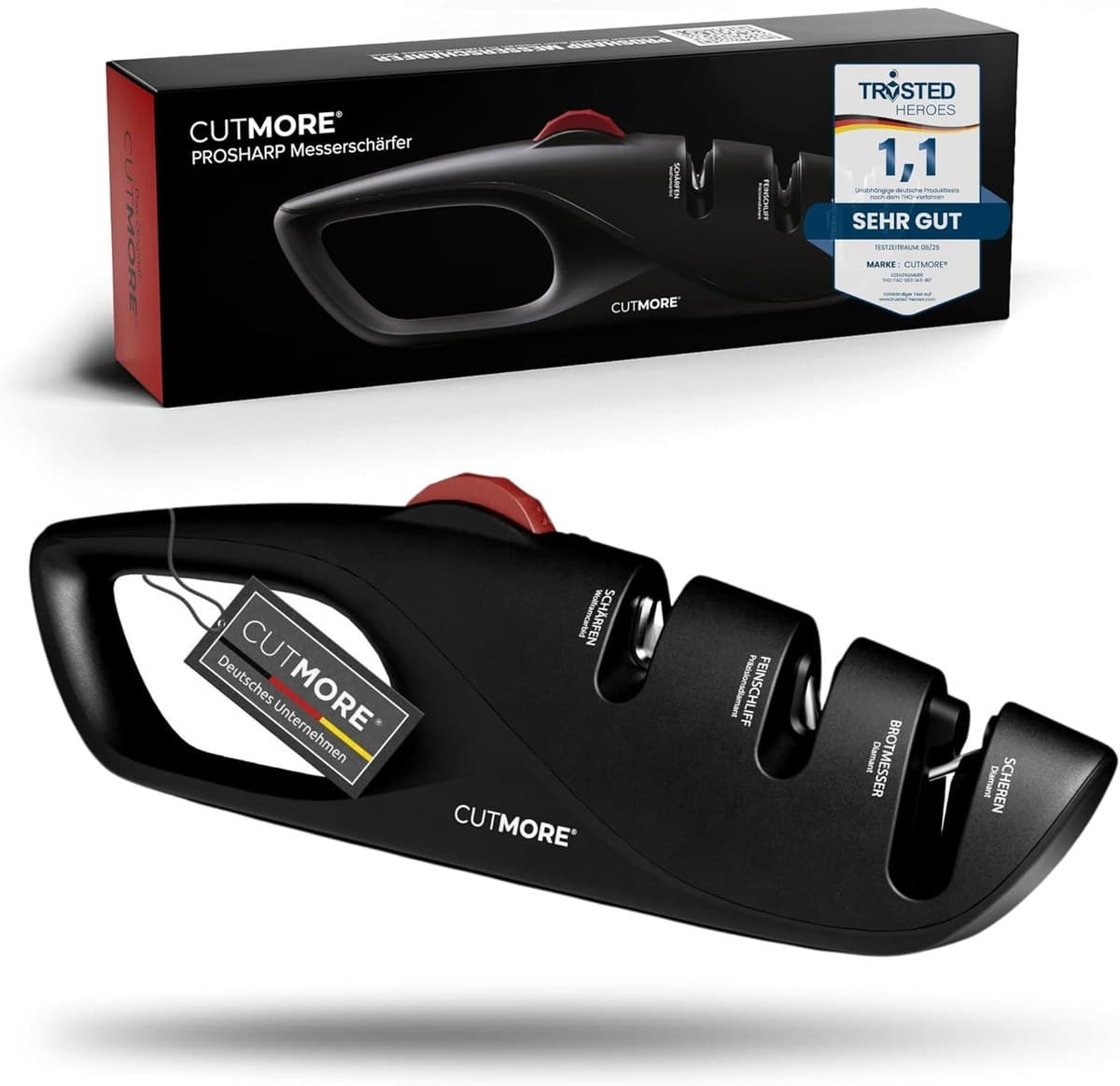
The ProSharp's exterior is entirely plastic but excellently made. The handle suits right and left hands equally for pinning the unit down, two rubber pads grip the worktop, and the flat build adds stability — under firm downward pressure nothing flexes, creaks or clicks. A large red wheel on top sets the sharpening angle of the tungsten-carbide unit: 15 degrees for delicate Japanese blades, 18 for Damascus and finely ground edges, 20 for classic European cook's knives, 22 for sturdier blades and 24 for outdoor and survival knives or machetes — with the manufacturer listing typical brands for each setting. Dedicated slots handle bread knives and scissors, plus a fine-honing slot for deburring after sharpening.
Tested against high-quality Japanese sushi knives, European cook's, utility, meat, vegetable and filleting knives, cheap no-name blades and outdoor and pocket knives, the results were very good to excellent across the board. Eight to ten pulls for the base grind plus a fine-honing pass — repeated two or three times for badly neglected blades — raised cutting performance dramatically. One extremely worn European cook's knife that could barely break a ripe tomato's skin sliced it paper-thin again after three rounds. With very blunt knives the first pass removes a lot of metal, visibly as filings and audibly as a grinding note that sensitive ears must simply endure; the payoff in the kitchen repays it many times over. Onions fall twice as fast, julienne succeeds flawlessly, and evenly cut ingredients even cook more evenly.
Two criticisms: the angle markings stamped into the red plastic could be easier to read, and when withdrawing blades you almost inevitably nick the plastic housing, so the device soon stops looking new. The angle question also deserves respect — sharpening a standard European knife at 15 degrees means heavy material loss and risks damaging the blade. Handled correctly, though, the ProSharp is little short of a miracle cure for blunt knives.
Cutmore OneSharp
The cheaper OneSharp works differently: one slot, with a side wheel — the marketing calls it a revolver drum — that swaps the grinding unit and thus the mode. Sharpening uses tungsten carbide with a spring mechanism holding the angle, but fixed at 20 degrees, so it suits European cook's knives, bread knives and scissors only — not Japanese or fine professional blades. A resin-diamond care mode maintains the edge every few days, a ceramic fine-honing mode removes burrs after every sharpening, and dedicated ceramic and hard-diamond settings cover serrated bread knives and scissors. The same robust plastic construction, rubber pads and squat stability apply — and the same unavoidable nicks in the housing over time.
Verdict
The ProSharp earns an emphatic recommendation: adjustable angles from 15 to 24 degrees make it safe for everything from sushi knives to outdoor blades, and the test results were excellent throughout. The OneSharp is the sensible budget pick for households whose knives are all European 20-degree standard — same build quality, simpler scope. Either way, mind the angle, accept the cosmetic battle scars, and enjoy knives that glide through tomatoes again.
Ready to Purchase?
Check current prices and availability
Affiliate Disclosure: As an Amazon Associate I earn from qualifying purchases. Truthful Reviews may receive a commission when you buy through eligible Amazon UK or Amazon US links, at no extra cost to you. Affiliate partnerships never determine our verdicts or recommendations.