Our Verdict
A thought-through entry into serious balcony solar: easy ballasted mounting, strong bifacial panels and the best storage in the class. Fixed tilt, short cables and sealing work are the honest caveats.
Research sources
Sources recorded for this page are linked below. Reported third-party testing belongs to the original publisher; it is not testing performed by Truthful Reviews.
Our editorial process
Research method, author and affiliate-independence details
Our editorial process
Research method, author and affiliate-independence details
Prepared by our editorial team using verified source material, product research, and a British-English editorial rewrite before publication.
- We review the working bundle for product facts, comparisons, and buyer-relevant tradeoffs before publishing.
- Non-English source material is translated into British English and rewritten into our house style without carrying over publication branding.
- Affiliate links and price references are handled separately from editorial judgements and never determine the verdict.
Read our full methodology: how we review
Affiliate links never determine our verdicts. Commercial relationships are disclosed separately from the editorial assessment, and we aim to keep buyer guidance clear, specific, and evidence-based.
Pros & Cons
Pros
- Genuinely beginner-friendly mounting with clear instructions
- Strong 2,000Wp bifacial array (22.5% efficiency)
- Outstanding battery: 4 MPPTs, 2.7kWh expandable to about 16kWh
- Ballastable frame with a wide base for added stability
- Quiet, efficient storage with a clear app
Cons
- Tilt angle not adjustable (35-45 degrees by roof pitch)
- 2.5m PV cables too short in practice
- About 24 roof penetrations need diligent resealing
- Large panels act as wind sails and are awkward to handle; smart meter not included
Key Features
Genuinely beginner-friendly mounting with clear instructions
Strong 2,000Wp bifacial array (22.5% efficiency)
Outstanding battery: 4 MPPTs, 2.7kWh expandable to about 16kWh
Ballastable frame with a wide base for added stability
Quiet, efficient storage with a clear app
The complete kit pairing the Anker Solarbank 3 E2700 Pro with Kleines Kraftwerk's XL 2000Wp Quattro is an exceptionally beginner-friendly solar system: large bifacial panels meet a simple, ballastable mounting frame with clear instructions. Installation succeeds without drama — but demands care — and combined with Anker's powerful battery the result is a well-conceived system with high yield potential.
Balcony Solar With Storage, Briefly
Plug-in balcony power plants have arrived on roofs, balconies and gardens everywhere, typically commissioning within hours. A complete kit with storage comprises solar panels, mounting for roof, balcony or ground, an inverter (often integrated in the battery), cabling and optionally a smart meter; surplus energy parks in the battery for later, raising self-consumption markedly. Connection, registration, metering and installer requirements vary by country and installation. Follow the manufacturer's instructions and current local guidance before connecting the system.
Delivery and Panels
The set arrives by freight on a pallet, the four panels upright in functional one-way packaging. The delivery is complete, including a flat-roof mount per panel, though cable ties aside, protective conduit and sealing compound are absent — and a smart meter was not part of this set despite being essential for optimal use. The panels are modern 500-watt-class bifacial modules from YH Sunpro (SPDG500-N108R12): around 196 x 113 centimetres, 26.6 kilograms, roughly 22.5 per cent efficiency, with rear cells harvesting reflected light — ideal on bright metal roofs. These sit in the most modern 500-watt class, and the efficiency figure is at the upper end of what is currently available, which is what makes them worth the handling difficulty: on a constrained roof they convert a small area into a lot of generation. The bifacial construction adds a second contribution that is easy to underrate — the rear cells collect light bouncing off the roof surface, so a bright metal deck effectively works as a reflector and lifts the yield beyond the headline rating. Build quality is solid with a stable 30-millimetre frame, but the 2.2-square-metre face per panel acts as a serious sail: avoid wind-exposed sites, and in stormy regions add a central brace and generous ballast.
Mounting
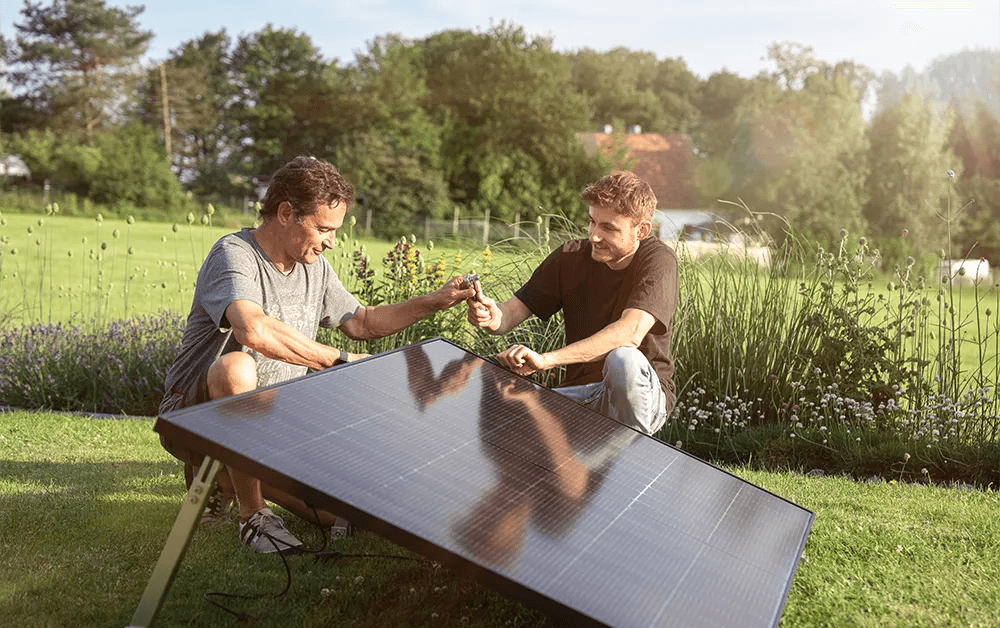
The frame targets bitumen flat roofs and standing-seam metal, needs a board layer beneath for screws to bite (M10 wood screws not included), and crucially is ballastable: concrete blocks or grass grids lie flat across the wide frame, spreading the load over two mounts per panel rather than concentrating it, Follow the supplied installation instructions for ballast and mounting. If they do not clearly cover your installation, contact the manufacturer or a qualified installer. Assembly itself is simple and beginner-appropriate — vertical spacing is fixed by the construction, only the 140-centimetre horizontal spacing matters — but the panels are large and unwieldy, and their backs can be damaged by the sharp-edged brackets to the point of total failure, so follow the handling guidance in the installation instructions. Two compromises: the tilt angle is fixed at roughly 35-45 degrees depending on roof pitch, unadjustable between summer and winter optimisation — a fixed compromise you accept at purchase rather than tune later, and around 24 roof penetrations across four panels demand diligent resealing with proper compound — on bitumen or sheet metal those holes are left entirely unprotected once the frame is down, which is the single most consequential detail an inexperienced installer is likely to skip. On the substructure itself, screwing into the board layer proved sufficient in practice; hitting additional rafters or beams is not strictly necessary, though it is worth doing where the roof structure is weaker. The supplied 2.5-metre PV cables are also too short in practice — plan longer continuous MC4 runs from the start.
Cabling
The supplied 2.5-metre PV cables deserve their own warning: with each module wired individually to the battery, a thick four-cable strand forms, and when the storage unit sits below the roof — as it usually does — the supplied length runs out fast. Continuous, longer MC4 leads ordered with the kit avoid outdoor plug connections entirely and save a second shopping trip.
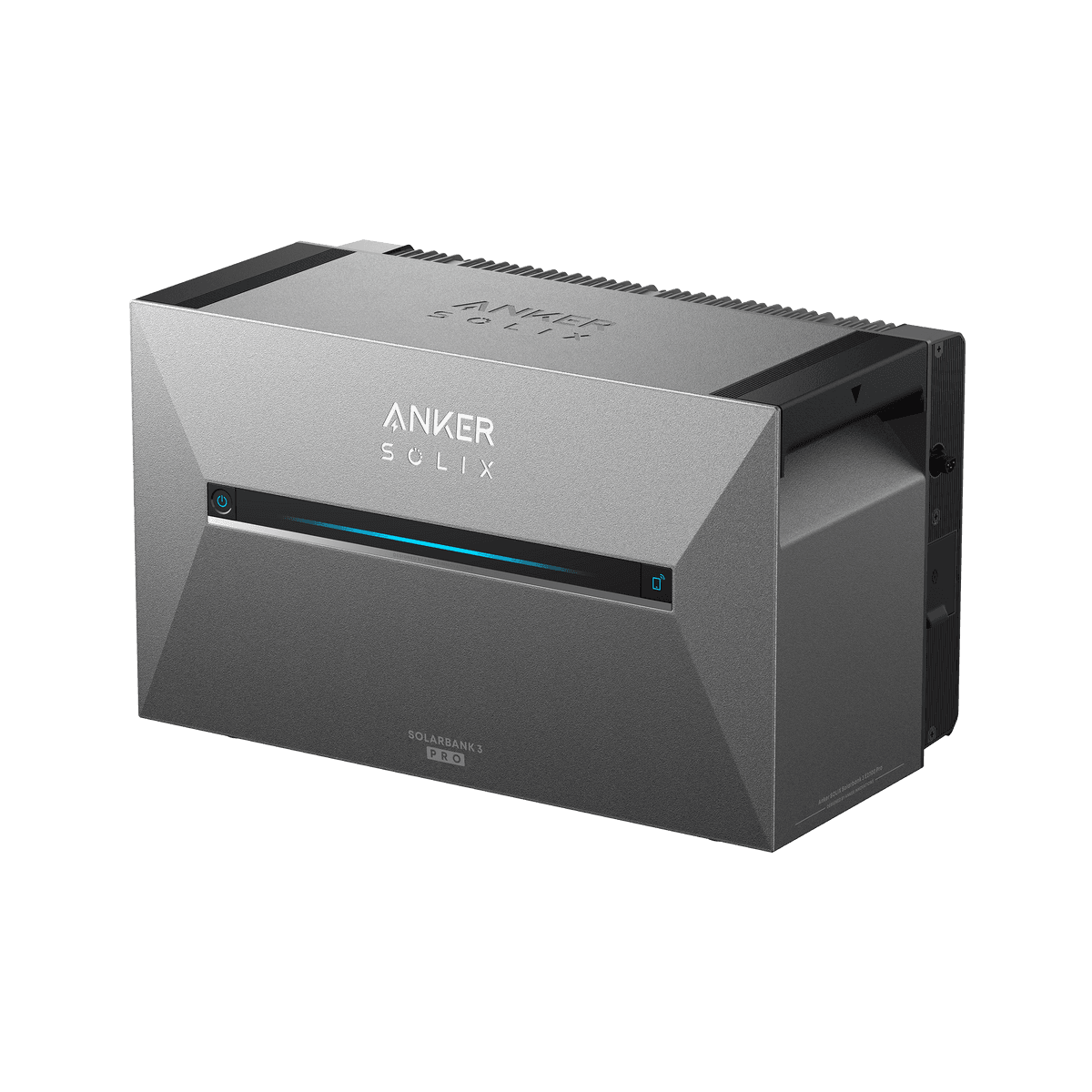
The Heart: Anker Solarbank 3 E2700 Pro

The battery is the system's core and currently ranks among the most convincing storage options for plug-in solar. The 2.7-kilowatt-hour base unit expands modularly to around 16 kilowatt-hours — up to five units stack — and accepts up to 3,600 watts of panels directly, leaving room for future roof upgrades. Four integrated MPPT trackers optimise each panel separately, securing stable yields across differing orientations or partial shade. In daily use it runs quietly and efficiently, the app presenting production, consumption and state of charge clearly. Operation needs only a Schuko socket; the location should be weather-protected and ideally frost-free.
Verdict
The Anker Solarbank 3 E2700 Pro with Kleines Kraftwerk's XL 2000Wp Quattro is a well-thought-out complete package with a clear audience: the simple assembly, ballast option and prescribed spacings make it especially attractive for newcomers, while the bifacial 2,000-watt array and the superb four-tracker battery promise high yields. Budget for sealing compound, longer cables, a helper and a smart meter — then this is one of the most beginner-friendly routes into serious balcony solar.
Ready to Purchase?
Check current prices and availability
Affiliate Disclosure: As an Amazon Associate I earn from qualifying purchases. Truthful Reviews may receive a commission when you buy through eligible Amazon UK or Amazon US links, at no extra cost to you. Affiliate partnerships never determine our verdicts or recommendations.