Quick Specs
Our Verdict
The Bromley 750’s essence in a more manageable, better-protected body, with class-leading endurance, a removable battery and connectivity nothing at this size matches. Soft sub-bass and a threadbare app keep it short of perfect.
Research sources
Sources recorded for this page are linked below. Reported third-party testing belongs to the original publisher; it is not testing performed by Truthful Reviews.
Our editorial process
Research method, author and affiliate-independence details
Our editorial process
Research method, author and affiliate-independence details
Prepared by our editorial team using verified source material, product research, and a British-English editorial rewrite before publication.
- We review the working bundle for product facts, comparisons, and buyer-relevant tradeoffs before publishing.
- Non-English source material is translated into British English and rewritten into our house style without carrying over publication branding.
- Affiliate links and price references are handled separately from editorial judgements and never determine the verdict.
Read our full methodology: how we review
Affiliate links never determine our verdicts. Commercial relationships are disclosed separately from the editorial assessment, and we aim to keep buyer guidance clear, specific, and evidence-based.
Pros & Cons
Pros
- The Bromley 750 formula in a more compact, cheaper format
- Iconic guitar-amp design with impeccable premium construction
- Genuine 40 hours of battery life — the reference in its class
- Removable 17000 mAh battery, interchangeable with the Bromley 750
- Homogeneous 360-degree dispersion with no sweet spot
- Exemplary wired connectivity: XLR/jack combos, RCA, chaining output
- Dedicated physical mic and instrument controls with delay and reverb
- IP55 protection, a step up from the 750
- Refined amber LED lighting instead of garish RGB
- Auracast pairing across brands, tested working
Cons
- Deep bass can smear and turn slightly congested on demanding tracks
- Dynamic compression perceptible around three-quarters volume
- App is too thin: no EQ, no lighting control, no effect settings
- Single handle and no wheels make 12.2 kg awkward over distance
- Control panel legends are not backlit
- No strap or mains lead supplied
Full Specifications
Key Features
The Bromley 750 formula in a more compact, cheaper format
Iconic guitar-amp design with impeccable premium construction
Genuine 40 hours of battery life — the reference in its class
Removable 17000 mAh battery, interchangeable with the Bromley 750
Homogeneous 360-degree dispersion with no sweet spot
Exemplary wired connectivity: XLR/jack combos, RCA, chaining output
Marshall spent years as a byword for portable Bluetooth speakers before pivoting in 2025 with the Bromley 750, its first true party speaker. That model's success has now produced the Bromley 450 — more compact, lighter, cheaper, and in one respect actually better protected than its big sibling. In a market drowning in garish RGB lighting and generic plastic boxes, it looks like a 1970s guitar amplifier, and that is exactly the point.
Design: a guitar amp in miniature
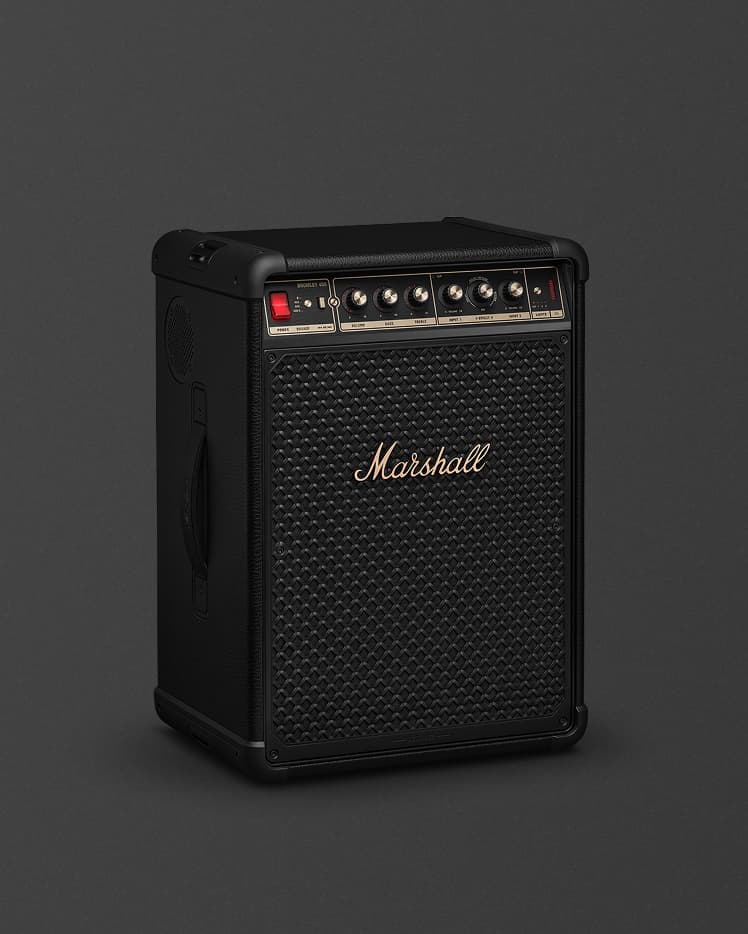
At 49 cm tall, with a vertical rectangular cabinet and the cursive Marshall script across the front, the Bromley 450 declares its heritage instantly. The finish sets premium expectations and meets them: synthetic leather covers nearly the whole surface, a brushed aluminium control panel spans the full top width, and flexible TPU corner reinforcements — directly inspired by classic Marshall amp corners — provide welcome impact resistance. Assembly is impeccable, with no play or creak, and the object feels every bit of its 12.2 kg.
Against the Bromley 750 the construction is slightly less monumental, but materials are identical and the sense of quality intact. One genuine improvement over the larger model: IP55 certification, up from the 750's IP54 — proof against spray and dust, so a terrace party or drizzly picnic holds no fear for the electronics.
The lighting deserves particular mention. Behind the acoustic fabric hide dozens of small amber-warm LED bulbs, far removed from the flashing RGB of rivals, with three presets: a soft ambient mode, a dynamic mode whose warm-white patterns react to the music, and a punchier club mode keyed to the bass. The effect is refined and coherent with the brand.
Transport is the compromise. A rubber handle on the left flank carries the weight horizontally with sensible balance, but 12.2 kg in one hand over distance is a trial. Strap attachment points exist — no strap is supplied — and there are no wheels, which the 750 has.
Controls: the physical interface done right
The brushed aluminium panel is covered in directly accessible knobs: notched potentiometers for volume, bass and treble that you locate by feel without looking. More unusually, the microphone and instrument inputs get their own volume knobs plus a shared effects potentiometer for delay and reverb, operated straight from the top — rare at this size, and it enables karaoke sessions or impromptu performances with zero app configuration. Input indicators even warn against clipping.
A source selector, playback slider, customisable M button, lighting selector and a battery LED indicator complete the set — the last meaning you never need to open your phone just to check charge, a small dignity many rivals deny you. The one limit: no backlighting on the panel legends, so in party darkness you need to know the layout by heart.
Connectivity: generous hardware, thin app

The rear panel is remarkably well equipped: two 3.5 mm jacks (input, plus an output that chains multiple Bromley 450s or 750s for synchronised playback), a USB-C port handling both audio and phone charging, RCA for a preamplified turntable or mixer, and two XLR/6.35 mm combo inputs for microphone or instrument.
Wireless brings Bluetooth 5.3 with SBC, AAC and LC3, multipoint, a claimed range beyond 70 m in open field, and Auracast — so several compatible speakers of any brand can join without manual pairing, tested successfully here in combination with a JBL Flip 7.
The app is where the product falls short. Marshall Bluetooth handles source selection, Auracast, the M button and auto-standby — and that is about all. No band equaliser, no remote lighting control, no mic or instrument effect settings from the phone. For a speaker at this price whose effects and lighting are headline features, that thinness frustrates, especially when Marshall's own Heston 120 soundbar app offers a five-band EQ and sound modes.
Sound
The True Stereophonic architecture pairs two 6.5in woofers mounted back-to-back front and rear, two 8in passive radiators for bass reinforcement, and four 2in full-range drivers, two per side — aiming at homogeneous 360-degree dispersion with no sweet spot.
It delivers on that promise. In front, to the side or behind, the balance stays coherent, without bass or treble presence swinging with the angle — a real advantage with listeners scattered around a party, and notably more versatile than the Bromley 750, whose mid and high dispersion is more directional.
The character is warm and powerful. Bass is present and holds together at high volume; electro, hip-hop and rock find their footing with satisfying low-end punch. Mids are clean and warm, projecting voices without drowning them; treble is dynamic and precise without aggression.
The reservations are specific. On very bass-heavy material the sound can turn slightly droning and congested, deep bass smearing into the upper-mid energy. Dynamic compression becomes perceptible around three-quarters volume — though the power reserve means you rarely need to go there — and the deepest sub-bass lacks some fullness against physically larger rivals. The top-panel bass and treble knobs correct much of this per genre. Maximum sound pressure reaches 100 dB at one metre: enough to run an outdoor party of twenty people without strain.
Battery: the category benchmark

This may be the most impressive number on the sheet. Marshall claims 40 hours, and the speaker honestly delivers it in real use — beating most of the segment, including JBL's PartyBox 120 at 18 hours. Lighting effects trim the figure only reasonably.
Better still, the 17,000 mAh lithium-ion battery is removable and replaceable — still rare in this class — and it is the same unit as the Bromley 750's, so owners of both can swap packs, or carry a spare for a theoretical 80 hours. Fast charging restores 6 hours of playback from 20 minutes, a full charge takes 3.5 hours over the dedicated USB-C port, and that same port charges phones and earbuds, making the speaker an emergency power bank mid-party. Mains operation is possible via a two-pin C7 lead, not included.
UK price and availability
In the UK the Bromley 450 is listed at John Lewis in Black and in stock at the time of writing. It is not currently sold on Amazon UK.
Verdict
The Bromley 450 pulls off something far from guaranteed: keeping the essence of the Bromley 750 in a more accessible, more compact and better-protected format. The design is unique in its category, construction is premium, the wired connectivity is exemplary, and the endurance is the reference point for the class.
The sound convinces — powerful, warm, homogeneous in every direction — though lovers of very deep, well-defined bass will find the rendering occasionally soft on the most demanding tracks, and the app remains the poor relation of the experience.
It costs meaningfully more than rivals like the JBL PartyBox 120. Against that it offers far superior battery life, richer connectivity, better construction and a style that belongs to Marshall alone. For a party speaker built to last — through the years and through the night — it is hard to walk past.
Ready to Purchase?
Check current prices and availability
Affiliate Disclosure: As an Amazon Associate I earn from qualifying purchases. Truthful Reviews may receive a commission when you buy through eligible Amazon UK or Amazon US links, at no extra cost to you. Affiliate partnerships never determine our verdicts or recommendations.