Quick Specs
Our Verdict
A genuinely innovative steering technology that Mercedes brings to series production for the first time among German manufacturers. The steer-by-wire system filters vibrations beautifully and the variable ratio is practical for parking, but the artificial force feedback still disconcerts experienced drivers. The option is for early adopters and those who want to stand out — most buyers will be served by the standard electromechanical steering for now.
Research sources
Sources recorded for this page are linked below. Reported third-party testing belongs to the original publisher; it is not testing performed by Truthful Reviews.
Our editorial process
Research method, author and affiliate-independence details
Our editorial process
Research method, author and affiliate-independence details
Prepared by our editorial team using verified source material, product research, and a British-English editorial rewrite before publication.
- We review the working bundle for product facts, comparisons, and buyer-relevant tradeoffs before publishing.
- Non-English source material is translated into British English and rewritten into our house style without carrying over publication branding.
- Affiliate links and price references are handled separately from editorial judgements and never determine the verdict.
Read our full methodology: how we review
Affiliate links never determine our verdicts. Commercial relationships are disclosed separately from the editorial assessment, and we aim to keep buyer guidance clear, specific, and evidence-based.
Pros & Cons
Pros
- Completely removes mechanical steering column
- Yoke-style wheel improves instrument cluster visibility
- Improved access for drivers with reduced mobility
- Excellent vibration filtering on degraded surfaces
- Variable steering ratio — never exceeds half a turn even when parking
- Redundant dual signal-path architecture for safety
- Rear steering and ESP provide additional safety backup
- Over 1 million km of pre-launch testing
- Custom airbag deployment design for the new wheel shape
- Mercedes is the first German manufacturer to ship this technology
Cons
- Artificial force feedback noticeable to experienced drivers
- Requires adaptation time for those used to classic steering
- No track record for long-term reliability
- Yoke shape may disconcert some customers
- Limited initial adoption — niche audience
- Cannot be tested in emergency manoeuvres before purchase
Full Specifications
Key Features
Completely removes mechanical steering column
Yoke-style wheel improves instrument cluster visibility
Improved access for drivers with reduced mobility
Excellent vibration filtering on degraded surfaces
Variable steering ratio — never exceeds half a turn even when parking
Redundant dual signal-path architecture for safety
Mercedes EQS Steer-by-Wire Test: What Does Driving Without a Steering Column Feel Like?
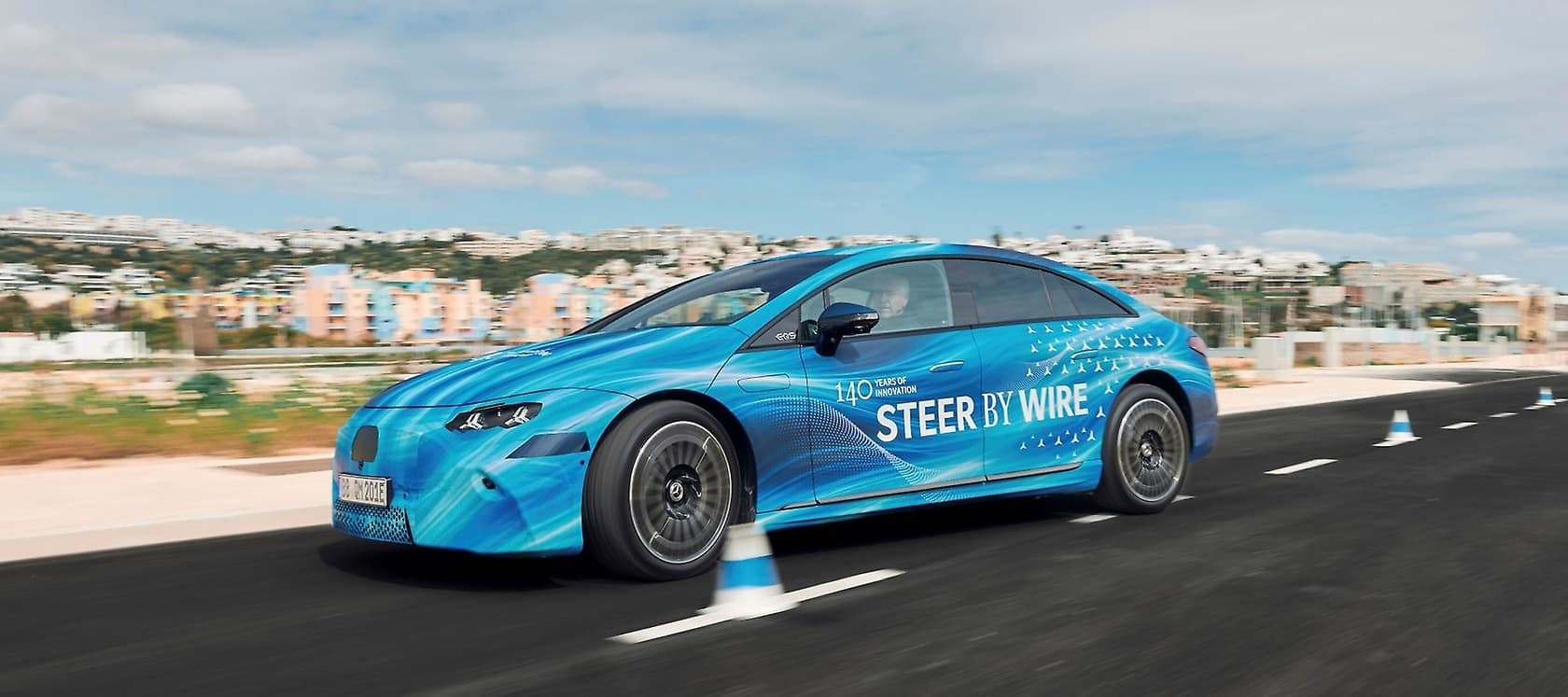
In 2026, on the occasion of the restyling of its luxury electric saloon EQS, Mercedes will at the same time launch a steering system still rare on the market, since it does not include a mechanical link. Already offered by Tesla on its Cybertruck and, in 2027, by Peugeot on its future 208, this type of steering promises numerous advantages compared to those of classic cars.
You could miss it if the steering wheel were more conventional. By sitting at the wheel of the restyled Mercedes EQS electric, equipped with steer-by-wire steering, the first reflex is obviously to look around and in particular at these immense screens that extend to the dashboard in front of the passenger.
Some will say it is probably too much, others that it is futuristic, even if these large digital panels well occupy our present today.
In short, the steering column is not what you look at first when you enter an electric car. And generally, you do not see it. And at Mercedes, if you saw it, you simply would not see it anymore because this same column now shines by its absence.
A New Yoke-Style Steering Wheel
Between the steering wheel and the front wheels, no longer the slightest physical link: just electronics, sensors, cables, and computers. What does this concretely change inside? The steering wheel, quite simply.
By the very admission of the Mercedes engineer at the origin of this technology, the steering wheel could be round, that is to say completely classic, rectangular like Peugeot with its Hypersquare, or even hexagonal — it would change nothing about the very principle of this technology.
"We could even replace the steering wheel with joysticks, especially since no European rule prevents us," the engineer confided. Certainly, but it would be enough to disconcert the customer. At Mercedes, the choice was made of a "Yoke" type steering wheel, even though it does not bear that name, for the simple and good reason that it is undoubtedly very Tesla-connoted.
For Mercedes, this steering wheel, which undeniably makes you think of the aviation universe or a giant pretzel, allows "facilitating the vision of the instrument cluster, but also access to the car itself for people with reduced mobility".
This steering wheel shape is above all a very simple and very marketing way to sell this technology to customers. It will be offered as an option on the restyled Mercedes EQS.
On the "Road": Sensations to Tame

Let us be honest: the first minutes are strange. Not unpleasant, but strange. The steering wheel responds, the wheels follow, everything works, and yet something is wrong with the perception. This artificial force feedback, supposed to simulate what the tyres feel on the road surface, does not fool anyone who appreciates driving even a little.
You feel that it is reconstructed, calculated, interpreted by software rather than mechanically transmitted. Mercedes speaks of "precise, intuitive, and effortless" steering. This is generally true, but the notion of "intuitive" deserves to be nuanced. Intuitive for someone who has never driven with classic steering, perhaps. For others, it takes time to adapt.
Vibration Filtering
The brain looks for landmarks it no longer quite finds in the same places. What works well, on the other hand, is the filtering of vibrations. On degraded surfaces, no more of that small parasitic trepidation that used to come back into the hands.
Variable Steering Ratio
Another notable point: the steering / wheel ratio is variable depending on the situation.
At low speed, for manoeuvring, the movements are amplified to reduce the rotation amplitude. In practice, you never exceed half a steering wheel turn in either direction, even for parking. It is surprising, then practical, then you get used to it.
This steering was unfortunately not tested on an "emergency" manoeuvre at 130 km/h for example, but let us bet that it is not too direct at the risk of being even more surprising for its user.
Safety: The Real Underlying Subject
Behind every exchange around steer-by-wire steering, the same question inevitably comes back: what happens in case of failure? It is legitimate. Entrusting the steering of your car to an entirely electronic system implies blind confidence in its reliability.
Redundant Architecture
Mercedes has clearly anticipated the objection. The system relies on a redundant architecture: two distinct signal paths operate in parallel. If one fails, the other takes over. And in the even more improbable scenario of a total failure, the rear steering and the targeted brake interventions via the ESP would still allow maintaining a trajectory.
Million Kilometre Test
The whole has accumulated more than a million kilometres of tests before commercialisation on benches, circuits, and open roads. Is this enough to be reassured? In theory, yes. In fact, you will have to wait for real usage feedback over time to form a definitive opinion.
Airbag Considerations
There is also the question of the airbag, less trivial than it appears. A flatter steering wheel without a closed upper edge changes everything in the deployment dynamics.
Mercedes has developed a specific architecture, with retention points and a folding scheme designed so that the cushion positions itself stably even without support on a classic ring. It is real engineering work, and the announced safety levels remain in line with the brand's usual standards.
A Foretaste of What Is Coming, Not Yet an Absolute Reference

Is Mercedes the only one in the world with this steering? Not really. Several players have been working on this technology for a long time. Infiniti had attempted the adventure as early as 2013 on the Q50 saloon, with a mixed result and a backup mechanical column maintained in parallel.
Other Players
Lexus today offers a more accomplished version than Infiniti on its electric RZ with a steering wheel shape very similar to that of Mercedes. ZF now equips the Chinese SUV Nio ET9 and announces an upcoming arrival in Europe. Bosch, Nexteer, SKF... the sector is teeming with players developing steering systems without mechanical link. Tesla is obviously not to be outdone with its Cybertruck.
Mercedes, by launching the EQS with this technology, simply becomes the first German manufacturer to take the plunge for a series vehicle.
French Competition
And France in all this? Peugeot will offer from next year on its new 208, the steer-by-wire steering also visible via a particular steering wheel, namely the Hypersquare.
What to Remember?
The artificial feedback, despite progress in recent times, still needs to evolve. Having tested the first steer-by-wire steering on the Infiniti Q50 about 10 years ago, indeed, we are light years away between what the Japanese manufacturer offered and what Mercedes is developing.
Public confidence in a system as fundamental as steering, entirely without mechanical link, will be built over years and not on a press presentation. And the price of this option, which adds to a saloon already positioned very high-end, will inevitably reserve this experience to a narrow fringe of buyers initially.
For those who choose not to adopt it immediately, Mercedes will continue to offer classic electromechanical steering, while a democratisation of this system on other models will depend on customer reception.
The restyled Mercedes EQS will not be the only one to try this technology, since the Mercedes-AMG GT Coupé 4 doors electric of 1,360 hp that will soon be presented should also offer steer-by-wire steering as an option.
Ready to Purchase?
Check current prices and availability
Affiliate Disclosure: As an Amazon Associate I earn from qualifying purchases. Truthful Reviews may receive a commission when you buy through eligible Amazon UK or Amazon US links, at no extra cost to you. Affiliate partnerships never determine our verdicts or recommendations.