Quick Specs
Our Verdict
Flagship autofocus, 30fps bursts and genuine 4K/60 in a sealed magnesium body - the Z50II delivers upper mid-range quality at an entry price. Buy it in a lens kit and forgive the modest battery; nothing in its class comes close.
Research sources
Sources recorded for this page are linked below. Reported third-party testing belongs to the original publisher; it is not testing performed by Truthful Reviews.
Our editorial process
Research method, author and affiliate-independence details
Our editorial process
Research method, author and affiliate-independence details
Prepared by our editorial team using verified source material, product research, and a British-English editorial rewrite before publication.
- We review the working bundle for product facts, comparisons, and buyer-relevant tradeoffs before publishing.
- Non-English source material is translated into British English and rewritten into our house style without carrying over publication branding.
- Affiliate links and price references are handled separately from editorial judgements and never determine the verdict.
Read our full methodology: how we review
Affiliate links never determine our verdicts. Commercial relationships are disclosed separately from the editorial assessment, and we aim to keep buyer guidance clear, specific, and evidence-based.
Pros & Cons
Pros
- Blistering 0.07-0.14s autofocus with flagship-grade subject recognition
- 30fps silent electronic burst shooting
- Sealed magnesium body with articulating touchscreen
- Excellent image quality - the 16-50mm kit lens genuinely delivers
- 4K/60 video, 10-bit, N-Log, unlimited recording, mic and headphone jacks
- USB-C with Power Delivery at last
Cons
- No in-body stabilisation (lenses provide it)
- Modest 250-shot battery life
- Screen brightness (490cd/m2) is low for harsh sunlight
Full Specifications
Key Features
Blistering 0.07-0.14s autofocus with flagship-grade subject recognition
30fps silent electronic burst shooting
Sealed magnesium body with articulating touchscreen
Excellent image quality - the 16-50mm kit lens genuinely delivers
4K/60 video, 10-bit, N-Log, unlimited recording, mic and headphone jacks
USB-C with Power Delivery at last
Price note: Overseas prices have been converted to approximate pound equivalents using the reference exchange rate current when this page was updated. UK prices and availability may differ.
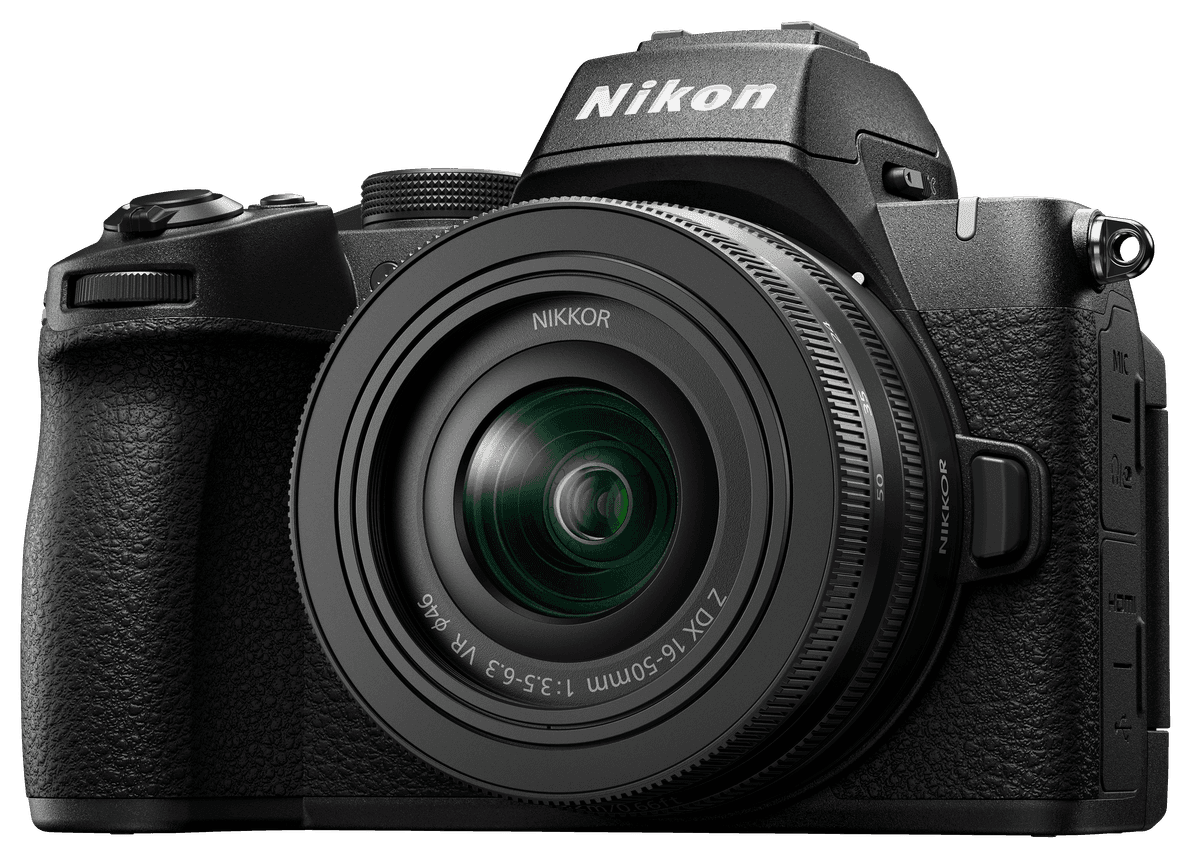
A system camera — one with interchangeable lenses — lets you fit the right glass for any situation in seconds. The Nikon Z50II is currently probably the best system camera for beginners: priced hard at the upper edge of the entry class, but delivering quality that has no equal at this level.
Build and Handling
In many respects the Z50II is already a mid-range camera, equally suited to ambitious users, beginners, photographers and filmmakers. The body sits superbly in the hand, is made from a robust magnesium alloy and even carries sealing against dust and spray — equipment normally found well above the entry price.
A major improvement over its predecessor is the fully articulating touchscreen, which makes shooting and filming from unusual perspectives easy. Its maximum brightness of 490cd/m2 is on the low side, but in bright sunlight the viewfinder steps in. Touch operation is well executed and integrates seamlessly with the physical controls — of which there are notably more than on other cameras at this price, clearly courting advanced users. The menus are intuitive: six main categories, a customisable favourites menu, and a quick menu of 12 functions behind the i button. Almost everything is reachable with the right hand, the mode dial holds three user memories plus a new picture-style button, and a lever beneath it flips between photo and video.
Autofocus and Speed
The autofocus is blisteringly quick and precise: depending on the lens's zoom position, the camera locks focus and fires in 0.07 to 0.14 seconds. The power comes from the Expeed 7 processor — the same chip as in Nikon's flagship Z8 and Z9 — bringing the same intelligent subject recognition as the professional bodies. It detects people, heads, faces and eyes (even in profile), animals and animal eyes, birds and bird eyes, and various vehicles including cars, motorbikes, planes and trains, either fully automatically or constrained to a chosen subject type.
Burst shooting is unique in this class: a silent electronic shutter captures a full 30 frames per second (a good 10fps mechanically), written quickly to a fast UHS-II card. The Z50II can also save HEIF files — still rare among cameras — which beat JPEG quality at smaller sizes.
Video

Filmmakers get far more than standard fare. 4K at 60fps — rare at this price — comes with a crop, while 4K at 30fps uses the full sensor width, oversampled from 5.6K for even better quality. Full autofocus functionality carries over to video, along with 10-bit colour depth, HLG for HDR and flat N-Log footage for grading. Recording length is unlimited, and both microphone and headphone sockets are present as 3.5mm jacks.
Connectivity and Battery
Wireless connectivity is today's standard: Wi-Fi and Bluetooth transfer images to phones, tablets or computers, and the SnapBridge app adds remote control and GPS tagging. Nikon has finally moved its APS-C line to a contemporary USB-C port with USB 3.2, charging support and Power Delivery compatibility. The speed comes at a price, though: around 250 shots per battery charge is modest against rivals and the predecessor alike — a power bank or spare battery is a sensible companion.
Image Quality

Image quality is outstanding, helped by the 20.9-megapixel APS-C sensor's deliberately moderate resolution — a figure Nikon has held since 2016 while rivals push double the pixels. The restraint pays off in performance, low-light ability and gentler demands on lenses. The 16-50mm f/3.5-6.3 VR DX kit lens deserves particular credit: cheap kit zooms rarely impress, especially pancake designs, yet combined with the camera's processing it shows almost no optical flaws and no heavy edge softness. An unusually good kit lens, a sensibly resolved sensor and a powerful processor add up to excellent image quality on the card.
The one omission is in-body image stabilisation — rivals offer it only on smaller Four Thirds sensors or at much higher APS-C prices — but every Nikon APS-C lens is stabilised, so you are never actually without it.
Which Kit to Buy
Skip the body-only option: the kit with the tested 16-50mm costs barely more, and the retracted lens is so compact the camera becomes a true everyday companion. The twin-lens kit adds the equally good 50-250mm, extending reach seamlessly. Alternatively the 18-140mm kit covers everything from under 28mm to over 200mm equivalent in one (larger but light) lens, with quality that likewise gives nothing to complain about. All the kits are excellent value — the choice is purely about shooting style.
Verdict
The Nikon Z50II is an outstanding system camera. The price is relatively high for the entry class, but what it buys is astonishing: nearly everything improved over the Z50, with much of the technology inherited from far more expensive full-frame Nikons. The processor is mighty, the autofocus blisteringly fast with the most advanced subject recognition in its class, and filmmakers get genuine 4K/60. Only in-body stabilisation is missing — the lenses provide it instead. In build and image quality alike, this is upper mid-range quality at a beginner's price point, and nothing in the entry class comes close.
Ready to Purchase?
Check current prices and availability
Affiliate Disclosure: As an Amazon Associate I earn from qualifying purchases. Truthful Reviews may receive a commission when you buy through eligible Amazon UK or Amazon US links, at no extra cost to you. Affiliate partnerships never determine our verdicts or recommendations.