Quick Specs
Our Verdict
Real portafilter espresso with capsule-machine effort, in a footprint nothing comparable matches. Black-coffee drinkers get a superbly judged machine; milk-drink households and tinkerers should look elsewhere.
Research sources
Sources recorded for this page are linked below. Reported third-party testing belongs to the original publisher; it is not testing performed by Truthful Reviews.
Our editorial process
Research method, author and affiliate-independence details
Our editorial process
Research method, author and affiliate-independence details
Prepared by our editorial team using verified source material, product research, and a British-English editorial rewrite before publication.
- We review the working bundle for product facts, comparisons, and buyer-relevant tradeoffs before publishing.
- Non-English source material is translated into British English and rewritten into our house style without carrying over publication branding.
- Affiliate links and price references are handled separately from editorial judgements and never determine the verdict.
Read our full methodology: how we review
Affiliate links never determine our verdicts. Commercial relationships are disclosed separately from the editorial assessment, and we aim to keep buyer guidance clear, specific, and evidence-based.
Pros & Cons
Pros
- Grinding, dosing, tamping and puck ejection fully automatic
- Genuine portafilter extraction at 16 bar — more character than bean-to-cup automatics
- Convincing espresso: full body, stable hazelnut crema, clear roast notes
- Exceptionally compact at 18 cm wide
- Quiet 69.5 dB ceramic grinder, kind to sleeping households
- Sixty to ninety seconds per cup, three self-explanatory buttons
- Puck ejects at a button press — no knock-box mess
- Adjustable, permanently stored cup volumes; pre-ground coffee supported
- Around half the housing made from recycled plastic
Cons
- No steam wand or milk frothing — the matching frother costs extra
- Grind size is fixed, ruling out fine-tuning per bean
- Very light and very dark roasts suit it poorly
- Lungo tastes flatter and less balanced than the espresso
- Espresso temperature of 60°C sits under the Italian ideal
- Fixed bean hopper leaves the grinder less accessible
- Frequent descaling needed in hard-water areas
Full Specifications
Key Features
Grinding, dosing, tamping and puck ejection fully automatic
Genuine portafilter extraction at 16 bar — more character than bean-to-cup automatics
Convincing espresso: full body, stable hazelnut crema, clear roast notes
Exceptionally compact at 18 cm wide
Quiet 69.5 dB ceramic grinder, kind to sleeping households
Sixty to ninety seconds per cup, three self-explanatory buttons
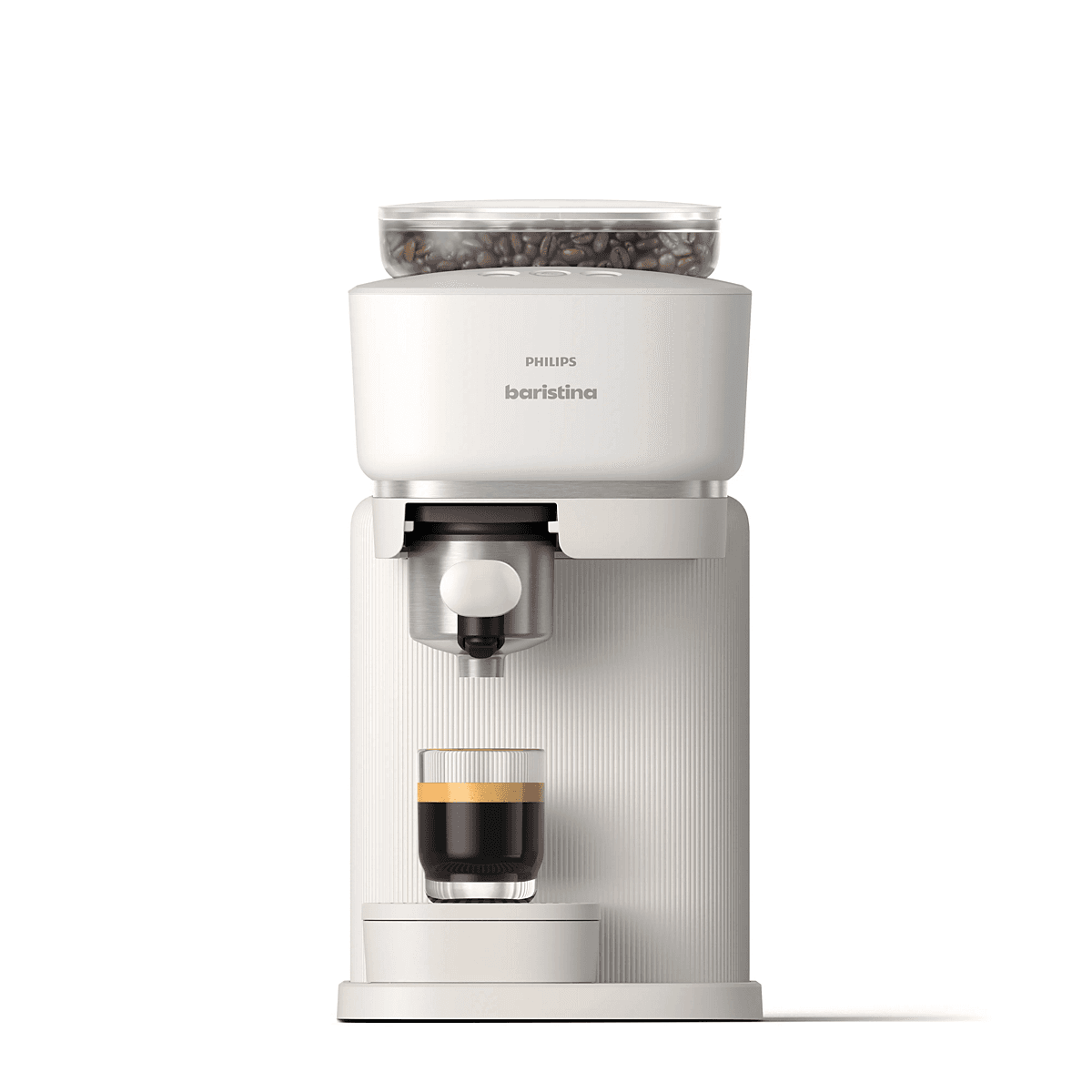
The Philips Baristina makes one promise: real espresso from freshly ground beans, without ever thinking about grind size, tamping or dosing. It belongs to a new generation of machines trying to combine portafilter quality with full-automatic convenience — but where hybrid machines from Sage or Solis pile on adjustability, the Baristina bets everything on radical simplification. You fill the hopper, you press a button, and the machine does the rest.
The concept has a cost, and not only the purchase price. There is no steam wand, no milk frother, no grind adjustment, no temperature control, no display. Whether that ruthless reduction is genius or a dealbreaker depends entirely on who you are.
What it is — and deliberately is not
Technically this is a genuine portafilter machine with proper brewing pressure — 16 bar — not a disguised bean-to-cup automatic. Yet the workflow is fully automated: grinding, dosing, tamping and puck ejection all happen without user skill.
At just 18 cm wide it is exceptionally compact, at home in small kitchens and offices, with a restrained modern design in black or white. The portafilter handle can be personalised in various colours, and about 50 per cent of the housing is recycled plastic.
What it deliberately omits: any way to froth milk, any grind adjustment, any temperature setting. Anyone wanting cappuccino or latte needs a separate frother — Philips sells a matching one at a meaningful extra cost. The target buyer is precisely defined: someone who drinks excellent black coffee and wants near-zero effort. Upgraders from Nespresso or Dolce Gusto are exactly who this is for.
The workflow
Preparation is remarkably simple. The empty portafilter clicks into place, then slides right under the grinder — Philips calls the gesture a swipe. The machine detects it, grinds directly into the portafilter, tamps with constant pressure, returns the portafilter to the brewing position automatically and starts the shot. Afterwards, one press on the portafilter's button ejects the spent puck into a bin. The whole cycle takes 60 to 90 seconds.
Three buttons run everything: Espresso, Lungo, and a Boost function for stronger coffee. Volumes are adjustable by holding the button until the desired amount is reached, stored permanently; factory presets are 40 ml for espresso and 110 ml for lungo, sensible standards that suit most people out of the box. Pre-ground coffee works too — fill the portafilter manually, hold Boost for five seconds and start the shot by hand, handy for sampling other coffees.
Grinder and noise
The integrated ceramic grinder measured a comparatively quiet 69.5 dB, where rivals at this level often reach 75 dB and more; tamping and brewing are quieter still. Early-morning coffee without waking the household is realistic. Ceramic burrs also age well and stay taste-neutral.
The grind setting, however, is fixed — a deliberate decision. Philips chose a middle setting intended to serve both espresso and lungo. The consequence is reliability without fine-tuning: reproducible results every time, but no lever to pull when a particular bean wants something different. For the target buyer, no problem. For an ambitious home barista, this is the deal-breaking limitation, because grind size is the single most important variable in espresso.
It also constrains bean choice. Very light and very dark roasts work less well; medium roasts and omniroasts suit it best, with classic Italian-style blends carrying nutty and chocolatey notes harmonising most happily.
In the cup
Despite the locked-down settings, the result convinces. Espresso arrives at about 60°C — a touch under the Italian ideal, but pleasant to drink — with a full, velvety body, nut and chocolate notes well presented, and a stable, even, hazelnut-brown crema. Against most bean-to-cup automatics the shot is more intense and characterful, which is exactly what genuine portafilter extraction at 16 bar buys you. Against a classical portafilter with a dialled-in grinder, the last degree of refinement is missing — there is simply no way to tune every parameter to the bean.
The lungo is the weaker discipline. At 68°C it is hot enough, but the taste is flatter and less balanced; the longer pull dilutes the aroma in a way a fixed grind cannot compensate. The Baristina plays its strengths on the short, classic espresso.
Cleaning

Cleaning is a genuine advantage. The spent puck ejects at a button press straight into a bin holding around ten pucks — no knock-box thumping. Water tank, drip tray and portafilter lift out and rinse under the tap; none is dishwasher-safe, but the simple shapes make that irrelevant. The bean hopper is fixed, which leaves the grinder less accessible than on machines with removable hoppers, and Philips recommends regular descaling every few weeks depending on water hardness — the compact plumbing means limescale bites quickly.
UK price and availability
In the UK the Baristina is listed at John Lewis in Black and in stock at the time of writing. It is not currently listed on Amazon UK. Budget separately for the matching milk frother if flat whites are part of your routine.
Verdict
The Baristina keeps its promise: genuine portafilter espresso with practically zero effort. The automation is reliable, the cup quality convinces — especially the short espresso with its full body and roast character — and the 18 cm footprint fits where no conventional portafilter setup could.
The machine is honest about who it serves. If you drink black coffee, have no interest in milk drinks or experimentation, and value your mornings, it is a thoughtfully engineered daily companion that outclasses the capsule machines it aims to replace. If you want to learn espresso as a craft, or your household runs on cappuccino, the fixed grind and missing steam wand rule it out — and Philips would be the first to agree.
Frequently asked questions
How do you use the Philips Baristina? Click the empty portafilter into place and slide it right under the grinder — the machine detects the gesture, grinds, tamps with constant pressure, returns the portafilter to the brewing position and pulls the shot, all in 60 to 90 seconds. Three buttons (Espresso, Lungo, Boost) cover everything; volumes adjust by holding a button and are stored permanently.
How do you clean the Philips Baristina? One press ejects the spent puck into a bin that holds around ten pucks — no knock-box thumping. The water tank, drip tray and portafilter lift out and rinse under the tap (none is dishwasher-safe, but the shapes are simple), and Philips recommends descaling every few weeks depending on water hardness.
Where can you buy the Baristina in the UK? John Lewis stocks it. It was not listed on Amazon UK at the time.
Ready to Purchase?
Check current prices and availability
Affiliate Disclosure: As an Amazon Associate I earn from qualifying purchases. Truthful Reviews may receive a commission when you buy through eligible Amazon UK or Amazon US links, at no extra cost to you. Affiliate partnerships never determine our verdicts or recommendations.