A bottle cage is one of the cheapest things you can bolt to a bike and one of the easiest to get wrong. The good ones are invisible: they sit tight against the frame, they do not rattle, and they grip the bottle firmly enough that it stays put over rough ground while still letting go without a fight. The bad ones wobble, chatter, scratch the bottle, or refuse to take the bottle you actually own. Seven cages were tested here, and the differences between them are larger than the category suggests.
What follows is recorded testing, translated. Nobody at Truthful Reviews has bolted any of these to a bike.
This page makes no health or safety claim of any kind. Everything below describes how the cages are built, how they were measured, and how they behaved mechanically.
What separates a good cage from a bad one
Two demands pull against each other. The cage has to hold the bottle firmly, and it has to give it up easily. Riders who care about pace want to take the bottle out and put it back without stopping; riders touring at a gentler pace care less about that and more about how much water they can carry, which means whether a larger bottle will fit at all.
The other variable is the bottle itself. Purpose-made cycling bottles have a particular ergonomy: they are sized to be gripped in one hand, and their caps are made to be worked one-handed too, which is not true of a supermarket bottle. Because not everyone wants to buy dedicated kit, some cages are designed around ordinary shop-bought bottles instead. Those all-rounders suit the occasional rider; a road or gravel rider using standard cycling bottles is better served by a cage built for them.
Frame geometry has the last word. On a frame with little clearance above the cage, the bottle cannot be lifted clear, which is where the magnetic and side-entry designs come in.
Mounting, bolts and materials
Bottle cages almost always have two holes taking standard M5 bolts of 12 to 16 mm, which thread into fittings most bikes carry on the down tube. A hex key and a few minutes is the whole job.
Bikes without those fittings are not excluded. There are cages made for the handlebar or the seatpost, and adapters that let an ordinary cage with standard hole spacing mount to a seatpost, which is how many riders carry a second bottle. Some cages fix with hook-and-loop straps or other arrangements instead. In practice the bottle usually ends up on the down tube or the seat tube.
Most cages are plastic now. Metal, aluminium in particular, used to dominate the category and has not disappeared, but aluminium tends to score the bottle. Modern plastic cages are slightly flexible and finished with a surface meant to mark the bottle as little as possible; that smoothness also makes the bottle easier to pull out. Carbon cages exist for riders counting individual grams, though they are usually not much lighter than plastic — weight depends far more on how the cage is constructed than on what it is made from.
Magnetic retention has appeared over the last few years, holding the bottle to a base plate rather than in a cage. That suits both fast riders and anyone whose frame leaves too little room to lift a bottle upwards.
The honest way to choose is to think about which bike you ride, how far, and how often. Occasional riders are well served by a simple cage; tourers and road riders should buy for their own particular case.
The picks
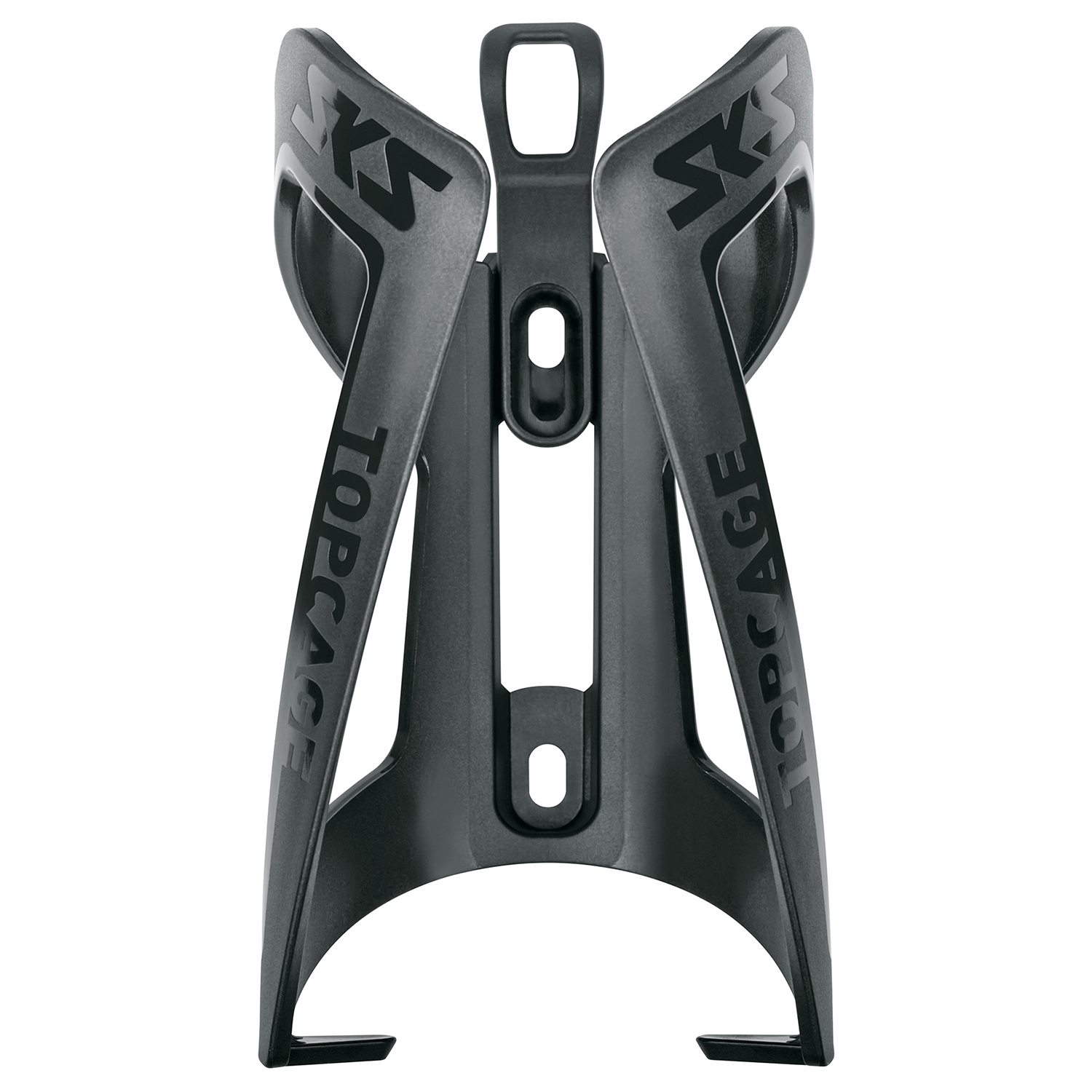
Top pick — SKS Germany Topcage
A classic, dependable cage in tough plastic, and the pick for most riders. It goes onto the standard frame fittings intuitively in a couple of minutes. What sets it apart is a movable catch clip, locked in place by the upper of the two mounting bolts. Slacken that bolt slightly and the clip slides up or down, so the cage can be set to whichever bottle you use. Change bottles and you simply reset it. That flexibility is the whole argument for it.
The manufacturer says a 1.5-litre PET bottle will fit. That depends on the frame: on the mountain bike used for testing there was too little room above the cage to get a bottle that tall in at all. A standard cycling bottle and a 1-litre PET bottle both fitted faultlessly. On other bikes the outcome may differ — a large bottle always needs a lot of space between the frame tubes. Once in, the bottle sits very firmly and still comes out comfortably, and putting it back is as easy as taking it out.
One fitment quirk: it ships without mounting hardware, and that turns out to be sensible. The short 12 mm bolts used for testing would not secure it and longer ones had to be found. Fitted properly, it does not wobble or rattle at all.
It is not one of the featherweights, so riders chasing low weight will look elsewhere. It comes in a range of colours, so it can be matched to the bike.
Search Amazon UK · Search Amazon US
The clever one — Fidlock Twist Bike Base
Strictly speaking this is not a bottle cage, because it needs either a bottle built for the system or an adapter. It is also the design you stop wanting to be without once you have used it.
It bolts to the frame with two bolts like anything else. The mechanism is magnetic: two relatively flat magnetic buttons into which the bottle's counterpart seats snugly, released with a gentle twist. It works while riding and at a standstill, and the action is so intuitive it needs no explaining. Despite how easily it lets go, the bottle sits rock solid on the base.
The base plate weighs 19 grams, which makes it extremely light, and there is no cage as such. Without a bottle in place the base is so small and slim it is barely noticeable on the frame, and since it comes in several colours it can be matched to the frame paint. Bottles for the system come in a range of sizes, specifications and designs, including bottles you can personalise.
The Bike Base is not limited to bottles either. Other items — a small bag, tool sets, lock mounts — attach to the same base, which makes it a universal mount rather than a bottle mount.
Riders who want to keep their existing bottle can buy the MonkeyLink AnyBottle cage separately and fit it onto the Fidlock base. It is best to seat the cage on the base before putting the bottle in, so there is something to push against. Once the bottle is in that cage it is very hard to get out again, and that is deliberate: with this arrangement you remove the bottle and the cage together. Compared with using the Fidlock bottle, it is much harder work.
Search Amazon UK · Search Amazon US · Search Amazon UK · Search Amazon US
The lightweight — Hilo Sports X-Lite
For riders who want a slender-looking cage and a low weight. It is made of firm but slightly flexible plastic and weighs 25 grams, which puts it among the lightweights, and it looks as delicate as it is light.
The surface is almost rubberised, which is what holds the bottle so firmly. At the same time the material flexes enough that the bottle goes in and comes out very comfortably, and without being scratched. The supplied bolts have it fitted quickly, and it does not wobble.
The manufacturer says it can be used with bottles of different sizes; in testing it was not possible to fit larger bottles into it, and the bigger PET bottles from a supermarket find no purchase in it at all. That makes it a road and gravel cage, for riders using standard cycling bottles, and its fine appearance suits the slim frames those riders tend to have.
Search Amazon UK · Search Amazon US
Also tested
Kabon Carbon bottle cage — a solid and very light carbon-fibre cage. Despite the material it looks slightly chunky, which is down to the production method: layers of carbon fibre laminated over one another produce fairly flat structures, so its struts are flat, wide strips and it looks less delicate than it might. That does not hurt the function. The conventional cage closes around the bottle very firmly, and it is stable while still flexible enough that the bottle pushes in and pulls out easily. Unexpectedly for a sport-orientated cage, the standard 1-litre PET bottle sits in it better than the purpose-made cycling bottle. Anyone simply after a light cage is better served by the cheaper Hilo Sports X-Lite. Search Amazon UK · Search Amazon US
M-Wave Unisex BC — a very stable, low-cost aluminium cage that, contrary to what the material suggests, is relatively heavy at 62 grams. Its pronouncedly minimalist matt-black design is for riders who want something classic and unobtrusive. It suits cycling bottles only, and it holds them extremely firmly — which is also why the bottle is a little awkward to take out while riding, though the material should give a little with use. A reliable, solid answer for anyone not wanting to spend much. Search Amazon UK · Search Amazon US
Zéfal Alu Plast — a minimalist cage in aluminium and plastic. At 39 grams it sits in the middle weight class, and its real draw is a wide choice of colours to match the bike. The manufacturer describes it as aluminium throughout, but the base that bolts to the frame is plastic, with the painted aluminium retaining hoop attached to it. Cycling bottles hold very well in it and 1-litre PET bottles sit even better; both come out and go back easily while riding. Good for riders on a small budget who like some colour. Search Amazon UK · Search Amazon US
Lamicall Universal bottle cage — an adjustable plastic cage with a red plastic wing screw at the lower end that is meant to set it to your bottle. No bottle was found that sat really well in it. Getting a bottle in and out feels notchy, and is better not attempted while riding. At 76 grams it is on the heavy side, and the adjustment offers no real benefit, because fully collapsed the cage cannot take a bottle at all. Search Amazon UK · Search Amazon US
Aomiun bottle cage — a plastic and metal cage with an impractical adjusting mechanism at the lower end that is supposed to adapt it to different bottles, and it is not one to recommend. None of the test bottles fitted it properly. The adjuster wobbles in every position, and that movement is transmitted to the laboriously fitted bottle while riding. The one thing that works well is the mounting: with the usual two M5 bolts it sits firmly on the frame. At 78 grams it is no lightweight either. Search Amazon UK · Search Amazon US
How they were assessed
Each cage was mounted with standard M5 bolts on a common e-mountain bike. Different bottles were then inserted and removed to see how easily they went in and came out: an aluminium cycling bottle, a 1-litre PET bottle and a 1.5-litre PET bottle.
Next the fitted bottle was shaken hard at a standstill to judge the hold, with attention paid to whether the contact surfaces caused scratching through friction and whether the material gave way under load.
Finally each cage went out on a test lap over several kerbs to check that the bottle stayed put while riding, with the bottle taken out and replaced mid-ride. The cage was then removed and weighed without its mounting hardware on a kitchen scale.
The short answers
Which bike bottle cage is the best? The SKS Germany Topcage. It is easy to fit and it holds the bottle properly. Its adjustable clip makes it a universal companion, because it can be set to whatever bottle you use.
How does a bottle cage attach to a bike? Usually with two M5 bolts. Most bikes already have holes at a defined spacing for them.
Do all bikes have bottle cage mounts? No. On most bikes they are on the down tube or the seat tube. Where a bike has no cage holes at all, there are adapters that let a cage be fitted anyway — to the seatpost, for example.
Are bottle cage mounts standardised? On most bikes the holes are 65 mm apart, and the cage fixes with M5 bolts using a hex key.
Verdict
The SKS Germany Topcage is the cage for most riders. The sliding catch clip is the reason: set it once and it grips a standard cycling bottle or a 1-litre PET bottle very firmly, and it can be reset in seconds when the bottle changes. It is not light, and it needs longer bolts than the shortest standard ones, but it does not rattle and it does not fight you.
If you want the cleverest mechanism on the frame, the Fidlock Twist Bike Base is it: a 19-gram base plate, a magnetic connection released with a twist, a mount that disappears into the frame when the bottle is off, and an accessory range that turns it into a universal mount. The condition is that you buy into the system with a matching bottle, or accept the compromises of the separate MonkeyLink cage.
Riders counting grams should take the Hilo Sports X-Lite at 25 grams, provided their bottles are standard cycling bottles rather than large supermarket ones. Of the rest, the Zéfal Alu Plast is the colourful budget answer and the M-Wave Unisex BC the plain, tough one, while the adjustable Lamicall Universal and Aomiun cages did not hold any test bottle convincingly.
For the rest of the bike, see our bike lock guide and bike phone mount guide.