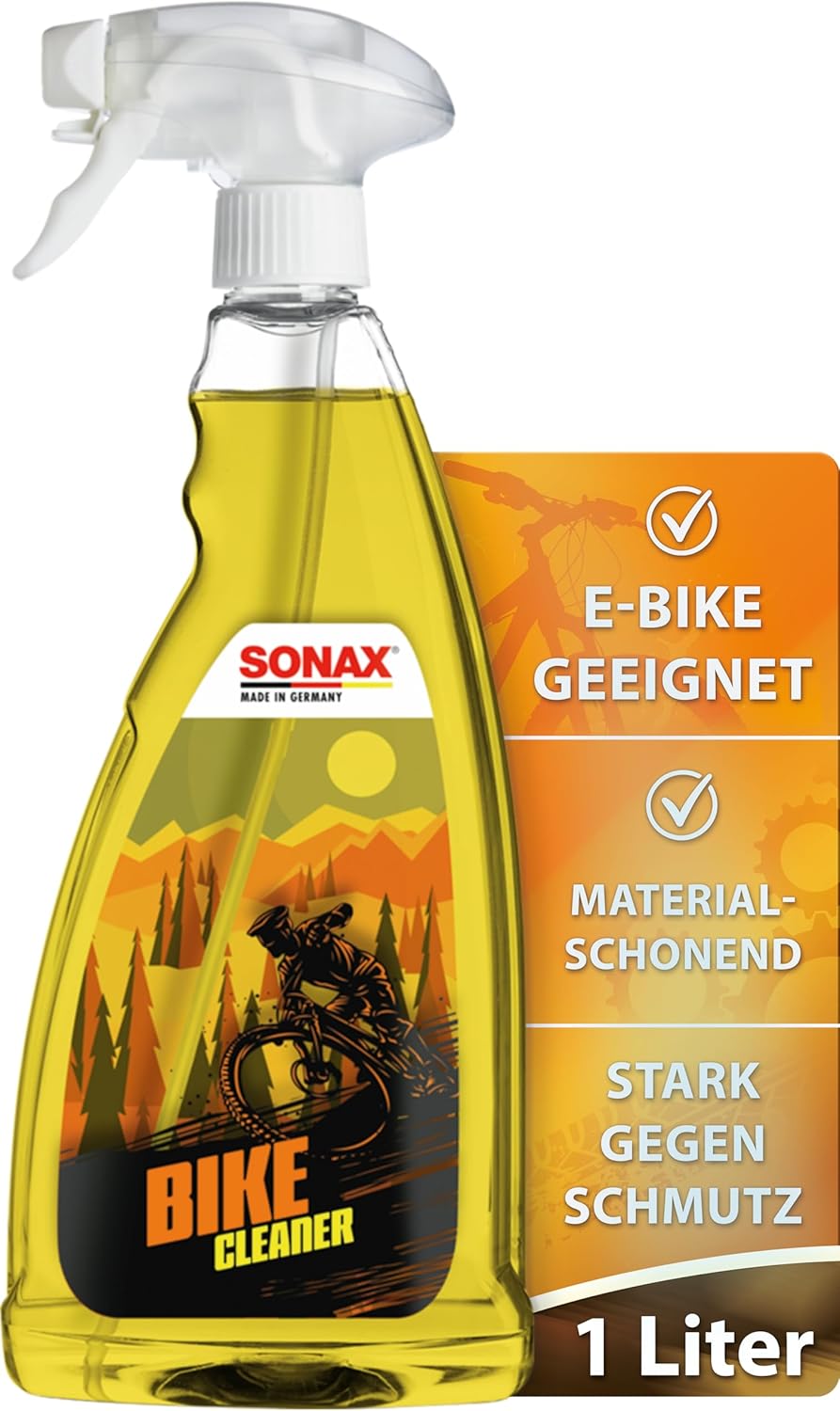
A specialist bike cleaner is meant to loosen dried road film, mud and oily grime before the final wipe. The practical differences are less about grand promises than about how the liquid leaves the bottle, whether it stays on a vertical surface, how long it needs to sit and how much residue remains after rinsing. This guide covers 11 bike cleaners, with the Sonax Bike Cleaner taking the top spot and two distinct alternatives following it.
What follows is recorded testing, translated. Nobody at Truthful Reviews has used any of these cleaners.
What was measured
Two repeatable dirt mixtures were prepared. Potting soil and clay were combined in equal parts, then water equal to half that quantity was added. A second batch used the same base with 3 tablespoons of cooking oil to represent oil-bound grime; cooking oil was selected because it held the dirt more firmly than bicycle oil.
Both mixtures were spread onto painted aluminium panels and dried in sunlight. Each panel carried the mixture without oil on the left and the oily version on the right, allowing the same cleaner to face both deposits. The panels were stood vertically, which also made it possible to see whether a foam or liquid stayed on the surface or ran away before it could work.
Every cleaner was applied according to the directions on its bottle. Where those directions called for a damp bicycle, the panel was briefly pre-wetted with a gentle stream; products intended for a dry bicycle went straight onto the dry panel. Any stated dwell time was observed. The spray head, coverage and adhesion were assessed during application, alongside the legibility and clarity of the printed directions.
Rinsing began with cold water and a gentle stream. A stronger stream was used only after the gentler one stopped removing solid dirt, and rinsing continued until those solid particles were gone. The result was then photographed. This method does not reward a cleaner merely for making plenty of foam: the useful result is how effectively it loosens both ordinary and oil-bound grime, and how little fine residue is left for a cloth to collect.
What separates one bike cleaner from another
Foam matters chiefly because it keeps the product in contact with dirt. A dense foam can cling to a painted panel while a watery formula drains down it, so two cleaners with similar final results may still feel very different to apply. The spray head matters for the same reason: an even, efficient pattern wets a useful area quickly, while a weak or very narrow jet makes full coverage slower.
Application also differs before the trigger is pulled. Some products go onto a dry bike, which can mean using more liquid to wet a thick layer of dirt. Others start on an already damp surface. Finish Line adds a third option because its cleaner can be used on either a wet or dry bike, or added to water.
None of the leading results made the finishing cloth completely redundant. Even the winner left a few very fine traces of clay on the white panel after rinsing, although they came away easily with a dry microfibre cloth. That makes the amount of follow-up more informative than a simple claim that a cleaner works without contact.
Chain coverage is another genuine point of difference. The Sonax cleaner was the only recommendation here also intended for chain cleaning. Liqui Moly and Finish Line both need a separate product for that part of the bike, as do several products in the wider field.
The picks
Top pick — Sonax Bike Cleaner
The Sonax Bike Cleaner put together the strongest all-round result. Its well-shaped spray head was practical and efficient, producing a slightly thick yellow foam that adhered very well to both paint and dirt. Because it stayed where it landed, the bottle covered the test area without the wasteful run-off seen with thinner formulas.
It was applied to a dry panel and left for 5–10 minutes before rinsing. Both the oil-free and oil-bound mixtures came away cleanly. A few extremely fine clay traces remained on the white surface, but a dry microfibre cloth removed them without effort. The result therefore combined strong loosening performance with very little finishing work.
The directions were easy to understand, albeit printed rather small. A light citrus smell made the application more pleasant than many of the stronger-smelling alternatives. It is also the broadest of the three recommendations in application scope because it can be used on the chain as well as the rest of the bicycle. Effective spraying, good adhesion and the clean result explain why it remained the overall favourite.
Search Amazon UK · Search Amazon US
Best for a damp-bike start — Liqui Moly Bike Cleaner
The Liqui Moly Bike Cleaner matched the winner closely on cleaning performance but uses a different routine. The panel was wetted first, after which the productive spray head laid down a light, comparatively fluid foam. Despite that thinner consistency, it adhered well to the paint and contamination rather than immediately running off.
Its dwell time was shorter at 2–3 minutes. The foam and loosened dirt then rinsed away readily, though the last marks still needed a pass with a soft, dry microfibre cloth. The printed directions were both easy to read and simple to follow, and the smell was pleasantly fruity without being intrusive. The main limitation is scope: it is not intended for the chain, so that job requires a separate cleaner.
Search Amazon UK · Search Amazon US
Most flexible application — Finish Line Super Bike Wash
Finish Line Super Bike Wash is the versatile recommendation. It can be sprayed onto a wet bicycle or a dry one, and it can also be mixed into water as a washing additive. The spray head placed its fine foam accurately, and the foam held well on both the painted surface and the dirt while it worked.
After the prescribed wait it rinsed away with the loosened contamination. As with every other product in the field, a light wipe was needed to remove the smallest remaining traces. Its smell was neutral rather than prominent, and the directions were clear and legible. Cleaning was good and the range of application methods sets it apart, although it is not intended for chain cleaning.
Search Amazon UK · Search Amazon US
Also tested
Antidot Bike Reiniger — cleaning was good and the remaining fine traces wiped away easily after a 2-minute wait, but the spray head delivered such a narrow, fine jet that covering the dirty area took noticeably more effort than with the recommendations. Search Amazon UK · Search Amazon US
Motorex Bike Clean — it cleaned well on a pre-wetted panel and its foam adhered properly, but the bottle directions were printed so small that they were difficult to decipher; once read, the instructions were clear, and the product is not intended for the chain. Search Amazon UK · Search Amazon US
Springer RX3000 — the cleaner produced a good result and had a pleasant smell, yet its watery consistency meant more was needed to soak dirt on the dry panel; after 5–10 minutes, rinsing and a small amount of wiping removed the residue, while chain cleaning remained outside its stated use. Search Amazon UK · Search Amazon US
Holmenkol Natural Bike Wash — cleaning performance was good and the directions were clear and legible, but even the foam ran off readily, so more product was needed on the dry panel; its smell was also unpleasant, and it is not intended for the chain. Search Amazon UK · Search Amazon US
Muc-Off Nano-Tech Fahrradreiniger — cleaning was good, but the tested bottle's tiny black directions were hard to distinguish against the translucent bottle and bright pink liquid; there were no German directions, its QR code also led only to English instructions, the smell was unpleasant and chain cleaning was excluded. Search Amazon UK · Search Amazon US
Nigrin Fahrradreiniger — the foam formed well and clung to the dirt, but the cleaning result was only middling and the smell was strongly unpleasant; it was not intended for the chain and did not earn a recommendation. Search Amazon UK · Search Amazon US
WD-40 Specialist Fahrradreiniger — foam production and adhesion were good, yet the cleaner left several residues after rinsing and its smell was strongly unpleasant; the recorded cleaning result was weak, chain use was excluded and it was not recommended. Search Amazon UK · Search Amazon US
Dr. Wack F100 Fahrradreiniger — the bottle was awkward to handle and its very weak spray struggled to penetrate the contamination, leading to a poor cleaning result and the clearest rejection in the field. Search Amazon UK · Search Amazon US
Verdict
The Sonax Bike Cleaner is the most complete choice from this group. Its spray head lays down dense, tenacious foam, the 5–10-minute dwell loosened both kinds of test dirt, and only the finest clay traces needed wiping away. It also covers chain cleaning, unlike the two other recommendations.
Choose the Liqui Moly Bike Cleaner when a damp-bike start and a shorter 2–3-minute dwell suit the job better. Choose Finish Line Super Bike Wash when flexibility matters most: wet, dry and water-additive application all come from the same bottle. Across the rest of the field, the recurring compromises were runny texture, weak or overly narrow spray patterns, hard-to-read directions and more residue after rinsing.
For more cycling kit, see our bike lock guide and bike GPS computer guide.