An electronic bite alarm does one job: it tells you a fish has taken the bait when you are not watching the rod tip. Ten of them were put through an extended test, and the differences turned out to be larger than the near-identical cigarette-packet housings suggest. Some are audible across a whole bank; one measured barely louder than conversation. Some hold a light for half a minute after a delicate pluck; others go dark in a dozen seconds. And several will not physically take anything thicker than an ultra-slim carbon blank.
What follows is recorded testing, translated. Nobody at Truthful Reviews has fished with any of these.
How an electronic bite alarm works
Inside the plastic housing, the line usually runs over a rubber wheel carrying one or more magnets. Occasionally the line's movement is read by a light barrier instead. When a fish takes the bait and pulls line, or gives line, the rotating magnets trigger a sensor, which signals the take by tone, by LED, or by both. Depending on the method being fished, the line is weighted with a swinger mounted either on the rear rod rest or on the alarm itself.
The units fasten by a standard thread directly onto a rod pod — the combined rest for up to four rods — or, where rods are set out singly, onto the front rod rest or bankstick in place of the ordinary rest.
There is also a second family that clips straight to the blank under spring pressure. It makes no difference whether the rod is standing steeply in the rest for ledgering or lying horizontally for other species. On some of these the line does not run over a rubber wheel at all: it is threaded under tension around two small lugs, and when the fish moves the line tightens, the rotatable sensor turns, and light and sound follow. Alarms of this type stay on the rod while you are playing a fish and while you are casting.
Single unit or a set with a receiver
Whether you want individual alarms or a set with up to four heads and a wireless receiver depends on how many rods you fish and how far apart they are along the bank. A receiver picks up the bite signal from a given rod in fractions of a second and repeats it — in that alarm's own colour, and usually audibly as well. Red, green, blue and yellow are the conventional assignments, so you can tell at a glance which rod has gone. If your chair and shelter are pitched right beside the pod, or you are fishing a single rod, you do not strictly need remote transmission. The option is useful all the same.
Some systems send a Bluetooth signal to a phone app instead, which lays out clearly which rod is producing the take. A quoted range of 40 metres is shorter than a classic radio link, though whether the 200 metres some manufacturers advertise is either useful or practical in the real world is another question.
Reading the light
When a fish takes the bait and moves off, the alarm signals by light, by tone, or by both, for as long as the line is running. Some units carry only a small, barely proud LED that is not always easy to see at a distance; depending on your viewing angle and the shape of the bank, a weak lamp of that sort is easily missed, and the rod blank itself can hide a single flush-mounted light. A vertical row of LEDs is far better — up to eight lamps lighting in sequence according to how hard the fish is pulling. Other makers add a glowing sensor wheel. On the best of them the LEDs sit in the tips of the snagbars, which makes them visible all round and at long range.
Identifying the right rod is helped by the afterglow function, a white or blue LED that can hold for up to 30 seconds. That matters because a cautious bite may last no longer than a blink, or amount to a few centimetres of line.
When the fish takes the bait and swims towards the rod, the line does not tighten and is not pulled from the spool: it simply falls slack. That is a drop-back, and most electronic alarms will show it too if the line has been weighted for it — an LED bar may flash in reverse order, for instance.
Sound, sensitivity and controls
Beeping and rasping signals can feel intrusive outdoors, but they earn their place, particularly through the night when attention drifts. Depending on background noise, distance to the rod and personal taste, tones from high to low can be picked at a range of volumes. Four tone options was the minimum in this field and the choice is often wider. More important than the number of options is the maximum volume. Some units use different tones for a run and for a drop-back, so you know what is happening before you reach the rod.
Fish are choosy and often only nibble and pluck at a bait, taking barely a centimetre or two of line. So that timid bites are not missed, sensitivity should ideally be adjustable. The catch is that a very sensitive setting also raises the chance of a false signal: gusts, current, floating debris, or a deep-bodied bream swimming past can brush the tight line and set the alarm off. Those cannot be designed out altogether, and the right setting is a judgement about conditions and species rather than a fault in the alarm.
On/off, volume (usually marked V), tone (T) and sensitivity (S) are handled either by buttons or by small rotary controls. Depending on the feature set, a unit may have a single button or as many as seven separate switching options, and doubled-up functions can be confusing when you use the alarm only occasionally and the instructions are no longer to hand — or have turned to pulp. The bigger risk is that markedly protruding controls can snap. Not every box includes a protective sleeve, and unprotected units get knocked about in a bag or a box. Whether you prefer a knob or a button is largely taste; what matters is that the controls are clearly marked and easy to read.
The rod rest and snagbars
The roughly semicircular rod rest on top of the unit varies a great deal in shape and finish. Some will take only an ultra-thin carbon blank of 16 millimetres diameter; others leave more room, enough for a heavier or older glass-fibre rod. Since a modern carbon rod is a significant investment, the rest ought to be rubberised or otherwise padded to protect the blank.
Snagbars — the roughly three to four centimetre screw-in or telescopic posts either side of the rest — should be fitted or at least capable of being retrofitted. The line from a rod on the rest does not always point straight forward out of the tip ring, and where the angle is pronounced and a fish goes off on a fast, powerful run, a rod without snagbars can be pulled off the alarm altogether.
Water resistance and what is in the box
Every manufacturer certifies its alarms as water-resistant to a greater or lesser degree of precision, which is essential given where they are used. On several units you can get a rough look inside through the battery compartment and see sealed and generously potted boards. The compartment lids themselves, though, show no gaskets — there is no rubber or silicone to be found.
Only the larger wireless sets normally include a properly protective hard case; single units usually arrive with no sleeve at all, so one has to be bought separately if the alarm is to last. Batteries are usually missing too, and nothing beeps or blinks without them. Often the size required is AAA; 9V blocks tend to last longer.
The picks
Top pick — Anaconda Blaxx iP set
Nothing else in the test got near it. The telescopic LEDs on the tips of the snagbars are very easy to see from every direction and angle, with no rod blank in the way of the indication. When a fish takes, a volume-selectable signal sounds very loudly at 80 dB, unmissable at distance. The relevant LED and the single-magnet sensor wheel then hold their afterglow for a good 20 seconds, in combination with selectable tones that differ for a run and a drop-back — a comparatively good figure. The last of the measurements is the rest, which at roughly 21 millimetres across takes slightly thicker blanks, or lets you set the banksticks closer together where the bank demands it.
It was tested as a set. The receiver pairs with up to four transmitters and is straightforward to operate and program with the detailed manual supplied. Three clearly marked buttons — S, power on-off, and T — keep operation simple. Volume adjusts through seven steps, and the eighth is silent for when you want a quiet bank, leaving only the LED. Trigger sensitivity is broadly variable too: you can set anywhere from around 2 centimetres of line movement for very cautious bites up to about 8 centimetres for a confident take, according to the species expected.
Three small marks against it, all on equipment and box contents: there is no permanently selectable night light on the transmitters, there are no batteries in the set, and the rests are not rubberised. That said, transmitters and receiver each run on two ordinary AAA cells, and the rests are at least not especially hard, being finished in the same soft-touch material as the rest of the units. On the credit side, the transport case is sturdy and very well padded inside, which suits sensitive gear. One detail stands out: the foam has a factory cut-out that would have taken exactly six AAA cells, and they could easily have been included.
As standard the transmitters carry an 8 mm thread with a sealing O-ring for mounting on a stick, plus a 2.5 mm jack socket for optical indicators. Taken together, very good measured results, good handling and a good feature set add up to a good overall showing in this field.
Search Amazon UK · Search Amazon US
Alternative — MK Angelsport Carbon set
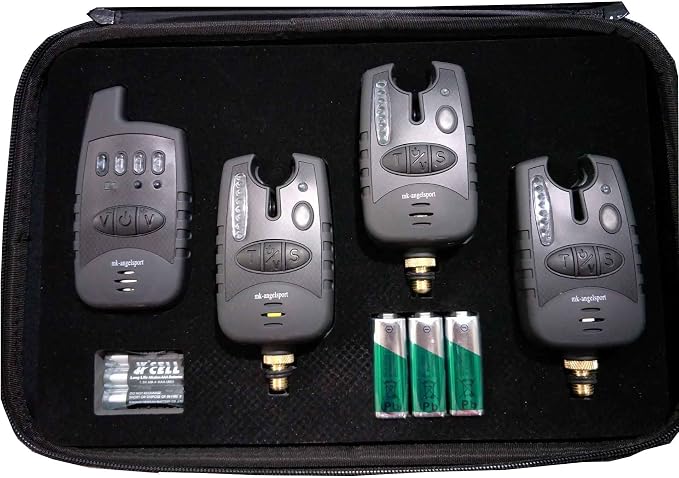
Sold only as a set, and it scores well in every category. The set tested came with three transmitters in a robust, well-padded bag; a four-transmitter version is also available, which is the maximum the receiver will manage. Every battery needed is included — 3 × AAA and 3 × 9V blocks — sitting in matching cut-outs in the foam.
The transmitters are bright and clear. Eight vertical LEDs light according to the strength of the bite and are easy to see at range. The optical indication is backed by seven different, loud tones that are simple to set. Afterglow at 30 seconds is among the longest in the test. Drop-back indication is there, as is a night light for finding the set-up in the dark, and trigger sensitivity is variable. Operation via four buttons on the transmitters is clear and manageable.
The one real limitation is the width of the rod rest, which stops at 16 millimetres. These alarms therefore suit only extra-slim specialist rods, or have to be mounted correspondingly far from the rear rest. The rubberised lining in that rest is good, and an expensive rod sits comfortably in it.
Two other gaps. There is no proper manual in the set — the English notes and small pictures are too sparse. And no snagbars are fitted, nor can they be retrofitted directly to the unit, so the equivalent hardware has to be added to the rod pod instead. A kit of that sort is inexpensive.
Search Amazon UK · Search Amazon US
Alternative — Balzer MK-BT
Thoroughly up to date, this one sends its signals to a clear, adjustable, free app. The app shows the connection status, the transmitter's battery level, and a run or a drop-back in different colours, tones and volumes. That saves a device outright: no separate receiver is needed.
In testing the transmitter returned good results overall. Coloured LEDs and the sensor wheel are very clearly visible, and a white diode holds an afterglow for up to 20 seconds. Volume from the transmitter alone is 77 dB, comfortably audible, and it can also be set from the phone. The rest is well judged at roughly 20 millimetres, wide enough for slightly thicker blanks, though there is no protective rubberising.
With no batteries and no case, the equipment is a little thin, and where the screw-off snagbars are supposed to live is anyone's guess — they can easily drop off during fitting or removal, at which point finding them in the bankside grass is unlikely. Handling, on the other hand, is exemplary: the four buttons and the on/off switch are clearly labelled and easy to use, tone, volume and trigger sensitivity are all variable, and three inexpensive AAA cells provide the power.
Its Bluetooth range is the stated 40 metres, shorter than a classic radio set-up.
Search Amazon UK · Search Amazon US
Also tested
Angel-Berger Elektronischer Bissanzeiger — closely resembles the MK Angelsport Carbon and shares its strengths and weaknesses. The vertical LED strip is very easy to see from all angles and is not hidden by the blank, maximum volume is a good 76 dB, and the buttons and switches are clearly marked and easy to use, with tone, volume and trigger sensitivity all adjustable. Afterglow runs to 20 seconds, enough to identify the alarm even after a slightly delayed reaction, and drop-back indication and a clearly visible night light are both built in. Against it: no manual in the carton, no 9V block battery, no protective case, no way to retrofit snagbars directly, and a rest suited only to slim sections up to about 16 millimetres — though that rest is at least rubberised. Search Amazon UK · Search Amazon US
Discoball Bite Alarm Sound & Light — calling a unit with only two small LEDs a Sound & Light model is a stretch, and visibility is satisfactory at best. At maximum it is genuinely loud, measuring 80 dB, so it carries a long way. Afterglow on a run or drop-back is well judged at roughly 28 seconds, and rest width is satisfactory at about 19 millimetres. There is no rubberised surface, and the side walls of the rest are very shallow, so the rod can be pulled sideways off it — the more so because there are no snagbars and none can be retrofitted directly. The buttons are clearly marked and respond well, and tone, volume and sensitivity are all variable. The list of negatives is long: no night light, no manual, no case, and no 9V block battery. That battery clamps directly into a very tight housing with no short lead and connector, and cannot be got out again without a pointed tool. Search Amazon UK · Search Amazon US
Caperlan Xtrem 500 — whether seven separate buttons make operation easier is debatable, particularly with no German manual, though the pictograms are logically drawn. Visibility of the two small LEDs is only satisfactory: both sit exactly level with the rubberised rest, so depending on your viewing angle one of them can be hidden by the blank. Volume is only adequate at 67 dB. Afterglow, by contrast, is rated very highly — 30 seconds is the best figure here. Rest width of roughly 20 millimetres gives relatively free rein in rod choice and stick positioning, and tone, volume and sensitivity are all adjustable. Snagbars are absent but can be retrofitted; the 9V block battery and a protective case are not included. The transmitter can in principle be combined with a receiver and programmed to one of four colours. There is no night light on this model. Search Amazon UK · Search Amazon US
NGT VX2 — a small unit and a loud one, at a measured 78 dB almost very loud. Afterglow is good at 20 seconds, as is visibility of the LEDs, which sit clearly below the rest. NGT is one of the few makers to include a nylon bag, albeit an unpadded one. The negatives run longer: snagbars are neither fitted nor retrofittable, there is no night light and no manual, the rest is only 16 millimetres wide with no rubber protection, sensitivity cannot be changed, and the optical and audible signals for a run and a drop-back are identical. The very specific LRV08 / 23A 12V battery is not included. Search Amazon UK · Search Amazon US
Coolnice Fishing Bite Alarm — the button cells supplied can only be fitted with a tool, but after that the alarm is ready at one press. Unlike most of the field it clips straight onto the blank under spring pressure, and the rod needs to be at least 12 millimetres thick at that point or it will not hold. To arm it you thread the line around two protruding lugs on a sensor wheel, putting it under tension; when a fish plucks at the bait the line tightens, the wheel turns, and a very loud, non-adjustable tone sounds while a tiny LED flashes to the left or right of the rod, depending on how the plastic clip is fitted. The list of minus points is too long to set out in full, but as a quickly deployed alarm for ledgering or float fishing the three-piece set is interesting. Search Amazon UK · Search Amazon US
Cormoran Pro Carp X 8000 — light and shade in roughly equal measure. Three rotary controls for tone, volume and sensitivity are clearly marked and easy to operate. Loud it is not: at 63 dB it is in fact notably quiet. Drop-back indication and the adjustable night light are very useful. After a bite, though, the afterglow lasts only about 15 seconds, which is very short. Rest width is good at roughly 21 millimetres but unprotected, snagbars cannot be retrofitted directly, and there is no case, no block battery and no proper manual. Visibility of the vertical LED band is poor as well, since it is set deep in the housing and does not stand proud, and the LEDs sit almost exactly level with the blank, so from some viewing angles they are barely visible or not visible at all. Search Amazon UK · Search Amazon US
DAM Pro Tronic — just two well-marked rotary controls for volume, on-off and tone leave few questions about operation. Two LEDs are mounted exactly level with the rod on the rest, which hampers visibility, and afterglow is not ideal at roughly 13 seconds. The rest does at least allow diameters up to 18 millimetres, and maximum volume of 72 dB sits mid-field. A long list of shortcomings holds it well back in the field: no block battery, no protective case, no snagbars, no rubberising on the rest, and no adjustment of trigger sensitivity. Search Amazon UK · Search Amazon US
How they were assessed
The alarms were scored across four categories — equipment and box contents, handling, functions, and the practical test — against 20 criteria in total.
Under equipment and contents the assessment covers whether batteries, a bag and snagbars are included and whether the rod rest is rubberised. Most of these alarms are sold in several different sets, so what arrives in the box varies.
Handling covers whether a comprehensible manual is supplied, whether buttons and switches are clearly marked, and whether tones, volume and sensitivity can be varied.
The functions category looks at whether the night light, drop-back indication and LED colour can be set, and whether Bluetooth transmission to a phone is available.
The practical test carried the most weight, at 45 per cent of the overall score. Maximum volume was measured from two metres away on a simulated bite using a sound-measurement app; the duration of the afterglow function was timed with a stopwatch; and the width of the rod rest was measured with a tape. Visibility of the various indicator LEDs was then judged from a range of angles with a rod resting in place.
The short answers
Which electronic bite alarm is the best? The Anaconda Blaxx iP. Optical and audible signals are both very good — easy to see, and very loud. As a set it adds practical details such as telescopic snagbars that cannot be lost, a relatively wide rod rest and a sturdy protective case.
How should the ideal bite alarm be specified? Alongside very good visibility and audibility from every angle and at distance, the rod rest should be on the wider side and rubberised. Snagbars stop the rod slipping off the rest by accident. Tones, volume and sensitivity should each be adjustable, and the buttons or rotary controls for them clearly labelled and easy to use. A night-light function for finding the set-up in the dark is very practical. On the functions side, a drop-back should be indicated too, ideally with a different tone from a normal run.
Do you actually need a wireless receiver? It depends. If you spread rods over a long stretch of bank, or you are on a very long session and attention starts to wander, a receiver or an app within range is worth having. For shorter trips with a manageable number of rods set out close by, a remote indicator is not essential.