A head torch is one of those tools you forget about until the moment you desperately need both hands and some light — fixing a bike in the dark, walking the dog on a winter evening, camping, running a trail, or peering into the back of a cupboard. A good one throws a bright, even beam exactly where you look and stays comfortable for hours. Fifty-nine head torches were tested for this guide; these are the recommendations that came out of it.
The short version
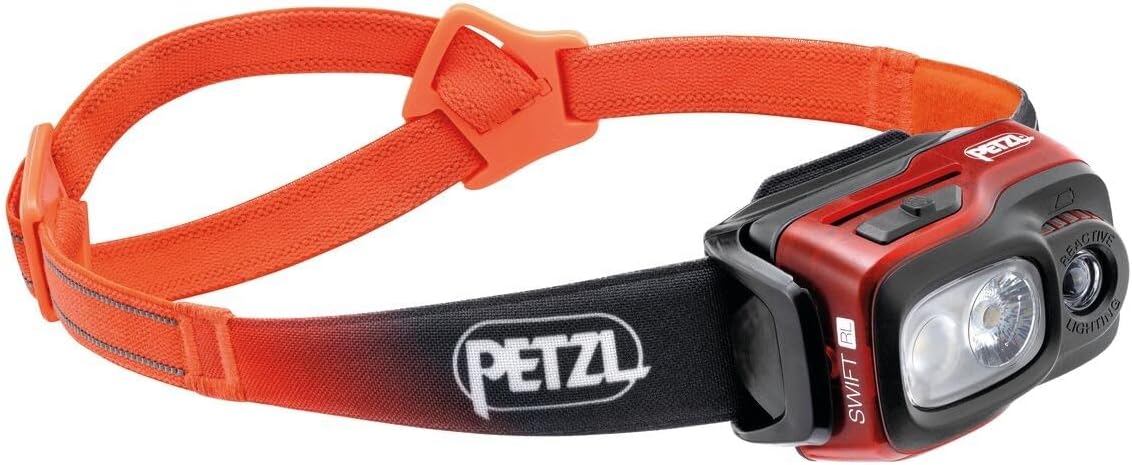
Test winner: Petzl Swift RL
The Swift RL was the test winner in its previous generation, and the current version holds the title. It is compact and light as ever, but has been brought up to date: it now charges over USB-C and puts out 1,100 lumen, up from 900 in the outgoing model.
Its headline trick is reactive lighting — a sensor reads the scene and adjusts brightness automatically, so the beam brightens when you look down a trail and dims when you glance at a map or a companion's face. That saves battery and spares everyone's night vision. Operation is intuitive, there is a lock function to stop it switching on in a pack, and the headband is adjustable. The price-to-performance balance is rated at the top of the field.
Check the price on Amazon UK · Search Amazon US
Robust all-rounder: Zweibrüder ZB5H
Zweibrüder is a new name in head torches — a brand that emerged from Ledlenser — and the ZB5H is a compact, very robust and still affordable lamp aimed at a broad range of users.
The controls are the standout: rather than burying too many sub-modes behind a single button, it uses two switches — a slider preselects the mode, then a push button switches on and dims. It comes with a generous set of accessories and runs on either its rechargeable battery or disposable cells, which makes it a sensible choice for expeditions where you cannot count on a socket. Mountaineers, tradespeople and campers are the natural audience.
Check the price on Amazon UK · Search Amazon US
Minimalist: Petzl Swift LT
Petzl's lamp for minimalists weighs less than 50 grams and, as the maker puts it, fits in the hollow of your hand. Plenty has been left out to get there: the headband is two thin stretch cords, the housing is shrunk to a compact block, and the fixed 880 mAh battery takes up little room.
At 380 lumen with very good, broad close-range illumination, it is no powerhouse — the beam range is short and it is only rain-resistant rather than properly waterproof — but it is precisely tuned to its audience. It suits trail runners and alpinists, anyone who wants as little weight on their head as possible during fast activity, and anyone after an emergency lamp that packs down to almost nothing.
Check the price on Amazon UK · Search Amazon US
Premium: Lupine Penta Pro
The Penta Pro is for light aesthetes. The build quality is beautiful, operation is easy, and the illumination is excellent — reactive too, when you want it. Yet the 1,400-lumen lamp stays pleasantly discreet rather than shouting about itself.
Lupine offers it with a choice of external battery packs: 22 Wh / 3.1 Ah or 25 Wh / 3.5 Ah SmartCore. The drawbacks are the obvious ones — it is expensive, and somewhat heavy.
Check the price on Amazon UK · Search Amazon US
Price tip: Lepro head torch
"A lot of performance for little money" sums the Lepro up, and it took the test's price tip. At just under 160 grams it is not the lightest lamp here, but it answers with 2,200 lumen and a solid aluminium housing that makes it genuinely robust. The maker rates it IP65, meaning completely dust-tight and protected against splashing water, and the battery is replaceable.
What it does not have is the cleverness of the Petzl models — there is no reactive sensor here. If you simply want a lot of light on your forehead for occasional jobs, it is the sensible choice.
Check the price on Amazon UK · Search Amazon US
Also tested
Several other strong lamps featured without making the recommendation list. The Ledlenser HF6R Signature earned an innovation tip, and the Silva Explore 5, Fenix HM70R, Klarus HM1, Ledlenser HF8R Signature, Black Diamond Distance 1500 and Olight Perun 2 Mini are all worth a look if the picks above do not suit.
What to look for
Brightness. Light output is measured in lumen, and the rule of thumb is more than 100 — in this test there is essentially no good lamp that falls below that minimum, which not long ago was considered a maximum. More is not automatically better, though: how well a lamp illuminates matters more than its headline figure. A head torch should light a field of view well enough that you can pick out details on and beside the path while walking briskly or running on uneven ground in the dark. Some lamps fail even that, particularly cheaper ones where the reflector has been poorly designed.
Reactive lighting. The cleverest lamps carry a sensor that brightens automatically when you look into the distance and dims when you glance at something close. It saves battery and spares everyone's eyes, and it is the standout feature of the Swift RL and, on demand, the Penta Pro.
Construction type. The tested field splits into three: compact lamps with the battery built into the headlamp; lamps with an external battery at the back of the head; and plug-in lamps, where the body and battery slot into a holder on the headband. Which suits you depends on use — and it is genuinely useful when the lamp doubles as an ordinary torch.
Weight. For running, trail running and other fast sports, aim for around 100 grams. Hiking and gentler activities tolerate more. Once you go well beyond 200 grams it becomes unpleasant — unless you are a caver, use a lamp professionally, or simply want to impress your friends.
Charging. The recommendation increasingly falls to USB, for a simple reason: built-in rechargeable cells are generally more sustainable than disposables. And while any cell eventually reaches the end of its life, on most of the more expensive lamps it can be replaced or bought separately.
Water resistance. Outdoor electronics carry an IP rating, and three matter here: IPX8 protects against water ingress on complete immersion (to one metre for 30 minutes); IPX6 protects against ingress during brief immersion; and IPX4 means splash-proof from any direction. Treat lamps with no certification at all with caution — there is no guarantee they will survive contact with water.
Brightness and the outdoors. One question the test deliberately leaves open is how bright a head torch should be. It is a sensitive subject for conservationists, and worth keeping in mind as a responsible user of the outdoors.
How the lamps were tested
All 59 lamps were used on running routes, hiking and bivouac tours and camping trips in late autumn and early winter — and above all checked against what the makers promise on the packaging.
The assessment covers handling (do you have to contort your fingers to reach the buttons?), whether a lamp is light enough to take on a trail run or is really a work lamp too heavy for sport, headband comfort, runtime and output, and whether operation is intuitive or needs several trips back to the manual. Operability with and without gloves is judged separately. The IP protection rating is decisive at the end: is the lamp merely splash-proof, or can it be submerged for longer? Finally, price-to-performance carries real weight — can the price be justified by what the lamp actually does?
Which should you buy?
Start with what you will use it for. For the best all-round head torch with bright, clever reactive lighting, the Petzl Swift RL is the one to buy. If you want maximum robustness, many modes and the option of disposable cells, take the Zweibrüder ZB5H. If every gram counts, the Petzl Swift LT is superb, provided you accept a short beam range and rain resistance rather than waterproofing. The Lupine Penta Pro is the choice if you want the finest build and illumination and will pay for it. And if you simply want a great deal of light for very little, the Lepro is the price tip.
Whichever you choose, match the brightness and beam to your use, favour a comfortable adjustable strap, keep the weight near 100 grams if you run, and check the IP rating for British weather.