Japanese saws cut on the pull stroke. That tension lets manufacturers use a thin, flexible blade, producing a narrower kerf and giving the tool a different feel from a conventional push saw. The useful question is not simply which one is sharpest, but whether its blade geometry matches the work: a single-edged Kataba, double-edged Ryoba or fine, backed Dozuki.
What follows is recorded testing, translated. Nobody at Truthful Reviews has used these saws.
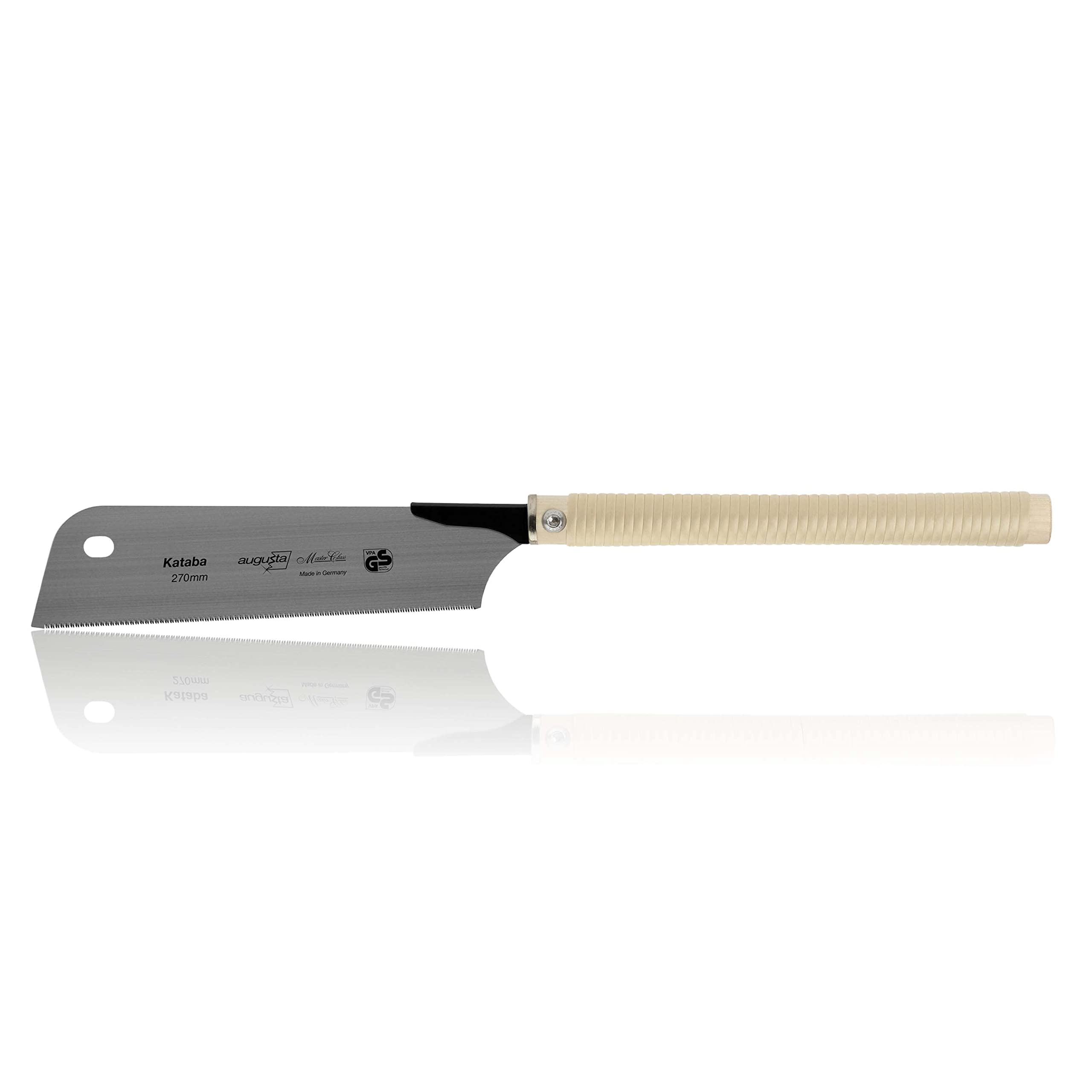
Thirty models were assessed across the test's updates. The current named field contains 24 saws, all retained here: four recommendations followed by compact coverage of the other 20. The Augusta-Heckenrose 44020 270 AMA remains the best choice for most people because it paired a thin, accurate cut with straightforward handling in both soft and harder wood.
Kataba, Ryoba or Dozuki?
A Kataba has teeth on one edge and no full-length reinforcing spine. Its blade can therefore make deep separating and mitre cuts, and its un-toothed back makes it the more suitable shape for flush cuts against a surface. The test also found the somewhat thicker Kataba format easier to control when learning to use a pull saw.
A Ryoba has two working edges. Fine, trapezoidal teeth handle crosscuts, while more widely spaced triangular teeth clear the waste from rip cuts along the grain. That versatility makes a Ryoba the natural all-rounder, but set teeth on both edges can scratch the face of a workpiece during a flush cut.
A Dozuki combines an especially thin, finely toothed blade with a rigid spine. The spine guides precise, narrow cuts and suits detailed joints such as dovetails, but it also stops the blade once the cut reaches a fixed depth. These construction differences matter more than treating every Japanese saw as interchangeable.
How the saws were assessed
Each saw first received a visual and handling check covering finish, tooth condition, grip construction, material transitions and loose or rattling parts. Marked right-angled pieces were then cut from timber. Rip cuts and crosscuts were made in soft and harder wood, after which accuracy, tracking, kerf quality, tear-out and surface defects were compared. Identical sections of wooden strip provided a final comparison of cutting speed, guidance and blade stability.
The recommendations
Top pick — Augusta-Heckenrose 44020 270 AMA
The Augusta Kataba was cleanly assembled, with no wobble or rattle. Its 30 cm ash handle is raffia-wrapped and capped with metal, while the flexible 270 mm C75 strip-steel blade carries fine, three-sided pull teeth and a short steel back. A hex screw holds the blade firmly; replacement is easy once the matching key is to hand, but it is not tool-free.
In soft and harder wood, the saw started quickly without juddering and moved through the test strip with little effort. Rip and crosscut edges were thin and exact, generally needing no sanding. It also cut a wooden dowel flush cleanly. That combination of pace, accuracy and uncomplicated control explains why this single-edged model leads the field.
Search Amazon UK · Search Amazon US
Best all-rounder — Wolfcraft 6951000
The Wolfcraft is a Ryoba with a 32 cm grooved rubber handle and a 0.6 mm stainless tool-steel blade. Its grip matched the top pick for handling and did not collect sawdust as some rubber surfaces did. A knurled screw releases the blade without tools, although the tooth covers were awkward to slide into place.
Fine trapezoidal teeth produced good crosscuts in soft and hard wood, while the coarser triangular edge tracked reliably on rip cuts. Its kerf was wider than the Augusta's because the blade is thicker. The only cutting-specific weakness appeared when trimming a dowel flush: the set teeth left light scratches on the surrounding surface.
Search Amazon UK · Search Amazon US
For small, detailed work — Heatigo Zweischneidige Zugsäge
At only 31 cm overall, the Heatigo is a compact Ryoba rather than a full-sized all-round saw. Its double-edged blade combines 11 and 17 TPI teeth, and the short beech handle was comfortable despite its knife-like shape. The blade cannot be replaced.
Its strength was fine work. Clean, exceptionally narrow rip and crosscuts were recorded in both soft and harder wood, and the saw also cut plastic and small branches. The compact blade was easy to manoeuvre around model-making and mitre work. As with other double-edged saws, however, the set teeth could mark a surface during flush cutting.
Search Amazon UK · Search Amazon US
Best folding saw — Z-saw Tuck-In Carpentry 240
The Carpentry 240 folds to 27 cm and locks its blade at two working angles. Its aluminium die-cast mechanism engaged positively, and the 20 cm rubberised handle remained usable with one or two hands. The blade itself is 240 mm long and 0.6 mm thick.
It cut hard wood, thick boards and battens quickly, with a clean start and tidy rip and crosscuts. The kerf was broader than the winner's much thinner cut, so this is not the first choice for the finest joinery. Its convincing cutting performance and compact folded form make it the strongest portable option in the recommendation set.
Search Amazon UK · Search Amazon US
Also tested
Augusta-Heckenrose 44019 240 AMA — this Dozuki's 240 mm, 0.3 mm blade made very clean, thin crosscuts and shortened a batten quickly, though its steel spine limits cutting depth. Search Amazon UK · Search Amazon US
Augusta-Heckenrose 44021 250 AMA — the sharp, double-edged Ryoba cut well and brought the same raffia-wrapped ash handle as its stablemates, but its unusually soft, flexible blade made control more demanding. Search Amazon UK · Search Amazon US
Germania Qualitätswerkzeuge Japansäge — loose-looking rattan reduced grip quality, harder wood produced an untidy kerf and hesitant progress, and the blade's printed finish left black marks on the workpieces. Search Amazon UK · Search Amazon US
Royal Gardineer NX7794-944 — this Kataba started its cut neatly but worked slowly, made poor rip cuts in both soft and hard wood and left a comparatively wide kerf. Search Amazon UK · Search Amazon US
Hinrichs Japansäge Ryoba 25 cm — a plastic locking screw made blade changes tool-free and general cutting was acceptable, but rip cuts in solid wood lagged behind; the blade also cut plastic. Search Amazon UK · Search Amazon US
Hardtwerk Zen Japansäge klappbar — this Kataba has a 24 cm rubberised handle and two blade positions, but its plastic-button hinge felt less substantial than the Z-saw's and its duller cutting was slowest across solid-wood crosscuts. Search Amazon UK · Search Amazon US
Famex Werkzeuge 5505 Profi Japansäge — a thin pull-cut blade and three-edge Shark tooth pattern gave clean, straight progress in thicker boards, although the saw sometimes jumped at the start; a button removes the blade without tools. Search Amazon UK · Search Amazon US
KLRStec 240mm Ryoba Feinsäge — the blade needed more insertion force than the similar Wolfcraft and Hinrichs designs, then sat firmly; fine and coarse edges produced very good cuts in soft wood and respectable results in solid timber. Search Amazon UK · Search Amazon US
Dictum Ryoba Seiun 240, Power Grip — individually impulse-hardened tips made clean crosscuts, but rip-cut starts juddered in solid wood and the very soft, flexible blade demanded more practice to keep straight. Search Amazon UK · Search Amazon US
Tajima Pull 265ST Zugsäge — the compact Kataba had a well-finished short rattan grip and made reasonable progress, but the blade vibrated deeper in solid wood and sometimes felt as though it skipped; blade release is tool-free. Search Amazon UK · Search Amazon US
Bosch Japansäge Ryoba 250 mm — its 25 cm blade pairs 17 TPI crosscut teeth with a 7–10 TPI rip edge and cut cleanly just behind the Wolfcraft, though with slightly less precision and the same risk of surface scratches on flush cuts. Search Amazon UK · Search Amazon US
Bosch Japansäge Kataba 270 mm — a flexible 270 mm, 0.6 mm blade with 17 TPI teeth made straight, tear-free cuts in hard wood and detailed work, including clean flush cuts; changing it requires a hex key. Search Amazon UK · Search Amazon US
Bosch Japansäge Dozuki 270 mm — nearly 64 cm overall, this Dozuki uses a 270 mm, 17 TPI blade with an almost full-length spine and delivered exceptionally straight, smooth crosscuts and mitres within its limited cutting depth. Search Amazon UK · Search Amazon US
Thorvald Japansäge klappbar 240mm — the 24 cm folding blade locks in two positions and carries ruler and angle markings, but its coarse teeth suit branches, boards and battens better than fine furniture work. Search Amazon UK · Search Amazon US
Ss Shovan Profi Ryoba Japansäge — its tool-free screw was stiff because of a poorly cut thread and the wave-shaped wooden handle had unfinished grooves, while the sharp blade gave passable crosscuts and stronger rip cuts. Search Amazon UK · Search Amazon US
Jorgensen 125mm Japansäge — the 125 mm, 0.4 mm Ryoba blade and 15 cm grip made exceptionally thin, accurate rip and crosscuts, but the soft blade bound readily in hard wood. Search Amazon UK · Search Amazon US
Famex Werkzeuge 5520 Japansäge Dozuki Mini — this micro pull saw left very thin cuts that needed no edge finishing and was easy to guide, but its single working edge made it less versatile than the Heatigo. Search Amazon UK · Search Amazon US
Gartol Japansägen-Set — the Ryoba is marked 17 TPI and 14 TPI, while the pointed second saw also has 17 TPI teeth; both produced broad kerfs and juddered in harder wood, and neither blade is replaceable. Search Amazon UK · Search Amazon US
Workpro 150mm Japansäge — this short Ryoba measures 330 mm overall with a 150 mm fixed blade; it advanced slowly on hard-wood rip cuts, tore soft-wood crosscut edges and could scratch a surface during flush cutting. Search Amazon UK · Search Amazon US
Grüntek Murena — supplied with separate coarse- and fine-cut blades that attach without tools, it tore fibres at the start, drifted from the marked line and left broad kerfs, although rough branch and batten cuts were passable. Search Amazon UK · Search Amazon US
Verdict
The Augusta-Heckenrose 44020 270 AMA is the strongest starting point: its 270 mm Kataba blade combines easy tracking with fast, narrow and accurate cuts, including flush work. Choose the Wolfcraft 6951000 when one double-edged blade must cover rip and crosscuts, the compact Heatigo Zweischneidige Zugsäge for small-scale detail, or the Z-saw Tuck-In Carpentry 240 when a folding format matters. The rest of the field shows why tooth layout and blade stiffness should follow the intended cut rather than a single saw being expected to do everything.