A tool belt keeps small tools and fixings at hand, avoiding repeated trips back to a box or workshop and leaving both hands free between tasks. The useful differences are not simply pocket counts: shape, access, belt construction, pouch position and how everything behaves when loaded matter more. The recorded comparison covered 19 tool belts and aprons, with two used over much longer periods than the rest.
What follows is recorded testing, translated. Nobody at Truthful Reviews has worn or used these tool belts.
What to look for in a tool belt
A typical belt threads a leather or nylon strap through loops on a padded backing, then through broad loops on removable pouches, holders or a drill holster. An apron is different: its pockets are sewn or riveted permanently to the belt and usually face forwards. That makes the contents quick to reach while standing or kneeling, but the fixed layout is less adaptable and the front pouches can obstruct movement in tight spaces.
Pocket totals can mislead because makers count every narrow loop for a pencil, drill bit or spanner. The belts here have three to six main pockets large enough for a hand. Five or six loaded pockets become bulky, so the right capacity depends on the job rather than the largest advertised total. A dedicated drill holster is uncommon but gives faster access than burying the tool in a large pouch; ring pockets are more useful for sorting long, slim hand tools.
Construction matters more than leather versus nylon. Double stitching, rivets, reinforced edges and doubled pouch bottoms all resisted wear better. The leather section of the Dewalt belt split at its unreinforced double-prong holes after four months under heavy loads, while the nylon strap on the long-running KS Tools comparison model was still intact after 14 years. Modular clips can replace the need for several pre-loaded belts, although added docks make pouches stand farther away from the body.
The recommendations
Top pick — Zakco Pro-20
Related Articles

The Zakco Pro-20 combines full-leather construction with rivets, double stitching and reinforced edges. Its five main compartments stay open and accessible, while firm inner ring pockets organise chisels, small pry bars and similarly slim tools instead of leaving everything loose. Separate lengths of fixings up to 25 cm fit without being mixed together.
Although there is no separate hip pad, mesh is sewn into the middle of the belt and the broad leather pouch loops increase the contact area; it remained comfortable when heavily filled and lay flatter against the legs than softer, stretchier rivals. Small outer loops hold short drill bits, and a well-positioned metal clip takes a tape measure. The named Zakco Pro-21 variant adds a small nail compartment and a second tool carrier. The reservation is the belt itself: its holes lack metal eyelets, the same area in which the Dewalt leather strap failed during long-term use.
Search Amazon UK · Search Amazon US
Best with a drill holster — Dewalt DWST1-75552
The Dewalt follows the classic layout: a padded backing, a 4 cm leather-and-nylon belt, one large universal pouch, a drill holster and a rear hammer holder. Pouch and holster stayed in position during awkward movement, and the holster can sit on either side. Thick material, doubled seams, broad rivets and reinforced edges and bottoms made the storage parts among the strongest tested.
The weak link is replaceable but significant. After four months carrying substantial weight, the leather tore at the double-prong holes. Inside the pouch are five ring pockets, the largest reinforced with plastic, plus open and zipped compartments; very short 8 cm bits could disappear too deeply into the narrow holders. It remains the all-round recommendation for work centred on a cordless drill, but the belt material did not match the durability of the pouches.
Search Amazon UK · Search Amazon US
Best tool apron — Stanley Werkzeugschürze STST1-80113
Related Articles
Stanley's buffalo-leather apron puts five main compartments across three forward-facing pouches, giving a short reach to tools and small parts. Double stitching, extra rivets and a nylon double-prong belt gave a durable impression, and the large openings accepted material up to 20 cm long. The trade-off is organisation: there are no inner ring pockets, only four short outer loops, so a long carpenter's pencil or folding rule will not stand upright and a standard drill does not fit a pouch. It suits jobs where front access matters more than a modular layout.
Search Amazon UK · Search Amazon US
Best modular system — Bosch Professional ProClick Werkzeuggürtel-Set 108
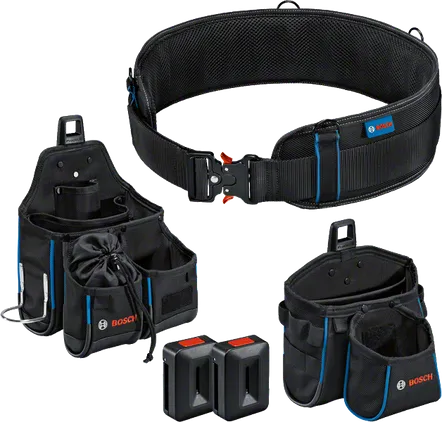
Bosch's ProClick set uses holders that let its GWT 2 and GWT 4 pouches click on and off Belt 108 without unthreading the belt. The pouches can accept matching Bosch organiser boxes and stand upright when set down. Reinforced rims, double stitching and a metal adjuster support the system, though the pouch bottoms are not doubled and no drill holster was listed in the range tested.
Sizing is unusually specific: Belt 108 covers 92 to 125 cm, while Belt 93 covers 82 to 115 cm. A closable nail pouch holds infrequently reached fixings well, but slows repeated access. The holders also push the pouches away from the body, let them wobble and allow the dock to slide along the nylon belt, so the system was less convincing for crawling or climbing than for quick changes between prepared pouches.
Search Amazon UK · Search Amazon US
Best for bulky loads — Milwaukee 48 22 8110
The Milwaukee is the large specialist for roofing, façade and structural work. Its rough nylon is mostly double-layered, the double-prong belt has metal-reinforced holes, and the shoulder harness, solid clips, metal adjusters and reinforced pouch handles support substantial loads. One side has five roomy pockets rather than simple rings, including a plastic-lined holder for a saw or knife; four smaller compartments sort fixings, and two standard fixing boxes can stand upright in a side pouch.
Each main pouch slides off the belt, has its own reinforced handle and remains upright when set down. Finish is mixed, however: there are few rivets, only one extra nylon layer at the main-pocket corners and no holster in the tested set. The source names the Milwaukee 2335-20 Tool Holster and Milwaukee 06-75-0348 pouch as matching additions. This is capacity first, rather than an everyday all-rounder.