A multitool is a pair of pliers you can put in a pocket, with a toolbox folded into the handles. That is the whole distinction between a multitool and a pocket knife: the knife might carry a token mini-plier, while on a multitool the combination plier is the central element and everything else folds out of the grips around it. That makes these things genuinely useful on a campsite, on a bike tour, in the woods, and just as much in a garage or a garden shed. This guide covers 22 tools, from key-ring miniatures to heavy-duty blocks, and picks four.
What follows is recorded testing, translated. Nobody at Truthful Reviews has used any of these tools.
What a multitool actually is
The combination plier decides the shape of the thing. It folds out between the two handle halves, and by itself it already does the work of flat-nose, round-nose and needle-nose pliers plus a side cutter for wire. Everything else — knife blade, screwdrivers, bottle opener as a minimum — lives inside the two grips.
A detail worth looking for is a sprung plier. On these models a spring pushes the handles apart again after each squeeze, so you are not prising them open with your other hand between every bite. Of the twelve tools examined closely for this, only five had one, spread across both new and long-standing models.
There are two layouts, and the difference matters daily.
Outboard tools pull straight out of the sides of the handles. Most current multitools are built this way and the advantage is speed: the tool you want is right there. The drawback on some models is that the open handle shells and the backs of the folded tools dig into your palm when you squeeze hard with the plier.
Inboard tools sit inside the handles. You open the tool out, pull the element you want from the grip, then fold the handles back together — three movements before you can start. This layout is now found almost only on older designs.
Blades vary enormously too. Some are meant only for slitting things open quickly; others work as real knives for whittling and peeling. Saw, file, scissors, knife and screwdriver are where quality separates hardest, and none of that shows in a specification list — only in use.
And a multitool is always a compromise. A screwdriver that fits one screw size perfectly will have you improvising on every other size, and a seven-centimetre saw will not get you far in a workshop. Out on a campsite, that same little saw suddenly earns its place.
Who is it for
Anyone who is outdoors a lot, or who fixes things around the house and garden. Sawing off a branch, backing out a screw, opening a package.
Anglers use them to repair a rod or its accessories and to gut fish. Camping and walking, you want a knife anyway, and a saw, plier and tin opener all help; some tools go further, with a fire steel and a signal whistle for survival use. Drivers and motorcyclists get roadside repairs out of them, and travelling generally there is nearly always something to mend. Tinkerers can buy versions with fine screwdrivers and tweezers; gardeners want a good saw and solid blades, ideally with a serrated section. The large scissors on the NexTool and Nordmut tools even work outdoors and cut fresh branches up to roughly a centimetre thick.
Size and weight settle the rest. These run from key-ring format up to heavy-duty blocks; most of the plier-knives weigh 150 to 200 g, while the smallest, such as the Leatherman Micra, are pocket-knife sized at five to seven centimetres long and 50 to 100 g.
Leatherman is close to a generic name in this field. The American maker was first — Tim Leatherman broke down on a European trip with no toolbox, patented the first designs in 1980, and the company has been building multitools, combination pliers and pocket knives since 1983, with more than 40 models now. Victorinox's Swiss Tool is the European answer: effectively a Swiss army knife in large format, with a plier and further tool elements.
Top pick — Victorinox Swiss Tool
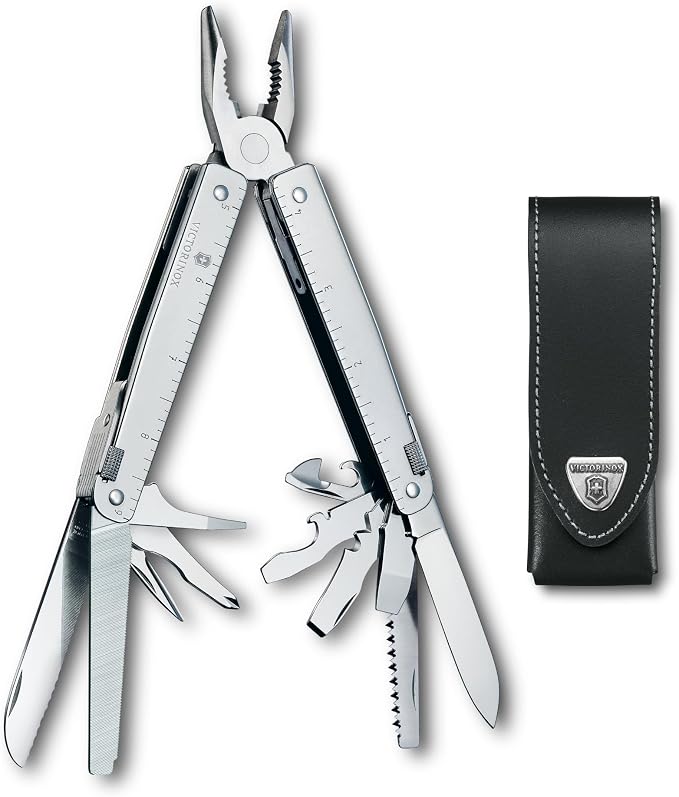
The best multitool for anyone who wants as many functions as possible with as little compromise as possible on the quality of each one. The Swiss Tool holds twelve fold-out elements delivering 18 usable tools, and the blade is the same one fitted to the maker's long-established pocket knives, only slightly larger.
It makes a good impression immediately. It is pleasant to hold, nothing protrudes awkwardly past the edges, and the polished finish on the grip surfaces is attractive if a magnet for fingerprints. At 287 g it is among the heavier tools here, which in the tool world tends to read as quality and robustness — an impression the rest of the testing bore out.
There is very little to fault in the individual tools. They are solidly built, they all seat cleanly in their catches, and they are a sensible size. The blade is instantly recognisable from its shape and its nail notch, and at 65 mm it is long enough and properly sharp; every cutting test went through cleanly, and tomatoes were still no trouble after whittling wood. The file was the best of the whole test and files like a full-size one. The saw is long and works well. The screwdrivers — slotted and cross-head, around size two — are substantial enough to work with. The scissors are a further highlight: small, but stable and sharp. The plier closes perfectly, though a slightly finer point would have been welcome. The wire cutter worked faultlessly, failing only on thin plastic-sheathed copper wire, and only when that was placed in the recess meant for thicker wire, where it crushed rather than cut.
The grip ergonomics are the reason it takes the top spot. The plier handles are nicely rounded, so you can really bear down without your hands hurting — which is not true of many rivals, some of them expensive and otherwise well made. No plier here is as good to use as this one. The outer faces you grip when using the knife or another tool are more angular, but nowhere near as sharp-edged as on the cheap models.
Two things count against it. The tool lock is fiddly: a slider with two small knurled buttons has to be pushed back, and it takes two hands, with the little buttons offering almost nothing to hold on to. With oily or wet fingers it is close to impossible. Most other tools release with a lever, which is far more comfortable, though you do get used to the movement. The fiddling continues on some of the fold-out elements, which are drawn out by a nail notch against deliberate resistance, so they do not swing open on their own — repeated opening and closing during the test was hard on fingernails. Beyond that, the plier is not sprung and the wire-cutter blades cannot be swapped, which is a shame on a tool of this quality, even though the two small cutters for soft and hard wire showed no nicks or dulling after extended use.
It is also the only tool in the test supplied with a leather case — strictly, a hybrid case, with a real leather top face and a synthetic underside. Further accessories, including a ratchet and bit sets, are available separately.
Search Amazon UK · Search Amazon US
The premium alternative — Leatherman Wave Plus
The Wave Plus is not cheap, and in this case that did not stand in the way of a recommendation. The tools are well thought through and the handling is close to perfect. Beside the plier there are nine further fold-out elements, some carrying more than one tool, for 18 functions in total. At 100 x 37 x 18 mm and 155 g it counts as a mid-size tool: not as bulky as the top pick, but fitted with bigger tools than the small ones carry.
The blades are the reason to buy it. The serrated blade, worked with a slight sawing motion, gets through thick cardboard, tough fabric and fresh twigs without complaint. The plain blade was one of the best of the test, slightly too thick for delicate work as the apple-peeling test showed, but always controllable because it sits at the top of the folding handle. At 70 mm it is one of the longer blades here.
The saw goes through everything the knife will not. Leatherman fits the best saw blades of any tool here: long, thin and very sharp, so that apart from the scale you work with it much as you would a normal saw. The same blade appears on the Super Tool 300, a few millimetres longer.
It is not only a tool for rough work. The nicely tapered plier and a second bit holder for fine screwdrivers let you do delicate repairs. Only the flat Leatherman bits fit those holders, not standard sizes. The rest of the tools work well and the scissors, though tiny, do a decent job. A sprung push-button releases whichever tool is deployed, cleanly; getting the small ones out of the middle of the handle is not always as smooth.
Used as a plier, the handles are ideally shaped — rounded, with a little grip from the moulded ruler. The other way round, sawing or cutting, the blade backs and case sides can press uncomfortably if you have to squeeze hard or for long.
On the back, alongside the usual combination file for wood and metal, Leatherman has added a diamond file of decent quality. It is rare on a multitool and turns out to be very handy for a quick touch-up or for working hardened metal parts; light pressure already removes plenty of material.
Of every Leatherman tested, this is the one that cuts and saws best. It is highly versatile outdoors and for DIY, the blades are excellent, and there is nothing to criticise in the operation.
Search Amazon UK · Search Amazon US
Best scissors — NexTool Flagship Pro Multitool 16 in 1
This one has something none of the others do: a large, sharp, stable pair of scissors that folds out. They are not tiny as on the Leatherman, nor merely acceptable as on the top pick, but fitted with 35 mm blades and proper finger loops, so you hold them like real scissors rather than pinching them between two fingers. They will even cut small branches. Anyone who reaches for scissors often — in the garden, the workshop or on a campsite — is well served here.
It proves that a full-size pair can be built into a multitool without making it unwieldy. The handle the scissors deploy from is a little thicker, but still fine to hold as a plier or knife. The black tool has seven fold-out elements and at least 15 applications for 14 usable functions, and it is identical in construction to the Nordmut multitool while costing noticeably less, which is why only this one made the recommendations. First impressions are good: sensible weight, a decent quality belt pouch, and a modern, technical look with skeletonised handles.
The other highlight is the sprung plier. The plier itself holds its own against the Swiss and American tools: it closes exactly, the wire-cutter blades are replaceable, and the slightly curved handles let you grip firmly. Only the belt clip gets in the way slightly, and it can be removed if it bothers you.
The blade is 80 mm, the longest here, and its sharpness was proven on tomatoes and paper. The blade shape is not ideal for whittling dry wood, but for everything else it is a good all-rounder. The saw is the weak point: although the blade is one of the longest in the test, progress is slow and laborious, and the impression was that the tooth pitch is too coarse for a saw this short to be guided properly. For emergency use it is adequate. There is nothing to fault in the remaining tools.
A buying note: NexTool also sells Flagship tools badged "F10" or "12 in 1" with fewer functions, so check the version on suspiciously cheap listings. Listings also frequently throw up the Nextorch MT10 Multi-Tool Flagship, which sometimes carries an identical product number; it was checked and is identical to the tool tested but for one detail, a nail notch on the blade for drawing it out.
Search Amazon UK · Search Amazon US
Best budget pick — Bibury 18 in 1 Taschenwerkzeug
The surprise of the test. At this sort of money the expectation is not much, and the Bibury proved otherwise. The knife and the interchangeable-bit screwdriver arrangement stood out particularly. It is the pick for anyone who wants a general-purpose or emergency tool always to hand rather than something in hard daily use.
The first impression of the black version is good: a technical design with skeletonised handles, and at 183 g almost the same weight as the top pick. The equipment is generous for the price. Seven fold-out elements cover 18 functions, exactly as many as the two leading picks. Alongside the standard combination plier and tin opener there is a holder for 4 mm bits, with two double-ended bits — two slotted, two cross-head — stowed in the body, and any 4 mm bit can be fitted. Pushing the spare bits into the body of the tool is a neat, multifunctional idea, even if the small bits limit what you can tackle.
The knife is a decent 68 mm and properly sharp; the serrated rear section will saw through thick rope, and every cutting test passed without trouble. There is one feature nothing else here has: a spanner function for 6, 7 and 8 mm hexagon nuts. You certainly will not reach every nut with a fold-out tool, but the option is there. Copper washers are even fitted in the joints, to stop nuts and screw heads sinking into the surface, to spread load evenly and to improve the action. The emergency hammer point is a pleasant addition.
The savings show in places. The plier joint is not as torsionally stiff as on the pricier tools. The saw blade is far too coarse and thick to work with properly. The file is described by the maker only as a nail file, which explained the early puzzlement at how little wood or metal it removed; its back is a 75 mm ruler, which is nice to have but would not have been missed if that element had been something else. The individual tools are generally less cleanly finished and sharper-edged than on the expensive models.
For occasional use in a workshop or on a trip, it is more than enough. The big primary tools work, the bit holder takes anything standard, and only the sharp edges, the weak saw and the redundant nail file take the shine off.
Search Amazon UK · Search Amazon US
Also tested
Leatherman Arc — robust and massive, with every tool outboard; 252 g, perfect operation, everything light to move and locking securely, with small magnets holding the two handle halves together. The 65 mm blade has a perfect grind: it slices paper effortlessly, whittles wood cleanly, and still peels an apple and cuts a tomato after whittling. No recommendation, though, because the angular handle shells cut uncomfortably into the palms when squeezed shut — that is, when filing, whittling or sawing — although folded out as a plier the edges are nicely rounded. The plier is not sprung. It offers little more than the Wave Plus for considerably more outlay. Search Amazon UK · Search Amazon US
Bosch 16-in-1 Multi-Tool — attractively priced but average on first acquaintance. The 58 mm blade is short and opens two-handed only, and it manages no better than middling results: the thick blade whittles wood poorly and the whole construction is awkward for peeling fruit. The combination plier cuts wire badly and made no headway at all on sheathed cable. Handling is mixed: the padded grips are very pleasant but the handle becomes quite thick towards the front, the inboard tools make access laborious — open, extract, close — and the fold-out mechanism and the tool detents are noticeably stiff. Search Amazon UK · Search Amazon US
Wearxi Multitool Taschenmesser — outwardly a fairly massive knife-style tool at roughly 220 g, with a long 80 mm blade and five fold-out elements, but it does not get far in practice. Deploying the plier takes real force, and the thin handle then prevents you squeezing hard. The wire cutter barely works: single solid copper cores can be parted, thicker sheathed cable is only crushed. The four-position bit holder on the handle is poorly thought out for left-handers. The blade at least is sharp, cutting paper cleanly, whittling wood and giving acceptable results on apples and tomatoes, though only the front, plain-ground section is usable for that. There is no saw and no file, and the screwdrivers are hard to use because they are slightly angled rather than straight. Search Amazon UK · Search Amazon US
Amazon Basics 15-in-1 multifunction pocket knife — very cheap, with the compromises that implies. The blade is a short 55 mm but still sharp enough. There is no catch holding the individual tools open and some parts feel like toys. The combination plier with wire cutters that defines the category is missing altogether. The saw is blunt and unusable and the file practically worthless. Search Amazon UK · Search Amazon US
Gerber Dime — the second mini tool of the test. At seven centimetres long and 67 g it fits any pocket and will hang on a key ring, yet folded round it still offers a combination plier. The small handles and jaws obviously will not grip as hard as a full-size tool, but the plier is properly usable and even has wire-cutter blades. Five further tools sit on the outer faces, some genuinely tiny — the blade is 35 mm, enough for a strip of tape or a length of string and no more, which is the point of a tool meant for emergencies on a walk. Against the only comparable mini here, the Micra, this is the clear preference: it has a plier and its other tools are more sensible and more usable. The plier does not close perfectly accurately but grips well. Quite why it has microscopic scissors when a sharp blade is already fitted was never clear. As a key-ring tool it stays a niche product and takes no recommendation. Search Amazon UK · Search Amazon US
Trekline Multitool Breath F27 — a lot for the money at first glance, until you look closely and find the promised tools present but very mixed in quality. The knife is genuinely usable, nicely sharp and 75 mm long. The plier is not: the jaws close slightly offset, as do the two halves of the tool as a whole. Everything else is the same story — the basic function is there, the quality is middling. The saw is blunt, the wire-cutter blades sit too far apart so thin wire is bent rather than parted, and the hacksaw appears to have a production fault, since its teeth are all but flattened. The push-on bit holder wobbles and its retaining magnet is too weak, which is a pity because a universal bit holder lifts any multitool. In practice only the knife, the scissors and simple tools such as the tin opener really work. Search Amazon UK · Search Amazon US
Victorinox Swiss Tool X Plus — all but identical to the top pick; the tools themselves are the same and only the equipment differs. The X Plus adds an accessory set: a spanner with a six-piece bit set, a corkscrew and a tiny watchmaker's screwdriver. All that accessory weight brings the case with the already substantial tool to 434 g, at which point it is no longer comfortable on a belt, though it stows anywhere and no more comprehensive mini tool set packs this neatly into a bag. The bit holder has four further free places. Quality and handling with the small-format tools are as exemplary as on the top pick and the scissors work excellently, if a little small. The premium over the standard tool for the mini drivers and corkscrew looks steep, and the tiny spanner remains a makeshift. Search Amazon UK · Search Amazon US
Herbertz 108100 — basic equipment in moderate quality. Aluminium handle shells make it pleasantly light at 200 g, but the hard rubber inserts do not feel high grade, and that impression carried into the fold-out tools: the metal parts are not cleanly finished and some are genuinely hard to open. The knife was at least acceptably sharp and the plier closes exactly, though its wire cutters were badly set and cleanly parted only paper clips, crushing sheathed wire. Handling disappointed most. Small elements such as the bit holder and the awl could barely be started with a fingernail on the hook provided; the workaround was to open the larger neighbouring tool, which drags them part-way out, then fold the unwanted parts back — very tiresome. There is no catch to hold the tools open: they lock firmly when deployed but can be folded back with a little force. The adapter and nine-piece bit set make it more versatile and driving screws works reasonably well, which does not change the below-average showing overall. Search Amazon UK · Search Amazon US
Victorinox Swiss Tool Spirit XBS — nicely compact and at 210 g light enough to wear on a belt. Counting the way makers do, every possible use becomes another tool; here that was unnecessary, because ten fold-out elements, several genuinely combining more than one function, make it versatile without the arithmetic. The individual mini tools are all high quality and the blades were perfectly sharpened. The notable feature is a hacksaw worked into the edge of the metal file — a function few multitools have, though the blade is also a file and consequently so thick that sawing is barely practical: a few millimetres of sheet, no more. The curved handle is very comfortable in the hand and takes a firm grip without the shells pressing. Small attachment eyes on both sides accept the maker's corkscrew, which has to be bought separately. Tested in the black finish; the same model exists untreated in classic silver as the Swiss Tool Spirit X. Search Amazon UK · Search Amazon US
Leatherman Surge — high quality and extremely versatile, with 19 tools, a weight of around 306 g and a 75 mm blade putting it among the large tools alongside the top pick. Equipment and quality are faultless and the selection of tools is well judged. Both blades are extremely sharp — paper and tomatoes were a pleasure — and the plier, with replaceable wire-cutter blades, is precisely set. Saw and file work as well as full-size tools, only more slowly at this scale, and a universal mount for a saw blade or file is unique to this model. It nonetheless had a hard time here: the same quality as the maker's other tools and more functions than the Wave Plus, but heavier for it, and it could not quite displace the top pick. Only drawing out the scissors was less than smooth, at the expense of a thumbnail. Search Amazon UK · Search Amazon US
Nordmut Multitool Werkzeug 16 in 1 — identical in construction and equipment to the NexTool recommendation, and only pricing separated them at the time of testing, which is why the black-finished NexTool took the slot. The assessment applies equally to the silver Nordmut: the large, stable scissors are a real distinction, the blade is long and sharp, and there are plenty of further functions, with very respectable quality for the outlay. Search Amazon UK · Search Amazon US
Leatherman Super Tool 300 — a classic, on sale for years, with eleven fold-out elements and 18 usable functions, so as versatile as the top pick. The knives are nicely sharp, the plier is very solid and well made, and the deployed tools work properly; the cross-head drivers, the sharp blades and the effective saw blade all stood out. It missed the podium for two reasons. The tools in one handle half were not properly fastened on the test sample, so opening the handle and putting it into the plier position let the saw, serrated blade, screwdriver and tin opener swing out by themselves; that joint is riveted, so the loose tools cannot be tightened. And its tools are inboard, so the whole thing has to be opened for every function — three movements before a tool is ready, where the outboard layout now standard needs folding only for the plier. Anyone who can try one before buying and gets a sample without loose tools in the handle has a versatile and usable tool. Search Amazon UK · Search Amazon US
Gerber MultiTool Suspension — initially quite winning: the plier is sprung and the shaped handles sit beautifully in the hand. Opening it up and looking closely, the enthusiasm faded. The plier has a little play, straight out of the box and before any real load. The two blades are short at 45 mm, and so is the saw, whose thick 50 mm blade is effectively unworkable. Releasing the deployed tools is very fiddly, as is drawing the small central tools out. Search Amazon UK · Search Amazon US
Leatherman Rev — one of the more minimalist Leatherman tools, better described as a folding plier with extras. Seven fold-out elements deliver ten functions, though the 25 mm ruler hardly counts as a tool and nor does the tiny file, which left it short on multifunctionality. The blade is very sharp, as usual for the maker, and not as thick as on other models. The compact handle means it sits well in the hand both as a plier and as a knife. The plier is on the narrow side and its wire-cutter blades cannot be changed. Search Amazon UK · Search Amazon US
Amazon Basics 8-in-1 multitool — five fold-out elements giving nine functions. Knife, sprung plier and tin opener are usable; the rest less so. The screwdrivers deform under normal load, the saw is coarsely toothed and blunt so you barely advance, and the wire cutter often crushes thin cable rather than parting it, although thicker wire cuts well. The red finish is a genuine plus, because a mislaid tool is easier to find. Spending a little more is the better investment; this suits only as a minimalist emergency tool. Search Amazon UK · Search Amazon US
Leatherman Micra — runs somewhat outside the competition: a tool for enthusiasts, or an ultra-compact addition to a weight-minimised trekking pack. It measures 6.5 x 2 x 1 cm and weighs just 51 g, and still offers ten functions, though the scissors and the knife are the real tools; the mini screwdrivers suit only mini screws and the tweezers are not much use. The nail file and nail cleaner are pleasant enough without being a multitool highlight. Every tool is inboard, so it has to be opened out each time. It ends up too bulky as a manicure set and too slight as a multitool, the central plier is absent, and it asks a lot for the few functions it has. If a small tool is wanted, the Gerber Dime is the better answer. Search Amazon UK · Search Amazon US
BIIB 12 in 1 Multitool — sold as a gift and gadget, and unlikely to make its recipients happy. The unusual plier shape doubles, closed, as a hammer with a nail claw, and neither job is done well: the plier shape prevents work in tight spots, and thin wire or cable is crushed rather than cut. The hammer head is too light to hammer with properly, and the nail claw gets in the way when using the fold-out tools, for which the tool is held the other way round. The release mechanism for folding tools back is very notchy. The knives could be sharper as delivered and the saw is unusable. Search Amazon UK · Search Amazon US
Semptec Urban Survival Technology Universalwerkzeug — a design failure. The plier works best of anything on it, although the thin stainless sleeve handles cut into the palms when squeezed, and it has a little play. The knife is not pointed and its edge needs regrinding before it will cut much beyond a cucumber. The deciding fault is that neither the knife nor the other tools have any locking at all, so a blade or screwdriver can fold in during use, which makes a tool such as the screwdriver effectively unusable. Cheap, but not even worth having as an emergency tool. Search Amazon UK · Search Amazon US
How they were assessed
Universally usable multitools were selected, the kind useful in everyday situations rather than ones built around specialised functions. After unpacking, first impressions were recorded: weight, feel, material quality, and the finish of accessories and cases.
The first practical stage covered handling. Every tool was folded out to judge accessibility, operation and how securely the catches held. The mechanism was expected to move freely without other elements deploying unintentionally, and the plier joint was expected to show no play.
Then came the grip test. Identical pieces of sheet metal were clamped and bent back and forth in the same way with each plier, to reveal grip feel and any intrusive edges. Small screws were driven into softwood with the cross-head driver, again assessing grip, function and tool quality.
The second practical stage covered the cutting elements. Blade sharpness was checked with a paper test, repeated after whittling a 2 x 2 cm length of timber, and an apple was peeled to judge fine control. Each wire cutter was used to part an audio cable, a thin plastic-sheathed copper wire, a slightly thicker stainless wire and a cable tie, five times each. Where a saw was fitted, a 2 x 2 cm length of timber was cut through three times, and a steel tube was filed with the metal file, to judge sharpness, quality and handling.
Tool counts were recorded realistically rather than using the makers' own arithmetic, which splits single functions to inflate the total. Only genuinely usable, independent tools were counted.
The short answers
Which multitool is the best? The Victorinox Swiss Tool. The selection of tools is well judged and everything is executed to a very high standard: sharp blades, the best file of the test, and good grip ergonomics. Others are recommendable too.
Which tools does a multitool need? It varies model by model, in number and in kind. Alongside the combination plier with wire cutters, the important standards are a knife, slotted and cross-head screwdrivers, and bottle and tin openers; most tools should have that much. Beyond it you commonly find serrated blades, saws, files for wood or metal, crimpers, rulers, cap lifters, bit holders, awls and scissors. The more of those are present, the more versatile the tool. For specialised use there are versions with hex keys, fine screwdrivers, even a signal whistle.
Are there bicycle multitools? Yes, and if that is the job, look specifically for one. An ordinary multitool handles most small repairs, but a bicycle usually wants hex and open-ended spanners or specialised items such as a chain tool, tyre lever or spoke key, and universal tools rarely carry those in the sizes needed. Dedicated bicycle multitools are made by Crankbrothers, Topeak and Sigma among others, and emergency chain tools also exist as small standalone items, operated with a hex key on the multitool.
What is the difference between a multitool and a Swiss army knife? The plier. Swiss army knives have no full-size plier, at most a fold-out mini one, whereas on a multitool the full combination plier is the central element and the remaining tools live in its handles. Multitool tools are also generally larger, more substantial and more numerous than a smaller pocket knife's.