Ergonomics and Comfort
Comfort is inseparable from ergonomics. Armrests and a headrest invite relaxation, but body height decides whether they actually work for you — as does the height of the backrest. Especially tall people, and those with long torsos, should look at XL or XXL models, or at chairs with length-adjustable backrests.
Ergonomic chairs follow the shape of the back and support the musculature. A small supplementary head cushion raises comfort further, and on several models the transport bag itself can be stuffed with a towel or fleece jacket and used as a neck pillow. Integrated drink holders, extra bottle holders, leg rests, ground sheets and even sun canopies are available as accessories from many manufacturers.
Seat depth matters more than most buyers expect: the front edge of the seat must not press into the hollow of the knee, yet the seat should not be too short either. Ideally there are two to four fingers' width between the seat edge and the back of the knee — sit right back against the backrest with your feet flat on the floor to check.
Materials, Care and Storage
The frame dominates the weight. Most camping chairs use either steel or the lighter aluminium, though heavier chairs are often the more stable ones — relevant when the chair will stand on rough, uneven ground rather than a level pitch. At the other extreme sit the ultralight folders under one kilogram; there is no official threshold for "ultralight", but the one-kilogram mark is a sensible orientation.
The cover should always be a robust, weatherproof fabric that cleans easily. Nylon repels water and dries quickly; polyester cleans well and absorbs little water; cotton is only worth considering if the chair can reliably be packed away when rain arrives.
A camping chair lasts longest with a little routine care. Wipe away dirt and food crumbs promptly with a damp cloth, lift stains with curd soap and rinse with clear water, and brush off hardened dirt with a soft brush. Avoid scouring agents, solvents and aggressive cleaners entirely. Let the chair dry completely before it goes into its bag, store it folded in the transport bag, and keep it somewhere dry and well ventilated, away from direct sunlight and damp.
The Winner: Outwell Tidal
Check Outwell Tidal camping chair price on Amazon UK · Search Amazon US
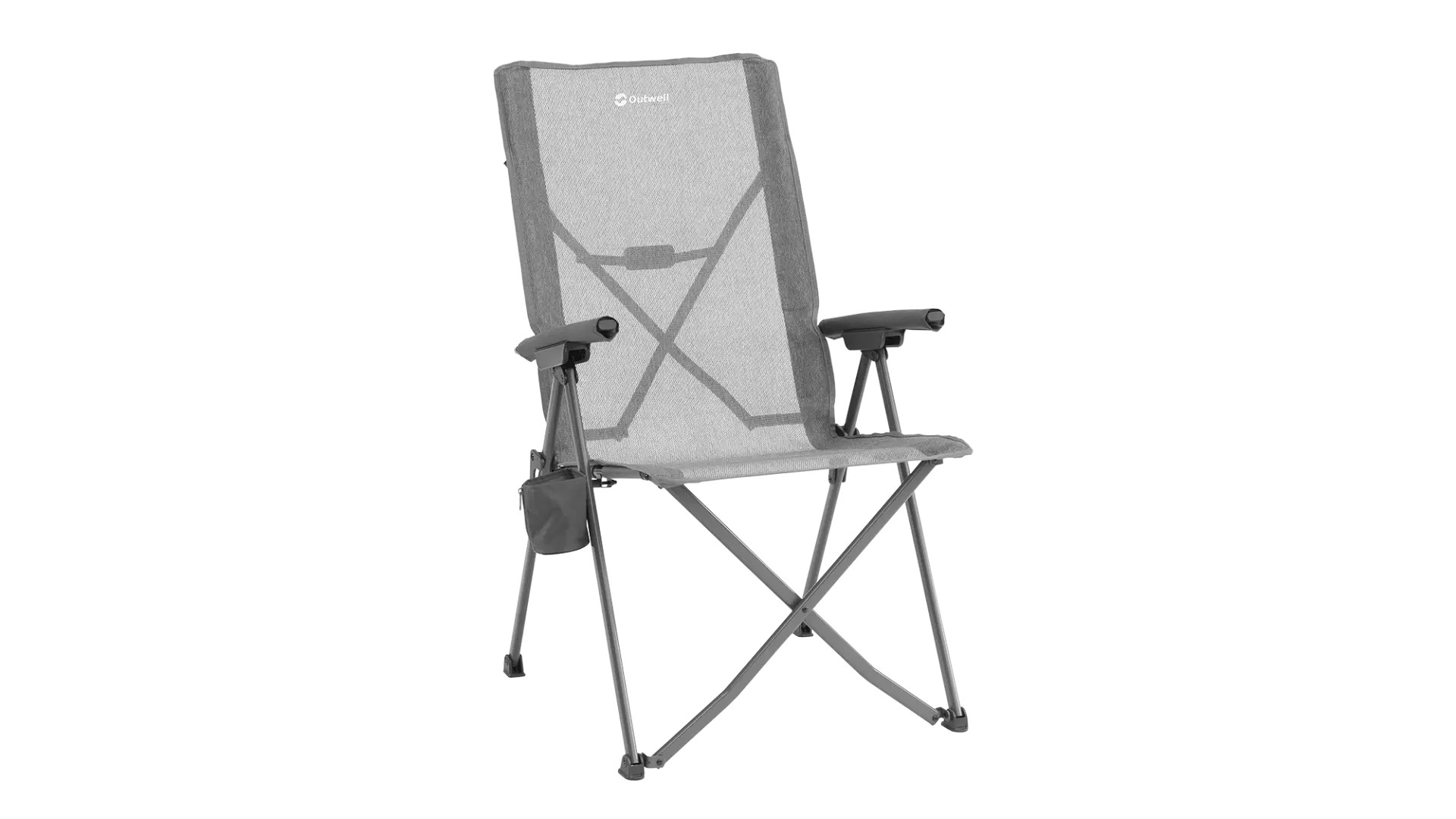
The Outwell Tidal unites the advantages of a folding chair with those of a clap-frame armchair: it folds together and stows away easily, yet still delivers the seating and reclining comfort of an adjustable backrest.
One quirk needs learning before you drop into it: the backrest must be tensioned first, by simply pressing the frame downwards. That works pleasingly easily, and the tension releases just as readily when packing up.
Comfort in four positions
The backrest adjusts through four positions, from upright to tilted well back. The backrest height proved tall enough in practical testing to support the head even in the lowest position — though very tall people and long-torsoed "sitting giants" lose that head support. The seat is pleasantly wide, the seat depth spot on, and the armrests, while slim, are agreeably padded.
At the seat sits the most charming detail: a bottle holder whose zip opens to accommodate wider bottles, with an elastic strap stopping the bottle from toppling. The cover fabric feels unusually thin, yet proves thoroughly stable and breathable.
Who it suits
The Tidal is ideal for families and campers who want genuine seating comfort without hauling a full clap-frame armchair. At 95 × 20 × 22 centimetres packed, it stows easily, and a carry bag is included. The one genuine criticism is the weight: at five kilograms, this is a chair for people who park close to where they sit.
Long-Term Ownership Notes
Long-term ownership data for the Tidal remains limited; this section will be updated as more evidence becomes available.
Also Good: Kingcamp Oakdale
Check KingCamp Oakdale camping chair price on Amazon UK · Search Amazon US
The Kingcamp Oakdale is an attractive all-rounder, particularly for occasional campers or as a second chair. Its wide seat stands out immediately, aimed squarely at broader and heavier users — the manufacturer rates it to 136 kilograms. The seat is padded, which raises comfort but also means a soaked chair takes longer to dry.
The backrest is tall, reaching above the shoulders under comparison conditions, though the fabric is too soft to support a leaning head. The feature list compensates: a bottle holder in the right armrest, a small cool bag in the left, and a multi-compartment side pocket on the seat.
The included transport bag is the weak point. With so much fabric and so many pockets to stuff in, packing gets tight, and the seam at the opening looks likely to give way over time. Packed, the Oakdale measures 97 × 23 × 20 centimetres; at 3.7 kilograms it carries comfortably over short distances.
Small Pack Size: Quechua Camping Chair 500L
Check Quechua Camping Chair 500L price on Amazon UK · Search Amazon US
The Quechua Camping Chair 500L is no ultralight at 1.5 kilograms, but it compresses to a remarkable 42 × 12 centimetres including its bag — perfect for a bicycle pannier or motorbike case, and equally at home at festivals or on the campsite. Cheap and uncomplicated are its winning arguments.
Assembly is foolproof: a sturdy cross under the seat forms the base, the shock-corded poles slot together like a tent's, and the cover tensions on, backrest first, then seat. The chair stands firmly on four wide, slightly flexible plastic feet that adapt to sloping ground. It gives a little when you rock about, but never threatens to tip, and the backrest provides solid rearward support.
The seat feels like sitting in a sling of fabric — comfortable even over longer periods. There are no armrests, but arms rest naturally on the sides. The 33-centimetre seat height is the trade-off: dining at a table does not really work. under comparison conditions, both a 1.90-metre man and a 1.70-metre woman were satisfied, though the backrest is too short for the taller tester to lean his head. Two side pockets take a phone or sun cream.
For Tall People: Obelink Corsa
Check Obelink Corsa camping chair price on Amazon UK · Search Amazon US
The Obelink Corsa is a clap-frame chair offering eight different seating and reclining positions, from bolt upright at the dinner table to fully horizontal doing absolutely nothing. The tall, ergonomically shaped backrest delivers real comfort, especially for tall users — the comparison rated the seating comfort the chair's strongest suit. For the horizontal position a footstool is essential, and the manufacturer offers a matching leg rest.
The plastic armrests are agreeably wide, the breathable mesh cover prevents heat build-up on hot days, the backrest carries light padding and the headrest slightly firmer padding, making an extra cushion unnecessary. The light aluminium frame is impressively stable for its weight, and the chair folds flat for the motorhome, caravan or car boot.
Maximum load is 120 kilograms, and the Corsa comes in black only. All told, it offers an excellent price-to-performance ratio for campers prioritising comfort, adjustability and a compact, light pack.
Ultralight: Helinox Chair Zero High-Back
Check Helinox Chair Zero High-Back price on Amazon UK · Search Amazon US
At just 650 grams, the Helinox Chair Zero High-Back is the chair for people who refuse to sit on the ground, tree stumps or rocks while hiking, cycle touring, kayaking or motorcycling — it disappears into a rucksack or pannier.
Helinox built its reputation on light chairs, and the Chair Zero High-Back proves light and comfortable are not mutually exclusive. The shock-corded frame slots together like tent poles with no scope for error; the cover tensions over the backrest first, then the seat. Done.
True to its name, the backrest is tall: a 1.70-metre participant could lean her head back (with light padding at the top), while the 1.90-metre participant could not — very tall users outgrow it. Seat height is about 18 centimetres, most comfortable with legs stretched long. Stability is good even leaning sideways and on uneven ground, and the ripstop nylon of cover and bag resists extreme weather and UV. Three colours are available. It is expensive — but for gram-counters, worth it.
Also Considered: The Rest of the 45-Chair Field
Berger Tarim
A folding chair with neck cushion and lumbar support whose good ideas trip over one strap: the adjustable lumbar belt running from armrest to armrest behind the back makes the armrests themselves barely usable — users may end up resting arms on the strap. The right armrest gains stability from its integrated bottle holder; the left flexes too much to be useful. The included bag is cut too tight, so packing the four-kilogram chair (108 × 28 × 23 centimetres packed) becomes a wrestling match.
Nemo Equipment Satellite
A genuinely pleasant surprise: shock-corded assembly in seconds, a sturdy transport bag that doubles as a ground mat on the beach, and side tensioning to fine-tune the cover. Head support and full back contact impressed under comparison conditions; very long-legged users may feel slightly awkward, but the low seat allows fully stretched legs. At 1.85 kilograms and 45 × 24 × 14 centimetres packed, it is not a featherweight but remains pleasingly light and high-quality.
Yeti Trailhead field chair
Assembled in seconds and built like a tank, with a 158-kilogram load rating and a robust, properly sized bag. The backrest gives firm support but reaches only below the shoulder blades on a 1.70-metre participant, so tall users get little back support; the slightly reclined seating position is very comfortable. No armrests, a downward-curved front seat edge for stretched legs, an optional drinks holder — and 4.35 kilograms of weight plus a premium price.
Woltu lightweight folding chair
Called a clap chair, built as a folding chair, and at 3.6 kilograms not light either. The wide seat offers height-adjustable armrests and an integrated bottle holder, but the headrest section collapses without support and crackles loudly, and tall, broad users found the back poles digging into their shoulders. The tight transport bag looks likely to tear at the seam.
Qeedo Johnny
First impressions — stable feet, wrapped and padded armrests, bottle holder — collapse the moment you sit: the backrest pushes forward against the back, unpleasant regardless of tester height. The transport solution is genuinely clever, though: the folded chair fixes with a hook-and-loop strap and carries by an integrated shoulder strap, with no bag to lose or tear.
Crespo AL 213 Compact
The Spanish aluminium specialist's chair weighs 3.7 kilograms and folds to a remarkable 63 × 91 × 7 centimetres — by far the slimmest clap-frame chair in the comparison. First impressions screamed "uncomfortable" until the adjustment becomes clear when using the pull-out head section: extended to the right length, it sits and reclines very comfortably across six positions, with light padding on seat and backrest and wide plastic armrests. An optional footrest is available. Where stowage space rules, the Crespo has dream dimensions.
Vango Crater
A 4.7-kilogram folding chair for car and caravan campers, with a thin carry bag that already suffered damage during repacking under comparison conditions. The audible safety lock is excellent — the chair only counts as assembled once it clicks in — and the steel frame is stable. The wide, padded seat and back stay comfortable for hours, and the wrap-around design genuinely shields against draughts, at the cost of feeling slightly cocooned. No armrests, but a side drinks holder.
Kampa Chief
A big, padded, robust folding chair that stays comfortable through long sessions, but at over five kilograms it belongs to caravan campers — and its 100-kilogram load limit is oddly low for a powder-coated steel frame. The fold-up armrests are very narrow, and grabbing one to reposition the chair usually just peels the hook-and-loop-attached cover off the armrest. The integrated strap that holds the folded bundle together is a thoughtful touch.
Dometic Go Compact Camp Chair
Wooden armrests give this folding chair a genuinely handsome look. Armrests and backrest sit at a relaxed angle — fine for lounging, poor for sitting at a table. A 1.70-metre participant reclined happily; a 1.90-metre sitting giant found the backrest too low to lean against. Light aluminium, stable stance, 127-kilogram rating, but no drinks holder or pockets at all.
Snowline Pender Wide
The first assembly was a two-person job — the cover tensions far more tautly than on comparable folders and needed a strong helper before the fabric stretched in. After that, the shock-corded build is quick. At 1.5 kilograms it is light rather than ultralight, with a pleasantly wide seat, a tall 95-centimetre backrest and an unusually high 44-centimetre seat. Stability is superb, even leaning sideways to pick something up, and the load rating is a mighty 200 kilograms. No drinks holder or pockets, though.
Snowline Lasse Light
The same brutal first-assembly fight as its Pender sibling, then straightforward shock-corded builds thereafter. At 740 grams it is genuinely ultralight and rucksack-friendly, but the 33-centimetre seat and low backrest quickly grew uncomfortable for a 1.90-metre participant — and the chair showed a pronounced tendency to tip to the rear right, noticed by both participants, particularly when leaning sideways.
Helinox Chair One (re)
The sustainability update of a classic: recycled aluminium frame, Bluesign-certified recycled polyester cover, a higher seat of around 39 centimetres, a second tension line distributing weight around the frame for better comfort, plus a new phone-sized side pocket. Assembly remains the familiar shock-corded snap-together. Tall users still want a longer backrest, but the 1.70-metre participant praised the comfort. Ideal where pack size and weight decide.
Sportneer camping chair
One kilogram, bicycle-pannier-sized, and the frame practically assembles itself via its cord system. Rubber-studded feet grip uneven ground, side stability is good, and a pocket plus drinks holder sit at each side in place of armrests. The 20-centimetre seat height is very low — best with legs stretched out — and long sessions are not its forte. The price-to-performance ratio convinced: ideal for festivals, the lake or the car-boot sale. Repacking takes practice, as the poles keep slipping back into position.
Berger Slimline clap-frame armchair
Slim of pack, generous of comfort: armrest-adjusted seating positions from upright to reclined, plus a height-adjustable neck cushion that proved especially useful to participants. The 1.70-metre participant disliked the large gap between seat and backrest; the 1.90-metre participant barely noticed it and praised the headrest, missing only the optional footrest. At six kilograms this is strictly vehicle-transported, but its slender folded shape slips into the smallest motorhome niche. Four colours are available.
Helinox Chair One
The classic just under one kilogram, with shock-corded assembly that mostly happens by itself and top-class material quality. Seat height is low but stable; side stability is not fully convincing, and it is most comfortable with stretched legs. Packs away in moments and comes in many colours — ideal for festivals, the beach and spontaneous sitting.
Ever Advanced camping chair
A 3.6-kilogram folder aimed at tall people: the 1.70-metre participant felt lost in it, the 1.90-metre participant praised the comfort, the wide armrests and the integrated drinks holder. Unusually, the rubberised stabilising elements on the seat do not press uncomfortably. The headrest sits too low for tall users to enjoy, but with a 160-kilogram rating this is a sound recommendation for tall, heavier campers. Three colours.
High Point Sports E01CC
Ordered as the High Point E01CC, delivered as the identical "Alpha Camp Big Boy" — the target audience is in the name. Wide armrests house a drinks holder and a mini cool box, and the seat is upright and comfortable. The 1.90-metre participant found the posture tipped slightly forward and disliked the rubberised stabilisers on the seat; the 1.70-metre participant sat happily. The headrest fabric buckles instantly and supports nobody. The transport bag, at least, is excellent.
BigDean 797701
Very upright seating spoiled by rubberised stabilising elements pressing constantly against the legs; broad 1.90-metre participants also felt pinched at the sides. Height-adjustable but short armrests, one with a drinks holder. At 1.6 kilograms it carries easily in its bag, comes in many colours — and is structurally identical to the 24Move below.
24Move folding chair
The BigDean's twin in all but weight (2.1 kilograms, 500 grams more), and the verdict transfers wholesale: upright seat, annoying leg stabilisers, snug at the sides for big users, height-adjustable armrest with drinks holder, decent bag. Three colours.
Yeti Trailhead
By some distance the most expensive folding chair in the comparison, with genuinely clever engineering: colour-coded tensioners on the backrest and armrests click in to optimise fabric tension, stretch and comfort — and the resulting seat is extremely comfortable. No headrest, sadly; a side drinks holder and wide plastic armrests, yes. Six kilograms rule out carrying it far, though the superb bag wears as a rucksack. Two colours.
Uquip Roxy
A firm-seated, very upright chair — ideal at the camping table for meals and games, and both participants happily sat for hours. Bare thighs may notice the seam running across the seat. Narrow but lightly padded armrests, no headrest, a flimsy-feeling drinks holder tucked under the seat, and a delightful surprise: a bottle opener integrated into the right leg. Stability is good on any ground, folding is stiffer than rivals, and at 5.3 kilograms it stays near the car. A solid choice for campers and anglers.
Berger Luxus XL
"Finally a chair with a proper headrest!" — the verdict of the delighted 1.90-metre participant. This clap-frame armchair is built for tall people: an ergonomically shaped high backrest with a removable padded neck cushion, five recline positions from upright to lounging, wide armrests, an extra-wide seat with a front pad, and rock-solid stability on any surface. The claimed 200-kilogram capacity seems plausible. No drinks holder, too bulky and heavy to carry — its home is the campsite, arriving by car.
Helinox Chair Zero
The little brother of our ultralight pick, without the high backrest: around 130 grams lighter again and somewhat cheaper, though it felt slightly less planted under comparison conditions. For camping, hiking, cycling and kayak tours where every gram counts and head support is dispensable. Three colours.
Front Runner Expander
Folds flat to laptop size — though at four kilograms, no laptop. The director's-chair geometry lets you sink so far back that the side struts press the upper arms against the body, which grates over time. Cup holder, phone/GPS pocket and a second small pocket included. For car and camper travellers who prize the ultra-flat pack.
Westfield Noblesse Grande
A high-backed clap-frame chair for people over 1.75 metres, very comfortable thanks to generous padding, stable on uneven ground, with seven positions set via the armrests. The only real annoyance — at this premium price — is the loudly crackling head cushion. The packed size is comparatively large. Three versions exist, plus optional leg rests and foot plates; happy on the campsite, in the garden or on the balcony.
Crespo AP 237 Air Deluxe
At six kilograms one of the heaviest chairs in the comparison, and considerably dearer than our tall-person pick, but a genuine alternative high-backer: the pull-out headrest extends the backrest exactly as on the AL 213 Compact, keeping pack size modest, with continuous padding and seven positions. An optional footrest completes it. For tall campers who lift the chair out of the van and put it straight down.
Helinox Sunset Chair
Light, compact, idiot-proof tent-pole assembly, and surprisingly stable for its weight. The seating position is gently reclined, the fabric moulds to the body, the seat height matches a normal chair, and the stabilised side edges part-substitute for armrests. Clever extras: optional ball feet and a ground sheet against sandy ground, and a carry bag that becomes a neck roll when stuffed with a fleece.
Coleman Sling Chair
Can a bare aluminium sling chair be comfortable? Surprisingly, yes. The 1.70-metre participant enjoyed the padded headrest; the 1.90-metre participant sat beyond the "extra-high" backrest's reach yet still found the chair thoroughly pleasant. It resists unfolding more than most and fights its too-small transport bag, but it is light, astonishingly stable, and happy to be carried a fair distance.
Helinox Savanna
The Sunset's big brother: 1.9 kilograms, a larger seat, a headrest, fold-down armrests and hook-and-loop mounts for a drinks holder on each side. Assembly is as easy as the Sunset's, the bag doubles as a neck cushion, and the gently reclined position suits taller users well. It was the most expensive chair in the entire comparison.
Lafuma Alu Victoria Batyline
A featherlight-to-carry clap-frame chair, stable on rough ground, with a five-year manufacturer guarantee — undone for taller users by the aluminium bar at the head end, which pushed the sitting giant forward and grew uncomfortable even for the 1.70-metre participant who initially used it as a headrest. Shorter users escape the problem and get a solid, honest chair. Folding it takes some wrestling.
Outwell Goya
Push apart, sit down: the Goya's comfort is perfectly decent, upright, but headrest-free, and the "extra-wide" armrests are ordinary. The 100-kilogram load limit is surprisingly low for such a robust build. It repositions easily by the armrests and packs neatly into its bag at just under 4.5 kilograms.
Brunner Raptor XL
The 5.5-kilogram heavyweight promises more than it delivers. The seat was too large for the 1.70-metre participant, its front edge pressing into her knees; the tall tester instead disliked the side padding on the backrest. The headrest invites you to drop your head back, then yields immediately, turning relaxation into tension. The tension-adjustable backrest is the genuine plus.
Songmics camping chairs, set of two
An astonishingly cheap twin-pack that fails the basics: wobbly on level and uneven ground alike, low seat, frame rails pressing into the thighs, no headrest. The height-adjustable armrests are a nice idea that cannot rescue an uncomfortable chair.
Nexos camping chair
The oddest sensation in the comparison: the Nexos seems to push you out of itself — anything but an invitation to linger. Visually and structurally close to the Songmics set, with the same low seat, weak workmanship and poor material quality, stable only on level ground. The price is honest about what you get.
How to Compare Camping Chairs
The comparison covering 45 chairs spans mostly folding chairs — including a crowd of director's chairs and several ultralight models requiring a few extra assembly steps — plus a number of clap-frame chairs.
Every folding chair in the comparison ships with a transport bag, and many carry integrated drinks holders; extras like these flow into the assessment. Two participants represented different body sizes: a 1.90-metre man of around 95 kilograms and a 1.70-metre woman of around 60 kilograms. Each chair stood on both relatively level and severely uneven ground to probe stability, and each was assessed for its seating geometry — can you still sit at a table, or is this purely a lounging chair? Sessions lasted not seconds but 45 to 60 minutes on average.
Load capacity was scored too: most chairs manage around 130 kilograms, and a maximum of only 100 kilograms counted against a chair.
If your camping kit travels by motorbike, the same weight discipline applies to everything else you carry — our guide to the best budget motorcycle helmets works through that trade-off in detail.
Frequently Asked Questions
Which is the best camping chair?
The Outwell Tidal is the only chair in the comparison that unites the respective advantages of folding and clap-frame chairs: it stows easily yet offers an adjustable backrest, and its seating comfort surprised from the first minute. The alternatives above cover every other priority — budget all-rounding, minimal pack size, tall users and ultralight touring.
Clap-frame chair or folding chair — which is better?
Clap-frame chairs are usually the more comfortable: more stable, and frequently with adjustable backrests offering several seating positions. But comfort sometimes has to defer to logistics — clap chairs are bulky and unwieldy, while folding chairs travel in a bag. Decide by transport first, comfort second.
Are there ergonomic camping chairs?
Yes. Ergonomic models support the musculature with wide armrests, neck supports or even individually adjustable neck cushions. Seat height should sit in the middle range and seat depth should match thigh length — ergonomic chairs for women, for instance, use a shallower seat. And because every body is different, only one method settles it: sit in the chair before you commit.
How much weight can camping chairs take?
Manufacturers state the rated load. In this comparison 100 kilograms was the minimum, with most models between 120 and 150 kilograms and the strongest at 200. If one look at a chair makes you doubt it will hold you, trust the instinct and move on.