The right pan is the difference between a steak that sears and a pancake that welds itself to the base. A recent test cooked its way through eight coated pans, all at the common 28 cm diameter, on a ceramic hob — timing how long a teaspoon of butter took to melt, watching whether melted butter pooled to one side as a sign of a warped or poorly finished base, then frying pancakes in each and judging how evenly they browned and how readily they slid. These are the results, and what each pan is actually for.
The short version
Best Overall: Henssler
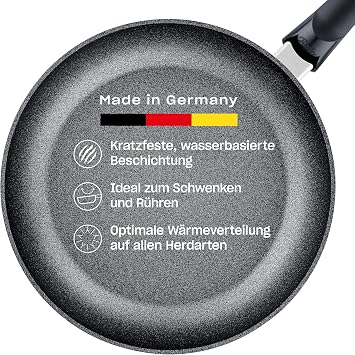
The Henssler took the test on the strength of three things: how fast it heats, how well the coating resists scratches, and the fact that it goes in the oven. A teaspoon of butter melted in 40 seconds, and it holds that heat for a relatively long time afterwards. The pancakes came out crisp and golden and did not stick — though because the pan gets hot so quickly, the risk of burning them is higher than average, so keep the dial lower than you might expect. The honeycomb sealing is the highlight: after thorough hand washing there was no sign of the coating starting to scratch. At 1.2 kg it sits comfortably in the hand, neither too heavy nor too light, and oven-safety to 230°C widens what you can do with it, on induction, gas, electric or ceramic.
Two drawbacks. The handle could be broader, and it is not dishwasher safe, so care takes more effort. Check the price on Amazon
Best for Oven Work: AMT Gastroguss
A professional-feeling pan whose 9 mm recycled aluminium base gives it very good heat distribution and excellent residual-heat retention. Its party trick is a removable handle, which is practical in itself and lets the pan go into the oven up to 240°C; there is a helper handle on the opposite side too, though it gets hot enough to need a glove. It offers the largest cooking surface in the test, at 28 cm across and 5 cm deep. Pancakes slid well and browned evenly, but it takes longer to come up to heat — the flip side of holding heat so well.
The weaknesses are honest ones: it is heavy, and the handle wobbles slightly, which can be irritating. Check the price on Amazon
Best Looking: SENSARTE Skillet
The design favourite, and the pan whose handle felt best in the hand of any tested — a bakelite grip with a wood-grain finish. It is light, which makes cooking with it a pleasure, and the high sides are useful. Pancakes slid well, though the grainy non-stick surface slowed them a little.
The catch is real and worth weighing: at higher temperatures the pan warps slightly, and an uneven base means uneven browning. Check the price on Amazon
Most Scratch-Resistant: Fissler Adamant Classic
A solid all-rounder with a large capacity, an ergonomic handle and a high rim, easy to swing one-handed at 1.2 kg, and it spreads heat evenly enough to produce a good pancake. Its stand-out quality is scratch resistance: after repeated use and cleaning, no sign of scratching appeared.
Two caveats decide whether it suits you. On a ceramic hob it takes a comparatively long time to heat up, and it is not oven-safe at all. The non-stick coating is also the weaker part of the package — pancakes did not slide as freely as on the best here, although they did not stick either. Check the price on Amazon
Best for Big Portions: Tefal Jamie Oliver Cook's Classics
With a 6 cm rim, this is the one for larger quantities, and its good non-stick coating produced very good pancakes. A pouring rim makes draining easier, and there is an integrated heat indicator that signals when the pan is up to temperature — a nice touch, though the colour change is subtle enough to be easy to miss.
It is slow to heat, and at 1.4 kg it is on the heavy side even empty. The handle is not ergonomic, though the pan still sits well in the hand. Check the price on Amazon
Solid Middle Ground: Gastrosus Industar
Robust, minimalist and solidly made, with a large capacity, a pouring rim and oven-safety to 230°C. It is slow to warm up but distributes heat evenly once there, and its non-stick performance was about average for the group.
Against it: the surface is somewhat prone to scratching, and the handle is not ergonomically shaped, which makes it less comfortable to use than the best here. Check the price on Amazon
Lightest: Tefal Day by Day
Extremely light, which makes it genuinely easy to handle — the name is the point, and it suits everyday cooking. Two pouring lips are a practical touch, and the built-in Thermospot shows when frying temperature is reached. It heats blisteringly quickly, so pancakes and similar are done in no time, and the titanium non-stick coating let them slide well.
That speed cuts both ways. Food catches quickly if you are not watching, and the heat vanishes as fast as it arrived, so a thick piece of meat is not its strength. It does not feel especially premium, and its capacity is small. Check the price on Amazon
Also Tested: Tchibo
The test's value pick was a Tchibo stainless-steel pan, which recorded the best heat distribution of any pan tested along with an outstanding non-stick coating, easy cleaning, an ergonomic handle and a pouring rim; its drawback was a relatively high weight - at 1.6 kg it is a genuine heavyweight - which makes it less handy. It links to a search for its exact name rather than a specific listing, and no similar pan is substituted for it. Search Amazon UK · Amazon US
How the Testing Works
Everything was cooked on a ceramic hob. Build quality and materials came first, then handling — size and weight — followed by the coating and how versatile each pan is: oven use, dishwasher suitability and which hob types it works on. The butter test checks for a flat base that does not deform when heated: the same quantity of butter goes into each pan, and if the melted butter runs to one side rather than spreading evenly, the pan is warping or was poorly finished from the factory. The time taken for a teaspoon of butter to melt measures how fast each pan heats. Then comes the pancake test, judging whether pancakes brown evenly and how quickly they catch.
What to Look For
Hob type decides more than anything else — induction in particular needs a pan with a suitable magnetic base, so check compatibility before you buy. Material is the next trade-off: stainless steel is the tough option, aluminium conducts heat well and stays light, and cast iron stores heat superbly but demands particular care. Cleaning is worth deciding in advance, because not every pan is dishwasher safe — the test winner is not. Oven use matters if you want to start on the hob and finish under heat, and only some pans allow it. And diameter should match what you actually cook rather than what looks generous in the shop.
Looking After a Coated Pan
The coating is the part that wears, so treat it accordingly. Let the pan cool before washing, and never run cold water into a hot pan — the shock can damage the coating. Use warm water with a soft cloth or brush, and avoid harsh cleaners, scouring agents and metal scourers entirely, since they scratch the non-stick surface. For stubborn residue, soak the pan in warm soapy water for a few minutes rather than scrubbing it. Store pans so that other utensils cannot damage the coating — a soft liner between stacked pans is enough.
Research sources
Sources recorded for this page are linked below. Reported third-party testing belongs to the original publisher; it is not testing performed by Truthful Reviews.