A dishwasher is one of the few appliances where the headline job — getting plates clean — is more or less solved across the market. What separates machines now is how quietly they do it, how little water and power they use, how well they dry, and whether the front disappears into your kitchen or stands apart from it. The three machines below cover the fully integrated, semi-integrated and freestanding options.
A word on where the figures come from. This is a market comparison built on published technical specifications and owner feedback rather than a hands-on trial, and the strengths and weaknesses noted for each machine are assessments of those specifications and that feedback. Consumption and noise figures are the manufacturers' declared values. Nobody here has run these machines through a kitchen.
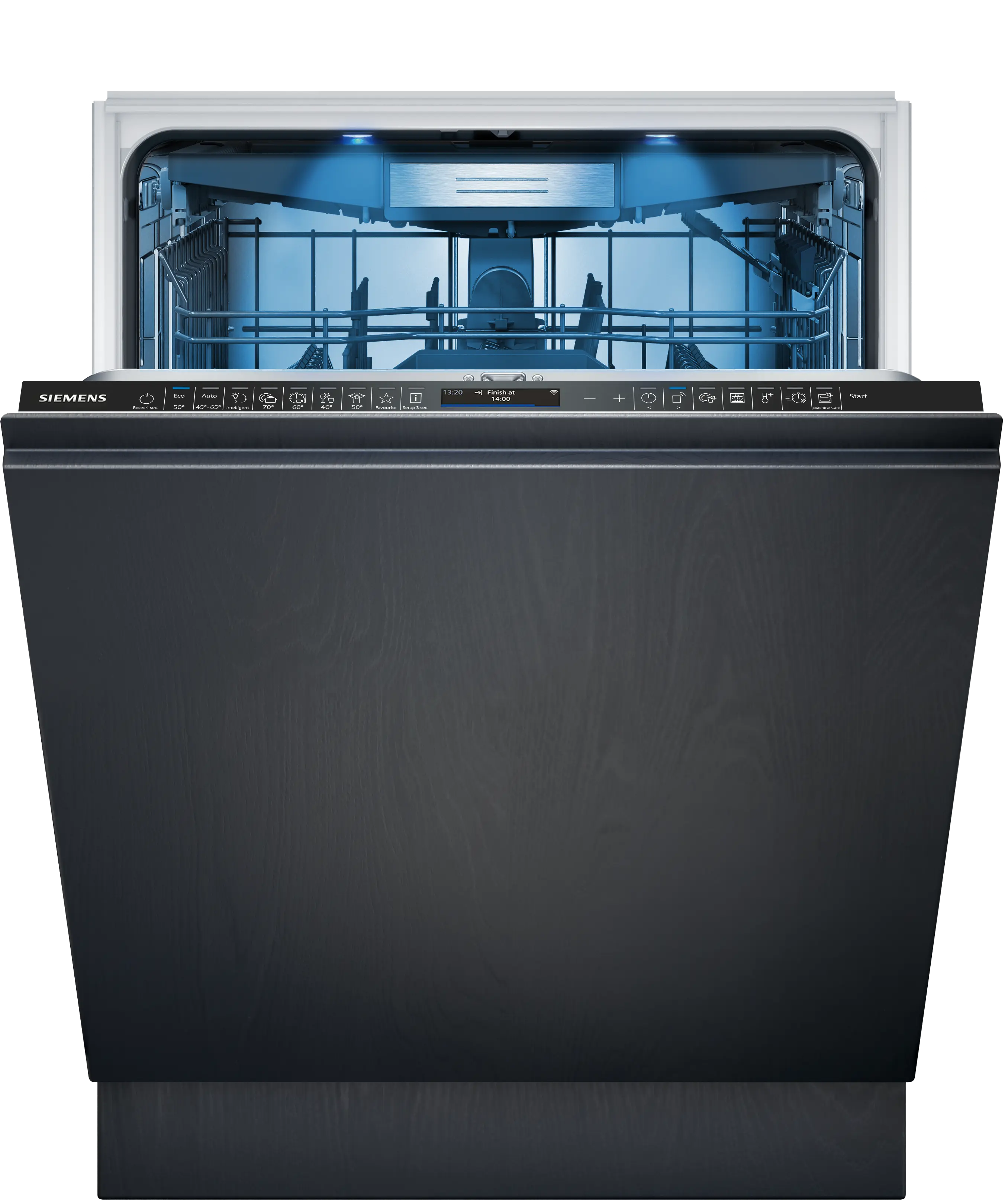
Best Overall: Siemens SN87TX00CE
A fully integrated machine and the strongest specification in this comparison. It holds 14 place settings, carries the top energy class A, and declares 54 kWh per 100 cycles with an average 9.5 litres per wash. Declared noise is around 43 dB(A). It measures 55 by 59.8 by 81.5 cm and weighs 43.1 kg.
The two features that justify its position are zeolite drying, which uses a mineral that releases heat as it absorbs moisture and so dries thoroughly without a hot final rinse, and varioSpeed Plus, which shortens the standard programmes by up to 60% when you need the plates back quickly. There is a flexible basket system and Home Connect for app control. Owner feedback on the retail listing is strongly positive, singling out cleaning, drying, ease of use and quiet running.
If you would rather see the controls, the Siemens SN57TS00CE is the semi-integrated version of the same machine with the same specification.
Search Amazon UK · Search Amazon US
Best Value: Bosch SMV6ZCX16E
Substantially cheaper than the Siemens while giving up very little, which makes it the pick for most kitchens. It is also the quietest machine here, with a declared 40 dB(A) — quiet enough to run overnight without anyone noticing. It takes the same 14 place settings and declares 2,520 litres a year.
It keeps almost the whole feature set: Home Connect, automatic soil detection that adapts the cycle to how dirty the load is, and the same zeolite drying as the Siemens. There are seven standard programmes plus an eighth, a favourites slot where you build your own combination and add extra functions to it. The Vario drawer forms a third level that takes small crockery as well as cutlery, and the Rackmatik system adjusts the upper basket through three positions across 5 cm of height, which is what lets wine glasses or long-handled plates fit.
Its energy class is B rather than A, so it will cost a little more to run — offset in practice by a much lower purchase price. Owner ratings are good almost across the board. The identically equipped semi-integrated version is the Bosch SMI6ZCS16E.
Search Amazon UK · Search Amazon US
Best Freestanding: Bosch SMS6ZCI16E
For kitchens without a fitted run, or where the machine has to stand on its own, this is the same generation of Bosch in freestanding form. It takes 14 place settings, has eight programmes including one you configure yourself, detects soil level and adjusts, and connects to Home Connect.
The practical touches are a height-adjustable upper basket, a variable cutlery drawer and a separate drying function aimed at the items that normally come out damp. It is rated energy class B with a declared 2,660 litres a year, so consumption is moderate and running noise is low relative to what it costs.
Search Amazon UK · Search Amazon US
Fully Integrated, Semi-Integrated or Freestanding?
The real question is whether you have a fitted kitchen and want the machine to disappear into it.
Fully integrated machines are faced with a panel matching the rest of your units, running the full height of the door, so the display and controls are hidden — usually on the top edge of the door, visible only when it is open. The kitchen reads as one uninterrupted run.
Semi-integrated machines are panelled across the lower part of the door with the controls left exposed. Day-to-day operation is easier because you can see the programme and the time remaining without opening anything, at the cost of a front that does not quite match.
Freestanding machines come in the manufacturer's own finish and can be positioned anywhere, which is the only option if the kitchen has no gap to build into.
Cleaning performance is essentially unaffected by which you choose — it is a question of taste and kitchen. The clearest evidence is that several manufacturers sell the same machine in more than one of these forms, as both Bosch and Siemens do above.
What to Look For
Energy efficiency. The label was rescaled after the old A+, A++ and A+++ tiers ran out of headroom. Class A is now reserved for genuinely exceptional machines and few reach it. B is still very efficient, C and D are solid and contain plenty of good machines, and it is only at E, F and G that efficiency is worth a hard look. You only need to insist on A if energy use is your single most important criterion.
Water use and noise. A modern dishwasher uses less water for a full load than washing the same load by hand. Efficient machines manage under 10 litres on the eco programme, holding the water longer and changing it only once it passes a certain soil level. Aim low on noise too: around 40 dB(A) is quiet enough to run at night, which is often when the electricity is cheapest.
Everyday operation. Controls are much the same everywhere — programme selection, delay start, start and stop. What matters is that the coarse filter and the salt filler are easy to reach, and that there is a remaining-time display so you know when the machine is done.
Size. Standard machines are about 60 cm wide and 80 cm high. Slim 45 cm models exist, but compactness is genuinely their only advantage: they are noticeably less efficient, so water and power use are not far off a full-width machine, and you save nothing on purchase or running. XXL models stand taller than 80 cm and take large plates or tall jugs, with consumption similar to standard machines and a higher price. Heights of 81 and 86 cm are both available to suit different worktops.
Choosing the Programme
The eco programme is the one to default to. It runs long — sometimes beyond four hours — but the extended soak means lower temperatures do the work, which usually produces the best cleaning result as well as the lowest consumption.
The automatic programme estimates load size and soil level and adapts. It saves time, but generally uses more power and water than eco.
The quick programme is for when you run out of plates mid-party. It costs roughly a third more water and energy than the eco cycle.
The intensive programme uses high temperatures and long cycles for baked-on residue and roasting dishes. The delicate programme does the opposite, running cool enough not to damage fragile glasses and good tableware.
Common Questions
Does water consumption vary much between machines? Yes. Most machines now use under 10 litres on the eco programme, but the automatic and quick programmes vary widely from model to model — anywhere from 10 to over 15 litres.
Can I connect a dishwasher to the hot water supply? Check the manual for your specific machine. Some models rely on cold incoming water as part of the drying process, and connecting them to hot water can leave the load wetter.
How wide is a standard dishwasher? Just under 60 cm, matching standard kitchen unit spacing. Height depends on your worktop, which is why 81 cm and 86 cm versions exist.
A Note on Model Codes
These are the exact machines the comparison covered, listed under their European model codes. British ranges from the same manufacturers often use different codes for equivalent machines, so a code here may not match what a UK retailer lists. Nothing has been swapped for a British near-equivalent: each entry links to a search for that exact model name, and no price or purchase link is quoted, because no exact listing was verified. Shopping in the UK, the specification pattern is what to match — place settings, energy class, declared water use, noise and build type — rather than the code.
For the rest of the utility room, see our guides to the best washing machines of 2026 and the best tumble dryers of 2026.
Research sources
Sources recorded for this page are linked below. Reported third-party testing belongs to the original publisher; it is not testing performed by Truthful Reviews.