Summer means picnics in the park, afternoons at the lake and camping weekends — and the eternal struggle to keep the drinks cold and the snacks fresh once the cool bag gives up. Electric cool boxes solve the problem properly: plugged into the car's 12-volt socket or a mains outlet, they hold drinks, food and even medicines at fridge-like temperatures wherever the day goes. This buying guide compares five recommended electric cool boxes — from an £88 picnic companion to a 50-litre compressor model capable of freezing to minus 20 degrees when it is available — and explains the technology differences that decide what your money actually buys.
A note on method before the recommendations: this is an editorial comparison built from published product findings, manufacturer specifications and current UK retail checks. Truthful Reviews did not test these boxes. Owner comments are identified as such rather than presented as measurements.
The Short Version
- Top pick — Peme Essential. A 23-litre thermoelectric box that runs on 12-volt and mains current, cools 14 to 18 degrees below ambient temperature, heats to 65 degrees for winter duty and weighs about four kilograms, with a matching Amazon UK listing observed at £96.83.
- Price tip — Mobicool Mirabelle MM24 DC. Twenty litres with a matching Amazon UK listing observed at £87.71 — 12-volt only and modest in ambition, but compact, 2.5 kilograms light and impossible to beat on price.
- Top alternative — AEG Automotive KK 28. Stronger cooling (up to 20 degrees below ambient), 28 litres and dual ventilation with a matching Amazon UK listing observed at £102.24, at the cost of weight and noise.
- The compressor pick — Juskys Yukon 50L. Fridge technology to go: 50 litres, temperatures from plus 20 down to minus 20 degrees regardless of the weather, display, app, wheels and handle, but no matching Amazon UK listing surfaced in the current retail check.
- Price alternative — Kesser 32 L. A large 32-litre thermoelectric box with warm-keeping to 65 degrees although no matching Amazon UK listing surfaced in the current retail check.
The Top Pick: Peme Essential
Check the Peme Essential price on Amazon UK
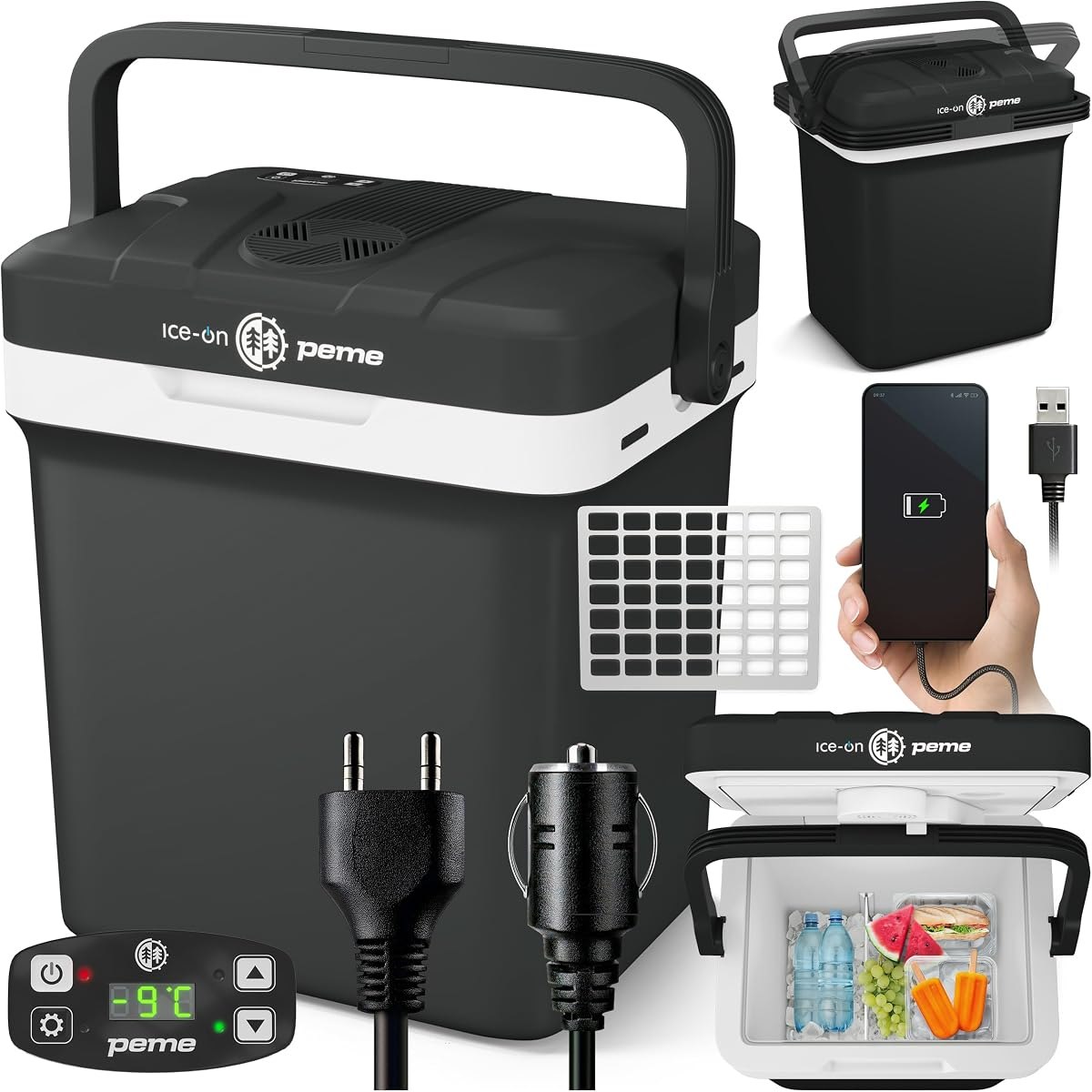
The Peme Essential earns the headline spot by covering the most ground for the least money. The 23-litre thermoelectric box connects to the car's 12-volt socket or directly to the mains, draws 40 to 50 watts depending on mode, and holds contents 14 to 18 degrees below the surrounding temperature — enough to turn a 30-degree beach day into properly cold drinks. A display shows the current temperature and takes a target setting, which is far from standard at this price. The party trick is the reversible mode: switched to heating, the box holds 60 to 65 degrees, turning it into a warm-food carrier for winter journeys.
At around four kilograms it carries easily even loaded, and the observed £96.83 Amazon UK listing places it close to the other thermoelectric models in this comparison. The honest caveats come straight from owner feedback: the box cools slowly — plan a few hours of lead time or pre-chill the contents — and the fan is audible enough that reviews mention it. Annual consumption of 93 kilowatt-hours also makes it no efficiency champion. As an all-round summer box with a winter second job, nothing here matches it for the money.
The Price Tip: Mobicool Mirabelle MM24 DC
Related Articles

Check the Mobicool Mirabelle MM24 DC price on Amazon UK
At an observed £87.71 on Amazon UK, the Mirabelle MM24 DC is the least expensive currently listed model in this comparison, and its limits are printed honestly on the box. It runs exclusively from a 12-volt socket — there is no mains option — and the maker guarantees cooling of up to 15 degrees below ambient only while the outside temperature stays at or below 25 degrees. Above that, expectations should soften accordingly. Unpowered, the insulated shell works like a classic passive box with a cool pack.
The virtues are practical: 20 litres of space swallow about five 1.5-litre bottles, the box weighs a mere 2.5 kilograms, and the compact 39 × 23 × 40-centimetre body fits the passenger footwell. Customer reviews split on noise — some call it very quiet, others too loud — but agree the price undercuts expectations. As a car-journey and picnic companion for pre-chilled goods, it is exactly what it costs.
The Top Alternative: AEG Automotive KK 28
Check the AEG Automotive KK 28 price on Amazon UK
The AEG KK 28 is the thermoelectric pick for people who want real cooling authority. The maker specifies up to 20 degrees below ambient temperature — the strongest of the thermoelectric trio here — and owner feedback describes that figure as reliable. Dual ventilation spreads the cold faster through the 28-litre interior, which comfortably swallows fruit, barbecue supplies and drinks for a family day. It connects to both the car's 12-volt socket and the mains, where its 1.25-metre cable allows flexible placement at home, drawing a brisk 55 watts.
The trade-offs are physical: at close to seven kilograms it is heavy for a thermoelectric box, and reviews describe the operating noise as comparatively loud. At an observed £102.24 on Amazon UK, it sits close to the other listed thermoelectric picks and below the compressor class — the choice when the Peme's cooling ceiling isn't enough but fridge-grade hardware is overkill.
The Compressor Pick: Juskys Yukon 50L
Related Articles

The Yukon 50L is a different species: a compressor cool box, technically a portable fridge. Where thermoelectric boxes can only offset the ambient temperature, the compressor sets absolute values — anywhere from plus 20 down to minus 20 degrees — and holds them largely regardless of the weather, which also makes the box suitable for continuous duty in a holiday home or as an emergency fridge. The 50-litre chamber is the largest here by half, and the equipment reads like it: a display, app control, a USB port for charging mobile devices, and wheels with a handle for the journey from car park to pitch.
The costs are exactly the two a compressor always brings. At 13.4 kilograms empty it is a two-handed carry without the wheels, and its lack of a matching Amazon UK listing means it cannot be treated as a current UK recommendation. It runs from 12/24-volt vehicle sockets and mains alike. For campers, anglers and road-trippers who need genuine refrigeration — or freezing — away from civilisation, it is the only technology in this comparison that truly delivers it.
The Price Alternative: Kesser 32 L
The Kesser rounds out the field as the big-capacity budget option: 32 litres — more than the top pick — with cooling up to 18 degrees below ambient and a warm-keeping mode reaching 65 degrees, at a portable 4.7 kilograms, but no matching Amazon UK listing surfaced during the current check. It splits the difference between the Peme's features and the AEG's capacity, and suits households whose main event is the weekly big shop surviving the drive home in August.
Key Specifications from the Comparison
| Model | Capacity | Power connections | Cooling range | Heating | Weight |
|---|---|---|---|---|---|
| Peme Essential | 23 litres | 12V, 230V and 240V | 14–18°C below ambient | 60–65°C | 4.1kg |
| Mobicool Mirabelle MM24 DC | 20 litres | 12V | Up to 15°C below ambient | — | 2.5kg |
| AEG Automotive KK 28 | 28 litres | 12V and 230V | Up to 20°C below ambient | Up to 50°C | 7.1kg |
| Juskys Yukon 50L | 50 litres | 12/24V and 230V | +20°C to -20°C | — | 13.4kg |
| Kesser 32L | 32 litres | 12/24V DC and 100–230V AC | Up to 18°C below ambient | Up to 65°C | 4.7kg |
These figures describe different technologies, so the cooling column must be read carefully. Thermoelectric models quote a reduction below the surrounding temperature; the compressor-powered Yukon quotes an absolute temperature range.
How the Boxes Were Chosen
The selection follows the assigned comparison's product findings, supplemented by current UK retail checks. Truthful Reviews did not lab-test these five models, so performance specifications are presented as manufacturer figures and owner comments remain attributed rather than being recast as measurements. Models without a matching UK listing are retained for technical context but are clearly marked as having limited current availability.
Thermoelectric, Absorber or Compressor?
Thermoelectric boxes — four of the five picks — cool via the Peltier effect: current flowing through a semiconductor module creates a temperature difference, one side cooling while the other heats, and reversing the current turns cooling into heating. They run from 12, 24 or 230 volts, tolerate rough handling and any orientation, weigh little, and are generally the least expensive form of active cooling. One purchase warning: check the connections actually built in — some models need a separately purchased converter for mains use.
Absorber boxes run on electricity or on propane and butane gas, making them independent of sockets entirely, and are nearly silent in gas operation. They must stand level and usually cost more than basic thermoelectric models.
Compressor boxes work like household fridges: a compressor pumps refrigerant through a closed circuit, delivering the strongest cooling — minus 20 degrees or below, independent of ambient temperature — with the lowest running consumption, making them the choice for continuous use. They are normally the most expensive of the three designs.
What Cooling Performance Really Means
Every specification except a compressor's is written as "below ambient temperature", and the small print matters twice. First, manufacturer claims and reality diverge — some promise 18 degrees below ambient, others over 30, and few boxes hit their number in blazing heat; when the shade reads 30 degrees, many cheaper boxes leave the beer lukewarm. Second, the connection matters: boxes often cool measurably better on 230-volt mains than on the car's 12 volts, and without any power at all, most active boxes insulate poorly — particularly in the budget segment. Pre-chilling the contents remains the cheapest performance upgrade there is.
Matching the Box to the Trip
Think about the destination before the datasheet. For the lakeside, where a box gets knocked over, thermoelectric technology shrugs where a compressor complains. For long carries, handles are mandatory and wheels with a trolley grip — as on the Yukon — are worth real money once the box is full. Fan and compressor noise matters more at a campsite at midnight than the spec sheet suggests, and owners' noise comments are worth reading before buying. And check the geometry: some tall boxes take standing two-litre bottles, but a domed lid can make the edges too low for them — leaving the box unable to close properly.
Cool boxes also pair naturally with the rest of a summer kit: our camping chairs guide covers the seating half of the same trips, and for cooling the home you return to, our portable air conditioner guide sorts that market's very different technology questions.
Frequently Asked Questions
Can a cool box replace a fridge?
Generally no. A fridge regulates temperature constantly and keeps perishables safely cold; a thermoelectric box only offsets the ambient temperature and suits keeping pre-chilled goods cold for hours, not days. The exception is the compressor class, which genuinely refrigerates — the Yukon holds set temperatures indefinitely on mains power.
How long does a cool box work without power?
Depending on insulation quality, ambient heat, how often the lid opens and how much cooling material is inside, a well-insulated box bridges several hours to about a day — with performance declining steadily as cool packs warm through.
How much current does a 12-volt box draw?
Typically between 3 and 8 amps, rising with the heat. Check the manufacturer's figure, make sure the vehicle socket can supply it — and avoid running a box off a parked car's battery for long stretches, which can leave you needing a jump start more than a cold drink.
How does an electric cool box actually work?
Thermoelectric models exploit the Peltier effect — current through a semiconductor module chills one side and heats the other, and reversing the flow swaps cooling for heating. Compressor models miniaturise fridge technology, pumping refrigerant through a closed evaporation-compression circuit. Both need external power: 12/24-volt vehicle sockets or the mains.
The Bottom Line
Five boxes, three technologies, one honest hierarchy. The Peme Essential is the most versatile currently listed all-rounder — dual power, real cooling and winter heating at an observed £96.83. The Mobicool MM24 is the lower-priced listed option at £87.71, while the AEG KK 28 adds cooling authority for an observed £102.24. The Kesser and Juskys Yukon remain useful examples of larger thermoelectric and compressor designs, but neither had a matching Amazon UK listing during the current check, so they are not current UK recommendations. Choose the technology for the trips you actually take — and whatever you buy, load it pre-chilled.


