When summer makes its final push, heat stands in the flat and the longing for cool air becomes physical, air conditioning offers relief — but a fixed split installation is an expensive project demanding structural changes and certified installers. Portable monoblock units are the cheaper, more convenient alternative: all the technology in one housing, hot exhaust air blown out of the window through a hose. After testing 32 portable air conditioners — 18 of them currently available — the verdict is nuanced: not a single total failure, yet honest physics limits what the entire category can achieve. The differences worth paying for lie in cooling power, electricity consumption, noise and equipment, and a handful of machines genuinely earn their place.
The Short Version
The De'Longhi Pinguino PAC EX105 is the best monoblock of the test: superbly built, strongly cooling and astonishingly frugal. The AEG Comfort 6000 is the smart pick with the first app that fully convinces, and the compact Dreo 318S serves small bedrooms and offices where bigger machines will not fit.
Test Winner: De'Longhi Pinguino PAC EX105
Efficiency that pays for itself
Related Articles
De'Longhi advertises the EX105's A+++ energy label loudly, and the test measurements back the boast: 500 to 570 watts under full load — the consumption of a small unit — while the cooling effect matches considerably hungrier rivals. No other machine in the field approaches this efficiency. Within half an hour the test room's temperature had fallen markedly and kept sinking. The arithmetic matters: at the official average electricity price of 40.55 cents per kilowatt-hour, a typical 770-watt unit costs 31.22 cents per hour — about 281 euros across a 90-day summer of ten-hour days — and stronger machines drawing over 1,000 watts cost proportionally more. Against that baseline, the EX105's frugality repays its premium purchase price within roughly two summers for frequent users.
Design and operation
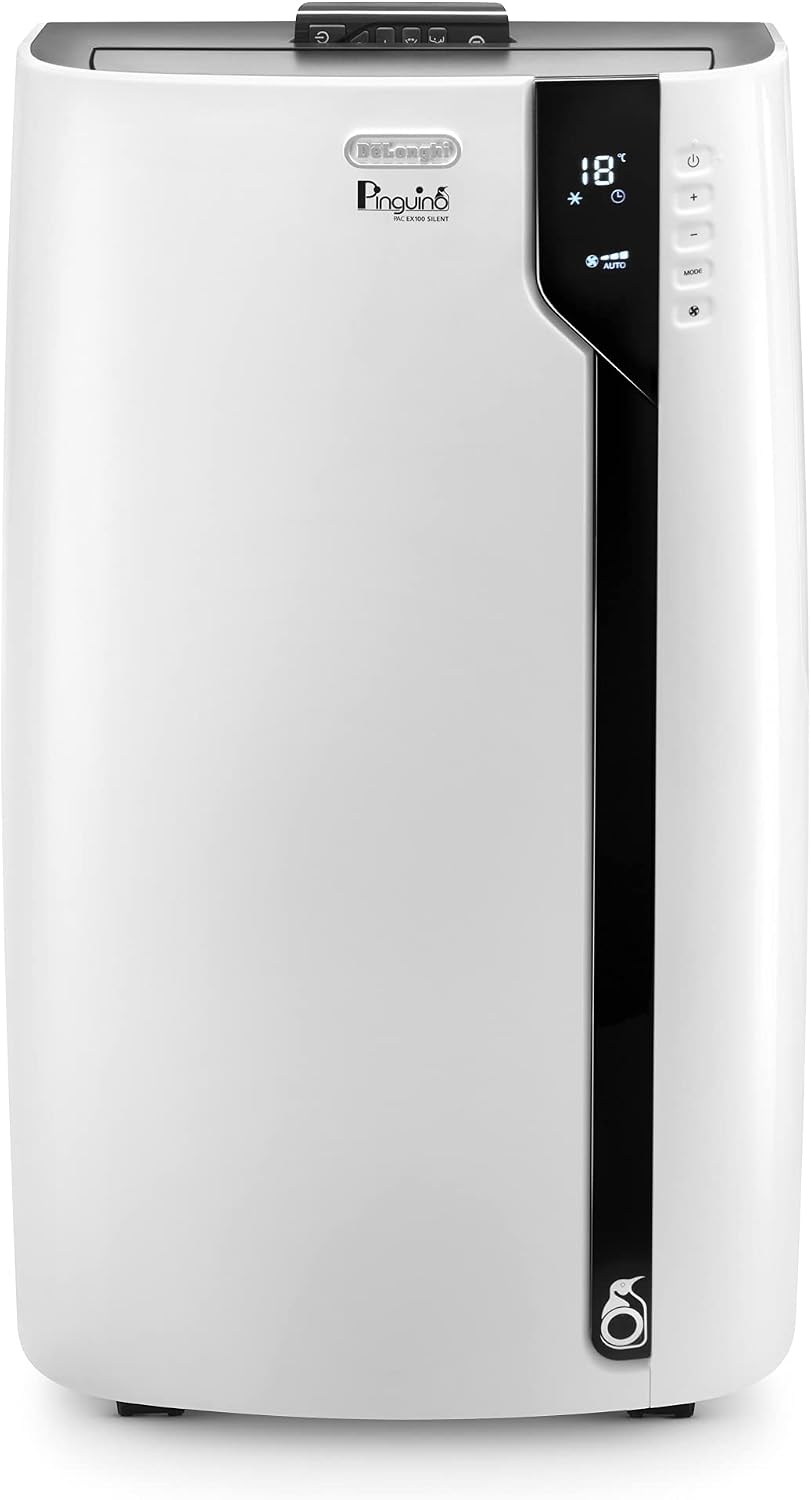
Visually the EX105 is the near-twin of its EX100 Silent sibling, distinguished by the colour of the vertical front stripe — no complaint, since the design genuinely pleases. Display and controls sit unusually in the upper right of the front face, which proves a quiet stroke of genius: the readout is visible from the sofa without standing up. The set-off keys look mechanical but are flawless touch fields, and a moulded recess on the top stores the bundled remote control. Build quality is immaculate, as both the brand and the price demand — and it signals the long service life that the amortisation case assumes.
Weaknesses
Related Articles
Two omissions niggle at this price: rollers but no cable winder, so the lead drags or rides in your hand during transport, and no window sealing kit in the box — an accessory most cheaper rivals include.
Smart Pick: AEG Comfort 6000
On paper the Comfort 6000 has the highest cooling power of the entire field — a stated 14,000 BTU per hour — and in practice it cooled the test room by a full three degrees in the first hour, eventually pressing below 20 degrees against rising outdoor temperatures, at one point pausing itself in apparent satisfaction at having hit target. But the recommendation rests on something rarer: the first companion app that convinces without reservation. Installation took under five minutes, every conceivable setting is reachable from the phone, and extras like a child lock and timer join genuinely useful guidance — the same software platform that drives AEG's entire smart range. The hardware matches: clean minimalist design, pleasant-action controls, unobtrusive LED indicators and — praiseworthy — a cable holder on the housing. The bills: peak consumption near 1,200 watts, sparse bundled accessories (the premium window kit sells separately), and the inevitable account requirement. At nearly identical size and weight to the winner (around 80 centimetres, 34 kilograms), it is the choice for connectivity-first households untroubled by the meter.
Compact Pick: Dreo 318S
The Dreo 318S is no toy mini but a genuinely compact monoblock with everything that belongs: at around 60 centimetres tall and 22.5 kilograms, it is more than 10 kilograms lighter and nearly 20 centimetres shorter than the other recommendations, and stows correspondingly easily. The manufacturer honestly rates it for rooms up to 15 square metres — its 7,500 BTU per hour cannot carry living or dining rooms, but in a bedroom or small office it shines, lowering the test room by a degree and a half through the morning before the afternoon heat fought back. Peak draw measured around 650 watts (standby a tidy 0.5 watts), and the 58.7-decibel maximum is acceptable for home offices and tolerable for less sensitive sleepers.
The detail execution charms: touch fields above a circular display showing target temperature, mode and fan speed at a glance; one of the best remote controls yet tested, with its own display for when the unit stands out of sight; and a clever five-second counter that appears while holding dual-function keys — small, but it ends the guessing that plagues such controls everywhere else. The app matches the AEG's class, configuring quiet hours and schedules as smoothly as the basics. Two caveats: the bundled exhaust hose, paired with a low-set outlet, barely reached the test window — measure before buying — and at around 460 euros the small machine costs mid-size money, with stronger (if cruder and louder) units available cheaper. For genuinely small rooms, it is the polished answer.
Also Tested: The Field
De'Longhi AP130I Pinguino GentleJet Inverter
A big, powerful, characteristically premium machine at nearly 1,000 euros and 30 kilograms: handsome design, integrated controls, a quality remote (screenless), and a sliding-window kit in the box — but nothing for tilt windows. It cooled the test room from 25.3 to 22.4 degrees before the late-afternoon heat surge won, peaking at 937 watts and around 59 decibels. Entirely respectable — and that is the problem, because under 900 euros buys better, some of it from De'Longhi itself.
Bosch Cool 5000
Bosch's larger Cool continues the series' virtues: excellent build, a smart functional design with a permanently attached, stowable exhaust hose (awkward to replace, admittedly), whisper and night modes, and a magnetic remote holder that deserves imitation. Cooling ran nearly two degrees in the first hour and held usefully below ambient through a heatwave afternoon; consumption climbed from 823 to over 1,100 watts — unexceptional for 12,000 BTU per hour — at a pleasantly steady 59 decibels. The one irritation: the remote works only from a narrow angle. A thoroughly decent machine, especially on offer.
Comfee Mobile 12000
The budget entry trades finish for price: membrane keys without quality feel, indicator-lamp displays hard to read across a room, and styling best described as forgivable. The backlit remote restores comfort, a "Follow Me" mode steers the unit by the remote's own thermometer (of limited use in the test room, potentially handy across small flats), and timer, sleep and drying modes are aboard, with an optional heating variant. Cooling managed 1.1 degrees in the first hour at 61.3 decibels and a constant 960 watts — neither a performance nor an efficiency wonder, but a serviceable alternative whenever its price dips properly below the establishment.
De'Longhi Pinguino AP98 GentleJet
Rated for rooms up to 110 cubic metres at 11,500 BTU per hour, the 34-kilogram AP98 cooled almost three degrees in its first hour at a restrained 690-watt peak (just over 700 with the swing outlet active) and roughly 60 decibels, falling to 53 in whisper mode. Good build, flawless touch controls, a functional if light remote — a machine that does little wrong and not enough right to escape the shadow of its own stablemates, especially at its current price.
Sichler NX-9766
The soberly styled Sichler earned affection for practicality: a front air outlet that makes the fan function genuinely useful, grip recesses, a rear cable winder with plug holder, and an exhaust outlet set high on the body — closer to the window, easing the tilt-window problem described below. The control panel is pragmatic soft-touch with a central digital display. Heating capability and Wi-Fi join the feature list, though the Elesion multi-device app is no revelation — overloaded menus, translation slips and fiddly pairing, redeemed by workable everyday control plus IFTTT, Alexa and Google Home hooks (voice control covers temperature but not swing or mode). The display-less remote compensates with a separate key per function — very welcome. Cooling speed sat in the upper midfield, heating satisfied, and the bill arrived accordingly: peaks above 1,100 watts and, less forgivably, 66 decibels under load. The cheaper sister model NX-9765 offers the same machine minus heating for smaller rooms.
Remko RKL 495 DC
The field's exception is technically not a monoblock at all: the Remko is a portable split, its compressor exiled to a clunky outdoor unit on balcony or wall. The physics advantages are exactly as theory predicts — much quieter indoors, far more efficient, no window seal required — and it cooled best of the entire test. Two facts keep it from a recommendation: a purchase price roughly four times the field's, and an outdoor unit that sounds, to the neighbours, like someone vacuuming outside their window for hours. For detached-house owners with budget, a fine choice; for flat dwellers, a feud waiting to happen.
Argo Milo Plus
Tall, rounded and top-vented, the Milo Plus cooled slowly but steadily to the field's lowest reading of just over 20 degrees after three hours, at 64.2 decibels under load, with dehumidify and heating modes aboard. Workmanship is flawless as befits the venerable brand, and the remote — generous separate keys, a large legible mono display — reflects it; the Wi-Fi app emphatically does not, falling far below the hardware's standard. Heavy and bulky enough to need help on stairs, otherwise a thoroughly solid machine for anyone who can ignore the botched app.
Home Deluxe Mokli XL
The bargain of the field cools quickly in its first hour without ever reaching the depths of better machines, charms with a black face and big digital display (early-nineties Turbo-button PC energy, meant affectionately), and counters with the field's loudest operation at 67.8 decibels, a tiny coin-cell remote beneath discussion, and no connectivity whatsoever. Heating, dehumidifying and a front-facing fan mode (best enjoyed seated, given the low build) round it out. Worth considering strictly on a good offer — prices swing wildly.
De'Longhi Pinguino PAC EX100 Silent
The winner's beautiful sibling would take any design prize — and teaches the field's most useful lesson in name-scepticism. "Silent" refers to a special mode that trades cooling power for moderation and still is not truly quiet; in normal operation the machine scratches 64 decibels like everyone else. The deeper problem is pace: peak draw of only about 560 watts sounds frugal but reflects genuine lack of punch, with temperatures falling too slowly to justify the price despite good build, an exemplary adapter set and pleasant touch controls. The EX105 exists; buy that.
Midea Silent Cool 26 Pro WF
The Midea is the test's detective story. At a measured 54.6 decibels maximum it is the quietest machine in the entire field, with the best remote control of the test, generous accessories and excellent drain fittings — a recommendation in waiting, except the room cooled implausibly slowly. Repeated runs, a fresh window seal and finally a thermal-imaging camera found the culprit: the exhaust hose, longer and wider than any rival's and poorly insulating, was shedding three to five degrees between machine and window — the cold literally evaporating en route, aggravated by the top-mounted outlet blowing cool air towards the hose. With a better exhaust solution this would be a hit; as shipped, it is a cautionary tale about the component nobody looks at.
EcoFlow Wave 2
The field's exotic needs no socket at all: with optional battery and solar input it cools tents and camper vans, weighs a class-light 15 kilograms, and wears its outdoor mission well — deliberately roller-free, beautifully built, with a sharp top display and crisp mechanical keys. Uniquely it ships two hoses, intake and exhaust, so the unit itself can stand outside the tent with only ducting indoors — clever for cramped canvas and kinder to sleeping ears. Within its niche it is excellent; as room cooling it plays a different, smaller game.
The mini class in general
Genuine mini air conditioners surface regularly and vanish from the market almost as fast. The pattern the EcoFlow exemplifies holds across the class: far less cooling power than mid-size machines by physical necessity, traded for flexibility no monoblock matches. For work nooks, camping and vehicles they have a real niche; for rooms, they do not.
How the Machines Were Tested
Every unit faced the same regimen in the same test room: cooling runs across full days with logged temperature curves against rising outdoor heat, electricity draw measured at peak and standby, sound-level measurements under maximum load, and condensate volumes tracked across ten-to-twelve-hour sessions. Equipment, remote controls, apps and window kits were assessed in actual use rather than from spec sheets — which is how a thermal-imaging camera ended up diagnosing a hose, and why the verdicts above lean on measured watts and decibels rather than brochure BTU.
How an Air Conditioner Actually Works
Every air conditioner is a heat pump — the same machine as the kitchen fridge, pointed at a room. A refrigerant cycles endlessly through the same stations: at a heat exchanger it absorbs warmth from the room air, cooling it; a compressor then squeezes the refrigerant, raising its temperature far above ambient so it can dump that heat into air blown out through the exhaust hose; at the condenser the pressure drops, the refrigerant turns liquid and very cold, and the cycle begins again. Understanding this loop explains every quirk that follows.
Why Monoblocks Cannot Match Split Systems
Fixed split installations — indoor unit, outdoor unit — release their heat outside the building. Monoblocks suffer a double handicap. First, their plastic exhaust hoses are uninsulated and get very warm, radiating heat back into the freshly cooled room on the way out. Second, blowing air out of a room creates negative pressure, and replacement air flows in from the easiest source — outdoors, typically through the very window the hose occupies. The result: portable units work, but never as efficiently as splits. Where structural or rental constraints rule a split out, a monoblock remains better than nothing — that is the honest ceiling of the category.
Condensation: The Litre Nobody Expects
Cooling air wrings water out of it: warm air holds far more moisture than cold, and the difference condenses inside the machine. Every tested unit collects this in a tank that needs regular emptying — and the volumes surprise: up to a litre after ten to twelve hours of cooling, and far more in the dedicated dehumidify modes every test model offers, where multiple daily emptyings become routine. Households fighting damp as well as heat may find that function genuinely useful — though a dedicated machine like the Meaco DD8L Junior we reviewed does that single job better.
Noise, Honestly
Monoblocks must usually run at high power to deliver real cooling — and then they are clearly audible, mostly around 59 to 61 decibels in this field. That is open-plan-office loud, acceptable in living rooms by day, marginal in bedrooms by night (the Dreo and whisper modes excepted). Anyone dreaming of silent sleep under portable air conditioning is dreaming of a split system.
Refrigerants and the Environment
The old environmental indictment of air conditioning — ozone-destroying, climate-wrecking fluorocarbon refrigerants — has been legislated away: since January 2020, portable units may only use refrigerants with a global warming potential (GWP) below 150, meaning a kilogram may warm the climate no more than 150 kilograms of CO2. The market's answer is propane, traded as R290, with a GWP of just 3.3 and a legal fill limit of 304 grams per machine — most tested units stay well below it. The honest environmental cost has shifted to the meter: the consumption arithmetic above is the real footprint, and it lands on your bill either way.
The German Window Problem
The category's eternal stone in the shoe is the exhaust hose meeting the tilt-and-turn window. Sliding windows — the Anglosphere norm — accept the bundled sealing rails most manufacturers ship; tilt-and-turn frames do not, forcing adhesive fabric seals that block less heat exchange, look worse, and effectively end the "mobile" promise: nobody re-glues a window seal to chase the sun around a flat, so in practice the machine lives in one room (or every window gets its own seal). The hose geometry compounds it — tilt windows open at the top, so hoses must climb nearly to the ceiling, enlarging the open gap. The clean solution, where single glazing allows, is a glazier-cut hose port in one pane; with insulated glazing, the fabric seal it is. Machines with high-set exhaust outlets, like the Sichler, ease the problem slightly.
How Much Power Does a Room Need?
The field's honest sizing guidance: around 7,500 BTU per hour (the Dreo class) carries rooms to roughly 15 square metres; the 11,500-12,000 BTU midfield (AP98, Bosch, Comfee) handles ordinary living rooms; 13,000-14,000 BTU flagships (AP130I, AEG) serve large open spaces. Oversizing wastes electricity and undersizing wastes everything — and no monoblock in the test reached an ambitious 18-degree target on a hot day, so expectations of three-to-five degrees below ambient are realistic, arctic ones are not.
A Living Test: How the Recommendations Evolved
Transparency about churn belongs in any honest comparison, and this category churns ferociously. Of 32 machines tested, only 18 remain purchasable — compact models in particular leave the market almost as fast as they arrive. The recommendation history tells the story: earlier favourites like the Rowenta Turbo Cool+ and Argo Orion Plus vanished from sale and were retired; the Medion price tip went the same way; the Hexafresh compact was removed over erratic availability; and newcomers like the Bosch Cool 5000 and Comfee Mobile 12000 entered the candidates list without displacing the podium. The practical lesson for buyers: act on a current recommendation while it is actually in stock, because in this category six months is a product generation.
Setting Up for Success: The First Day
How a monoblock is installed decides half its performance, and the field's collected experience condenses to a checklist. Place the machine as close to the window as the hose allows, keeping the hose as short, straight and uncrushed as possible — every metre and every kink sheds cooling capacity, as the Midea's thermal images proved vividly. Seal the window opening properly before judging the machine: an unsealed tilt window feeds hot replacement air directly to the intake. Keep the unit clear of the wall and out of direct sun. Close doors to uncooled rooms, draw blinds against direct radiation, and pre-cool in the morning rather than fighting a heat-soaked room in late afternoon. Finally, check the condensate tank daily in humid weather — several machines pause themselves when full, which reads as mysterious failure until the litre of water explains itself.
Cheaper Relief First
Before any compressor, the cheap and effective remedies deserve their hour: fans move air across skin for a fraction of a cent per hour, tower fans do it in narrow spaces, and so-called air coolers — evaporative boxes — promise much and deliver little in the test experience. The rational ladder runs: shade and ventilation discipline first, fans second, a monoblock where those fail, and a split installation where cooling is a long-term need and the building permits.
Fans, Tower Fans and 'Air Coolers': The Cheap Alternatives Rated
The pre-compressor options deserve their own honest paragraph each. Ordinary pedestal and desk fans remain the value champions of summer: they cool people rather than rooms, by accelerating evaporation from skin, at running costs measured in fractions of a cent — and their effect vanishes the moment they stop, which is precisely why they pair so well with discipline about shade and night ventilation. Tower fans buy the same effect in narrow floor plans and tighter modern flats, trading some airflow for footprint and usually adding quieter night modes. The seductive third category — evaporative "air coolers", sold hard every summer as cheap air conditioning — disappoints reliably in practice: they add humidity to the room while cooling only marginally, which in a German summer means trading dry 30 degrees for muggy 28. Between honest fans and real compressors there is no effective middle category, however the marketing reads.
Reading the Energy Label Properly
The winner's A+++ badge demonstrates both the value and the limits of the label. The class compares machines within their category under standard conditions, so it rewards exactly what the EX105 does — more cooling per watt — and the measured 500-to-570-watt full-load draw confirms the badge translates to the meter. But the label says nothing about how a specific room, seal and hose installation will perform, which is why the measured three-degree-per-hour results above vary more between installations than between adjacent efficiency classes. Use the label to shortlist, the wattage measurements to compare, and the installation checklist to realise what either promises.
Frequently Asked Questions
Can I run a portable air conditioner without a window?
No — the heat must go somewhere, and "somewhere" must be outside the cooled room. A hose port, a sealed window passage or at minimum a door to an unloved hallway is non-negotiable; recirculating units that claim otherwise are fans with marketing.
Why does my room warm up again in the afternoon?
Every test unit lost ground when outdoor temperatures spiked — physics again. The winning strategy is running the machine early, before heat load peaks, rather than asking it to reverse an already hot room at 4pm.
Are the BTU numbers on the box trustworthy?
As laboratory ratings, broadly yes; as room predictions, only when paired with honest room sizing, window sealing and direct-sun management. The gap between the AEG's paper-leading 14,000 BTU and its measured behaviour was small precisely because the machine is good — cheaper machines wear their numbers more loosely.
How loud is too loud for sleeping?
Field experience puts the comfortable sleeping threshold well below the 59-to-61-decibel running levels of most monoblocks. The Midea's 54.6 decibels marks the field's quiet frontier, whisper modes (Bosch, the AP98's 53-decibel hush) buy tolerability at reduced power, and the Dreo's 58.7 maximum suits the less sensitive. The robust strategy remains pre-cooling the bedroom before sleep and switching off, or accepting a timer-managed compromise.
Do the heating modes matter?
Several machines (Sichler, Comfee variant, Mokli XL, Milo Plus) double as heaters. As a primary heat source they are uneconomical against proper heating, but for transitional weeks in a home office or holiday flat the dual use can spare a separate device — a tiebreaker rather than a reason to buy.
What about the seal kits and accessories?
The accessory gap is real money: the winner ships without any window kit, AEG sells its premium kit separately, and only some rivals (the AP130I for sliding windows) include usable sealing. Budget 20 to 60 euros for a quality tilt-window fabric seal and treat manufacturer kits as a bonus, not an expectation. The winner's missing cable winder and the field's universal indicator-light-only tank warnings complete the small-print picture — no machine in the test beeps when the tank fills or the water needs emptying.
Is a used or last-season unit a good buy?
Often, yes — with two checks. Refrigerant rules changed in 2020, so anything older may carry banned high-GWP coolant and should be avoided; and compressors dislike being transported lying down, so any second-hand unit deserves 24 upright hours before first start, the same settling rule the Gastroback-style appliances state for factory-fresh machines.
Can a monoblock dehumidify on its own?
Yes — every compressor air conditioner dries the air as a by-product, and most of the tested machines expose a dedicated dehumidify mode that runs the compressor without aggressive cooling. In muggy weather this alone improves comfort markedly, because damp air at 27 degrees feels far worse than dry air at the same temperature. The catch is the condensate: in dehumidify mode the water arrives faster, the internal tank fills sooner, and machines without a continuous-drain hose option will pause more often. For a genuinely damp room a dedicated dehumidifier like the Meaco DD8L Junior we reviewed remains the more efficient tool; the air conditioner's mode is a useful bonus, not a substitute.
How should the machine be stored over winter?
Run the fan-only mode for an hour to dry the heat exchangers, empty the condensate tank completely, clean or rinse the dust filters, and store the unit upright in a frost-free room — refrigerant circuits and freezing leftover condensate do not mix. Come the next heatwave, the upright-transport rule applies again: if the machine travelled on its side, give it a day standing before switching on.
The Bottom Line
The De'Longhi Pinguino PAC EX105 is the rare portable air conditioner whose premium price refunds itself, cooling like the big machines on small-machine electricity; frequent users should buy it and stop calculating. The AEG Comfort 6000 earns the smart-home household's money with the field's first genuinely excellent app and mighty cooling, paid for at the meter. The Dreo 318S owns the small-room niche with polish the budget class never sees. And the category caveat stands in fairness to all three: a monoblock is the compromise you choose when a split system is impossible — sized correctly, sealed properly and run early, it is a good compromise.