The most expensive electric toothbrush in a maker's range and its cheapest one clean your teeth about equally well. That is not a value-hunter's hunch — it is what the dentists consulted for this testing say, and what the independent testing of one major brand's whole range has repeatedly found.
So the useful questions are not about price. They are about technique, and about which two extras are worth having.
What the evidence actually shows
A Cochrane Collaboration meta-study, pooling the results of 56 scientific investigations, found electric brushes remove up to 11% more plaque than manual ones, and that after three months the electric group had on average 21% less build-up.
Two honest caveats travel with that figure. Many of those studies were commissioned by manufacturers of electric toothbrushes, which qualifies the result. And manual brushing depends heavily on technique: you can clean well with an ordinary brush. As Dr Carolina Ganß, president of the German Society for Preventive Dentistry, puts it, the crux is applying it correctly.
The technique nearly everyone gets wrong
Most of us brush our teeth quite incorrectly. The method is:
- Small circular movements on each individual tooth.
- Hold the brush at a 45-degree angle.
- After a few movements, sweep plaque from gum to tooth — the principle summarised as "from red to white".
Doing all of that properly is genuinely difficult, which is the strongest practical argument for an electric brush: it removes some of the technique burden.
Rotating-oscillating versus sonic
Rotating-oscillating brushes — rotation brushes for short — drive a small round head with an electric motor that rotates it over 8,000 times a minute and pulses it over 40,000 times, moving alternately clockwise and anticlockwise, forwards and back. You hold it against one tooth for a few seconds, then move to the next, leaving all the movement to the motor and cleaning each tooth individually. It suits the meticulous brusher.
Sonic brushes do not clean with sound waves, despite the name and the common misconception — they clean mechanically too, through bristle contact. The name comes from the piezoelectric transducer used instead of a motor, vibrating the bristles through several tens of thousands of sideways movements per minute to loosen plaque more effectively. Two consequences follow. The transducer draws far less current than a motor, so sonic brushes last much longer between charges. And the technique differs: with a sonic brush you simply glide over the teeth, without circular or scrubbing motions. Because they can be guided more gently, sonic brushes suit sensitive teeth and delicate gums better.
Ultrasonic brushes vibrate the bristles higher still — up to 1.8 million times per second — and sometimes need a special toothpaste that produces tiny foam bubbles which the vibrations burst. Makers argue this spares teeth and gums by avoiding mechanical action. That is not proven.
Which to choose is partly taste and partly attitude. As Professor Zimmer of the University of Witten/Herdecke frames it: motivated, well-instructed users do very well with a round brush head, while those who would rather not relearn their habits should reach for a sonic brush. Used correctly, both clean properly.
Why a cheap model is enough
Within one major brand's rotating range, models span an enormous price spread — yet they barely differ in cleaning performance. That was confirmed by two independent dentists who work with electric toothbrushes in research daily, and by an independent consumer testing organisation that awarded every model from that maker at least a "good" grade for tooth cleaning across repeated test rounds.
The conclusion is blunt: a cheap electric toothbrush, with no functions beyond moving the brush head, is entirely sufficient.
The extras, ranked honestly
Timer — worth having, and nearly universal. Almost every electric brush now has a 2-minute timer, usually stuttering briefly at 120 seconds. Nearly all subdivide those two minutes into 30-second segments, which proved genuinely useful in testing because it helps clean all four quadrants evenly. One maker's brushes simply switch off after two minutes, which is irritating if you want to carry on. Some models add a 3-minute timer and cost more; that alone does not justify the premium.
Pressure control — worth having, but only one implementation works. Receding gums and exposed necks of teeth can indicate you are pressing too hard. Only the visual warning on some Oral-B models convinced: press too hard and an unmissable light comes on at the handle. The sensitive or acoustic versions from Braun, Philips and Panasonic are barely noticeable — they stop the rotation or stutter, which you scarcely register mid-brush. If that is the implementation on offer, you may as well save the money.
Cleaning modes — not worth paying for. Top models advertise up to six named modes. There is no scientific study of electric toothbrushes that says anything about the different cleaning modes, and the dentists consulted see no medical advantage. In hands-on use the difference was barely detectable — on one Philips model, no difference at all between its three modes. The only real benefit is if a mode feels pleasanter and so improves your motivation to brush.
"Smart" features — mostly redundant. Bluetooth models pair with a phone app showing elapsed brushing time, active mode, whether you are pressing too hard, and which areas were cleaned well or poorly; the fuller apps add personalised plans and reminders. The headline feature is position detection using the phone camera to spot neglected corners. Uneven brushing is a genuine problem — but in testing, the position detection did not deliver.
The picks
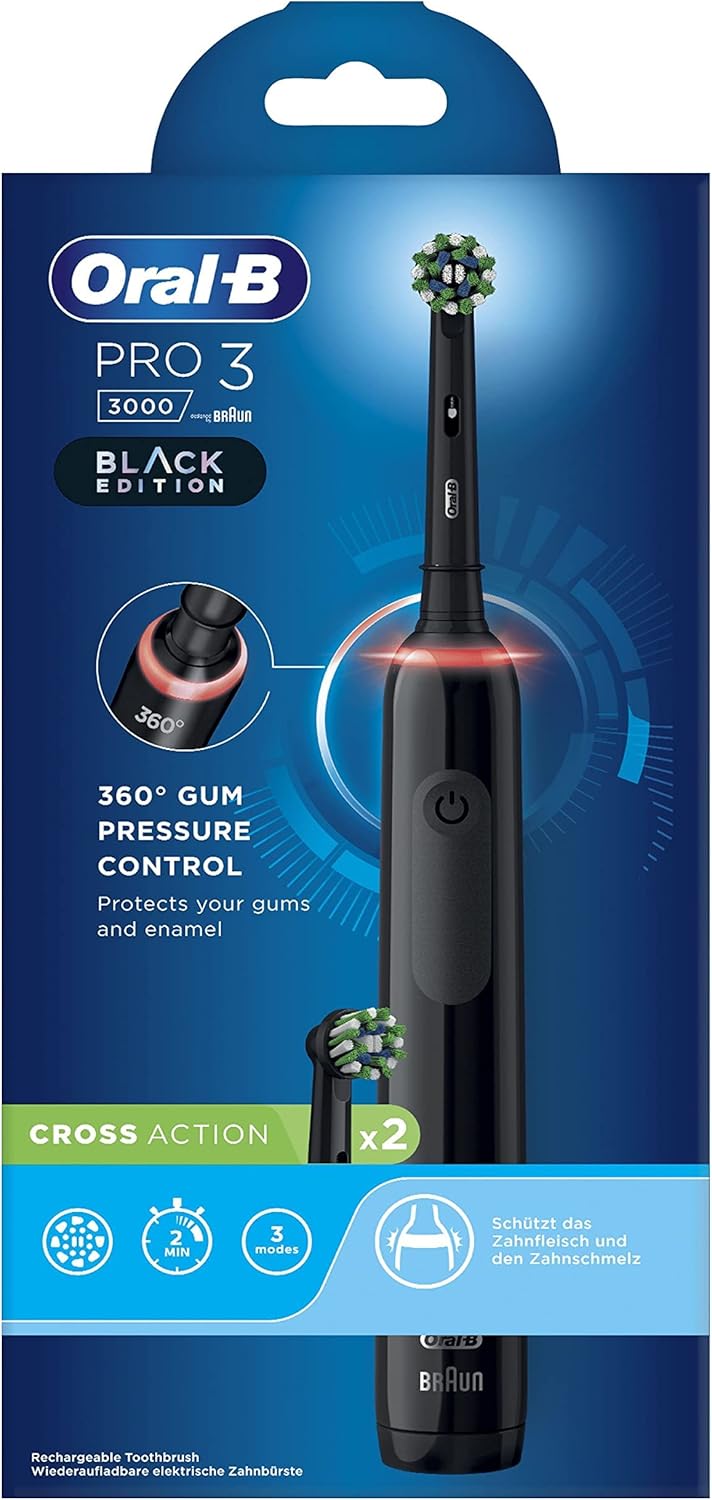
Best overall — Oral-B Pro 3 3000. It brings everything you need and not much you do not — which, given everything above, is the point. Many people press too hard against the gums, and this model warns with the visual pressure control that actually works: a red light when you press too hard. Quality is solid and substantial as expected from the brand. It deliberately forgoes many modes and extras, and testing confirmed you do not need them. The UK listing names 360-degree pressure control and the 2-minute timer.
Best sonic — happybrush Eco Vibe 3. For anyone who prefers sonic technology, brushing with this feels a little as though it were stroking your teeth. Its 41,000 vibrations per minute have real power, and the relatively soft heads clean thoroughly yet gently. Also notable: up to six weeks of battery life, a travel lock, a clever charging station, and climate-neutral production. It has no pressure control. The UK listing confirms the multi-week battery and includes replacement heads.
Best with an app — Oral-B iO Series 7. The best app-connected brush in the field. It shows brushing time on a display and gives immediate feedback as a smiley that is either pleased or sad depending on whether you managed two minutes, and the charge indicator now appears on the display as a nine-bar gauge plus a percentage. The design and magnetic charging station are genuinely handsome. The costs are real: it is expensive, and only the pricier iO-specific heads fit — a running cost that outlasts the purchase.
On the budget pick. The field's cheapest recommendation is the Prokudent Motion, a German drugstore own-brand that convinced particularly on cleaning results with no extras at all — not even pressure control. It has no Amazon UK listing, and we have not substituted a different model in its place. Read it instead as the evidence for the argument above: at the very bottom of the market, cleaning performance can still be the part that works.
Before you buy
Four questions. Round head or sonic? Meticulous brushers do well with round; anyone unwilling to relearn should choose sonic — and sensitive gums point the same way. Does the pressure control light up? If it only stutters, it will not change your behaviour. How often will you travel? Sonic battery life is measured in weeks, rotating in days. And what do replacement heads cost over five years? — on one pick here that is the real price.
Our best hair dryers guide covers the rest of the bathroom shelf, and our best fever thermometers guide the home health kit.