The number printed largest on an espresso machine's box — "15 bar", "20 bar" — is close to meaningless, and knowing why will do more for your coffee than any feature on the spec sheet.
From a tested field of 29 machines, here is what actually matters.
The bar figure is marketing; the clock is the measurement
The pressure that decides your espresso is the brew pressure at the coffee puck, and it should sit at around nine bar. What the box quotes is the pump's maximum pressure — not the extraction pressure the coffee ever sees. The two are related the way a car's top speed relates to your commute.
Pressure matters enormously; the printed figure just is not how you check it. Too little pressure gives a flat, watery espresso with no crema; too much over-extracts and turns it bitter. But you do not need a pressure gauge to know where you stand. The honest measurement is the clock: if your espresso runs through in 25 to 30 seconds and carries a proper crema, the pressure is right in every way that matters.
That check costs nothing, applies to every machine here, and outranks every manufacturer claim.
Single or dual circuit — and why home users need not pay for two
A dual-circuit machine keeps two separate water circuits at their own temperatures — one for espresso, one for steam — so you can pull a shot and froth milk simultaneously. In the entire tested field only one machine works this way, and one other adds a thermoblock for fast, stable steam temperature.
For a café that is essential. At home it is not: a single-circuit machine simply asks you to wait a few seconds while it changes temperature between coffee and steam. Two workarounds remove even that wait. After frothing, press the espresso button to flush hot water through the steam wand — cool water follows automatically and the temperature drops faster. Or make the espresso first, froth the milk second, and pour the shot into the milk.
The dual boiler is for someone pulling shot after shot with constant steam. Everyone else is paying for a queue that never forms.
PID and pre-infusion, translated
Two abbreviations recur in product descriptions and deserve plain English.
PID is automatic brew-temperature regulation — proportional, integral, differential control — smoothing out temperature swings during extraction. Many newer machines carry it, especially the hybrid segment. It is not a guarantee of a perfect shot, but it is a genuinely sensible feature rather than badge engineering.
Pre-infusion wets the puck gently before full pressure arrives, and appears on several machines in the field.
What deserves equal attention is adjustability of the ordinary things: being able to set the water volume per drink directly affects shot quality, and adjustable brew temperature is worth having even if good factory settings mean you rarely touch it.
The part nobody budgets: you
The honest finding of the whole category is that beans, grind and water hardness are at least as decisive as the machine. If you want genuinely good espresso, you will experiment with grind size and flow time — there is no machine at any price that removes that apprenticeship. The picks below differ mostly in how much of it they automate.
Water deserves one concrete number. A simple hardness test from any DIY shop tells you where you stand, and if your water sits well above 14 °dH, filtered or softened water is not fussiness — it is sensible, for the espresso and for the machine's lifespan alike.
One practical note on size: a machine's bulk does not affect its espresso, but very light machines can shift when you lock the portafilter in, forcing two-handed operation. Heft is a feature here, not a flaw.
The picks
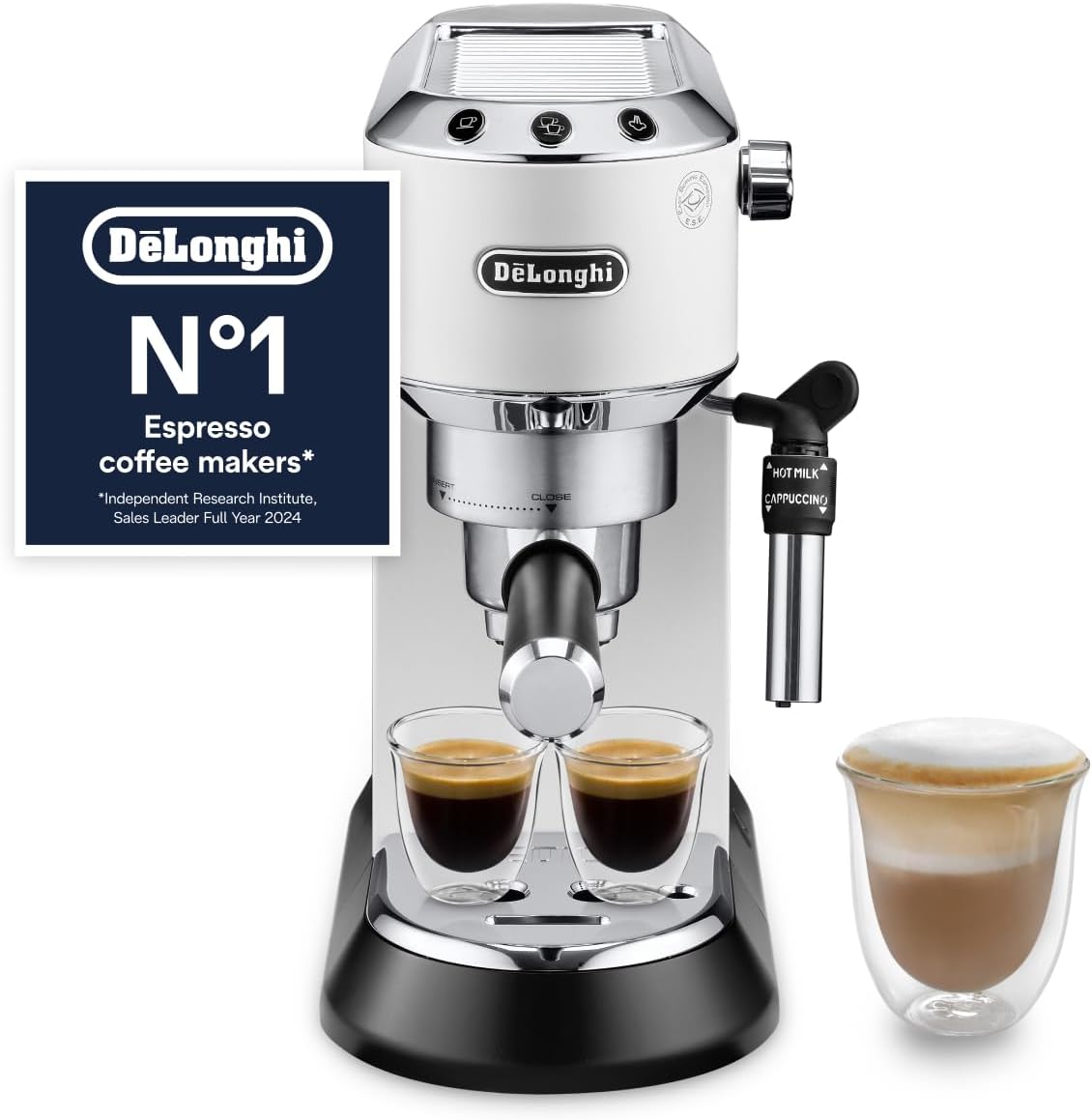
Best overall — DeLonghi EC685 Dedica. The best machine for most people: stainless-steel looks well above its class, good espresso, and milk foam that is more than convincing for its price bracket. In the UK it sells as the Dedica Style family — the exact tested model appears as EC685 with a colour suffix (EC685.W white, EC685R red), alongside near-identical Dedica Style listings at lower prices. Check the model code if you want precisely the tested unit.
Built to outlive everything else — Rancilio Silvia. Emphatically not an entry-level machine, but fair value for its class. It is optimally pre-set, so day-to-day operation is simple, and it invites grind experimentation. What separates it from cheap machines is materials: high-grade construction that a budget machine simply cannot offer, and a service life to match.
Most automated — Sage Oracle Jet. The hybrid redefined: an ultra-fast touchscreen with 14 recipes and 20 settings, an integrated Baratza grinder with 45 steps, an automatic steam wand that also works manually, a professional 58 mm portafilter with single-wall baskets, 30-second heat-up, and cold extraction for cold brew. The Auto-Queue function starts the milk automatically after the shot. Very expensive, and earns it.
Best for beginners with ambitions — Sage Barista Touch Impress. The optimal degree of automation: integrated grinder, an automatic tamping station and an excellent steam wand mean espresso, cappuccino and latte macchiato succeed with no prior experience — while the results in the cup stay excellent. Heat-up is a short 40 seconds — quiet by Sage standards apart from that grinder, which is loud and remains the one honest complaint. A cleaning kit comes in the box.
Best looking — Smeg ECF01. A compact entry machine with strong retro design and very simple operation, adjustable water volume and three brew temperatures. The espresso is solid with good body and attractive crema, helped by beginner-friendly double-walled baskets. Its shape costs it some stability on the worktop, and ambitious barista-fans will outgrow it — but as a stylish first machine it is exactly what it looks like.
Before you buy
Four questions. Will you actually froth milk while pulling shots? If not, skip the dual-boiler premium entirely. How much apprenticeship do you want? The Sage machines automate what the Rancilio expects you to learn. Does the machine let you adjust water volume and temperature? Those two settings matter more than most headline features. And have you budgeted for beans? — because the machine is at most half the result.
If you would rather press one button, our best bean-to-cup coffee machines guide covers the automatic route, and best coffee machines surveys the whole landscape.
Research sources
Sources recorded for this page are linked below. Reported third-party testing belongs to the original publisher; it is not testing performed by Truthful Reviews.