Late-night films at full clarity while the house sleeps: that is the whole job of TV headphones, and ordinary Bluetooth is often the wrong tool for it.
This guide draws on a tested field of 22 dedicated wireless TV headphone systems — the kind that come with their own transmitter base.
Why not just use Bluetooth?
Most televisions will pair with ordinary Bluetooth headphones, and the demand for exactly that is enormous. Dedicated systems still exist for reasons worth understanding.
Traditionally these use a 2.4 GHz radio link from the base station to the headphone. Many now transmit over Bluetooth as well, and some use both at once — 2.4 GHz between transmitter and headphone, Bluetooth between the headphone and any other source you like.
Each has a genuine advantage. Bluetooth transmission often has less range than the 2.4 GHz link, and can be more susceptible to interference, particularly when several Bluetooth devices are working nearby. What Bluetooth buys you is versatility: the same headphone can run from the base station for the television and double as a normal headphone for your phone, without unplugging anything.
The point they share is latency — or rather the absence of it. Every transmission standard used in this field passes sound to the headphone with no noteworthy delay. That is not a nicety but a requirement, because these headphones are almost always used alongside a picture. Film dialogue that is not lip-synced, or seeing the goal go in and hearing the cheer a fraction of a second later, ruins the thing entirely.
Range was assessed by walking away from the base station with the headphones on, out to 10 metres line of sight.
The picks
Test winner — Sennheiser RS 5200. Sennheiser's signature television design: in-ear buds joined by a light band that runs under the chin, carrying oversized buttons you can find purely by feel. That is the heart of its supremely simple operation, and it is the reason this design keeps being imitated. Transmission has moved on from the infrared of old to far more reliable radio, and speech intelligibility is outstanding — which is the entire reason these products exist. The supplied fittings and ear tips let you either seal the room out or deliberately keep it audible. A full charge in the cradle — which also houses the transmitter — delivers more than 15 hours of sound.
Best for music too — Sennheiser RS 195. This one is not limited to television. Thanks to its tonal balance and built-in sound control it acquits itself well even on a good hi-fi system. It offers three modes: optimised for speech, optimised for music, and a dedicated mode for the hearing-impaired. That range is what makes it, in the source's words, the first choice for music fans. UK listings carry it as the RS195-U.
Over-ear price pick — Retekess TA007. It has every necessary analogue and digital interface, and it can also connect directly over Bluetooth to a television or a smartphone, independently of the transmitter. Either way the transmission is stable and the sound very good. Being inexpensive as well is what makes it the current price pick among over-ear designs. One practical grumble: the batteries sit under the ear pads and are awkward to reach.
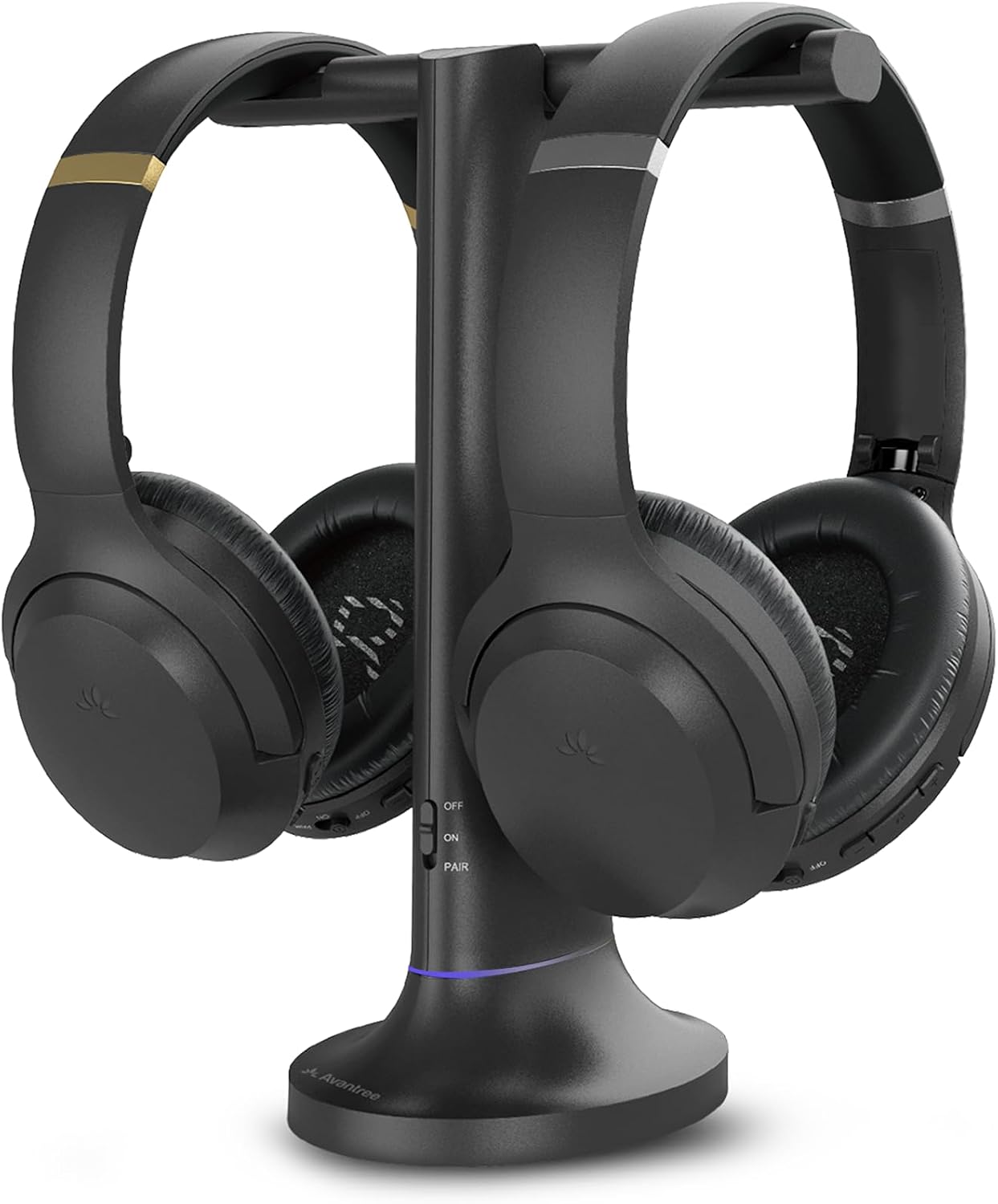
For two or more viewers — Avantree Duet. The name is the specification: the set ships with two headphones, and the transmitter is built to charge both at once, though USB-C means each can also be charged independently of the base — a cable is included for that. Every important TV connection cable comes in the box, digital and analogue, and it has analogue and digital outputs that pass the audio on to something else, a soundbar for instance. So two people can listen on headphones at their own individual volumes while everyone else hears the room speakers. Each headphone adjusts volume and its own sound signature, switching between Clear Voice for dialogue and Balanced for an even presentation. Range sets no records but shows no notable weakness either. Per its datasheet, up to 100 headphones can be served from the one transmitting station, which turns it from a two-person product into a genuine problem-solver for a room full of people.
Also tested — TechniSat Stereoman ISI 3. In-ears with a chin band, built along the same lines as the Sennheiser designs, with the main controls sitting comfortably on that band. Its distinctive feature is a mute function that switches off the television sound at the press of a button and makes the surroundings audible instead — genuinely practical when somebody speaks to you. Sound is good and a spare battery is included. A UK caveat, though: we could not find the Stereoman ISI 3 itself listed on Amazon UK. What is on sale here is a different model, the Stereoman 3 BT, along with replacement batteries described as compatible with the ISI 3 — so do not assume the tested model is a straightforward UK purchase.