On-ear headphones sit on the ear rather than around it, and that one structural fact drives everything: they pack down smaller, they weigh less, and they seal less well. Forty-eight were tested for this guide. The best for most people is the Valco VMK15 — it sounds excellent, is uncomplicated to operate, and stays comfortable after hours of listening.
The short version
On-ear or over-ear — which should you buy?
The trade-off is sealing against size. Pads that enclose the ear shut out far more of the world, which is why over-ears dominate for noise cancelling: with effective passive isolation already in place, active cancelling has an easy job. Pads that rest on the ear have much more work to do just to shut the world out passively.
What you get in return is compactness. On-ears fold smaller, weigh less and disappear into a bag — which is the whole reason to buy one.
Test winner: Valco VMK15
Valco, a Finnish maker, sells the VMK15 as a no-nonsense product, though with a distinct twinkle — the manual walks you through the ten phases of "head mounting" and warns you not to use it as lavatory paper.
The no-nonsense part is real, though. There is no touch panel, deliberately, in favour of proper buttons, and the Finns consider an app superfluous too. In the box you get the obligatory charging and audio cables, an adapter for aeroplane and train sockets, and a hard case that takes the headphones and the accessories together.
The controls are genuine buttons under the fabric of the left cup, arranged as a D-pad you can neither see nor feel — so it is a matter of trying them or reading the manual. An English-only voice prompt helps, delivered in a gravelly heavy-metal voice that is its own small joke. The combined power and pairing button sits bottom-centre, the button for the two ANC modes sits top-centre towards the headband (switching cancelling on is acknowledged with the word "Silence"), and volume and track buttons sit front and back. After a while you operate it without thinking.
What clinches it is comfort that is genuinely remarkable for an on-ear, thanks to low clamping pressure and pleasantly soft, adaptable pads. Valco also takes durability seriously: if a fault or damage falls outside the warranty, the headphones can be repaired for a flat fee, and that fee expressly includes replacing the built-in battery if it is needed.
Price pick: Marshall Major V
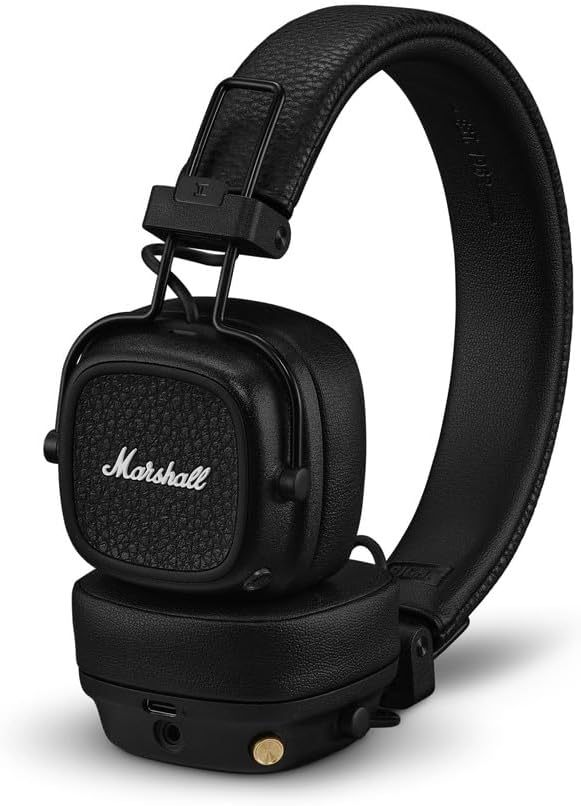
The direct successor to the Major IV, and unmistakably a Marshall: the livery of the company's guitar amplifiers, in hard-wearing, lightly textured faux leather, offered in black, brown, cream and midnight blue.
The signature control is the brass-coloured pin. Press it to power on or start pairing, and use it as a rocker to skip tracks and set volume; the app documents the exact mapping and lets you change it — including the short guitar riff that acknowledges power on and off. Less conspicuous is the M button on the left cup, which can be assigned to Spotify Tap to jump straight into the streaming service, or to the equaliser or a voice assistant, or switched off entirely to prevent mis-presses.
Its special feature only reveals itself after a very long time: battery life of 100 hours. That is enough to take them away for a long weekend without thinking about a socket, and a quarter-hour on the charger returns roughly 15 hours of listening. The notable omission is that it comes without a transport case.
Best with noise cancelling: Beyerdynamic Aventho 100
The Aventho 100 is one of the few on-ear designs with active noise cancelling at all, and Beyerdynamic has accumulated plenty of experience with the Aventho line. It folds down about as small as an on-ear can, then sits comfortably in the supplied cloth bag. Besides the brown of the test model, it comes in cream and black.
The joints and much of the cups are solidly made of metal, and every pad — the headband's included — is soft and adaptable, which makes for thorough comfort. All the controls live on the right cup: a combined power and pairing button, and, clearly separated by feel, a three-part volume rocker whose middle section is itself a button for playback and telephony.
The battery lasts about 60 hours with cancelling off and a good 40 hours with it on. Cancelling and transparency each have three levels and can both be switched off, and notably none of those settings has any audible effect on the sound. Beyond that there are five sound presets or a 5-band equaliser, a low-latency mode for gaming, a voice assistant, and sidetone — which lets you hear your own voice on a call. Speech intelligibility is very good in both directions.
The sound is fresh, light and open, helped by fine resolution and dynamics through the mid-to-high range, with a pleasingly deep bass that never becomes overbearing and stays controlled as the volume rises.
The featherweight classic: Koss Porta Pro Wireless 2.0
This is the second generation of the wireless version of a genuine classic — the wired Porta Pro has been demonstrating since 1984 how good a light on-ear can sound on the move.
The change that matters is what has gone. The cable, with its microphone and battery box dangling between the cups, is no more: battery, microphone and electronics are now built into the cups. Weighed in operating trim it comes to 66 grams, which is actually less than the predecessor, because that figure included the old model's cable and box.
Battery life has improved too, from twelve hours to up to 20. And so that twenty hours need not be the end of it, there is now a USB-C audio cable for emergencies, letting you plug the Porta Pro straight into a headphone socket — though that will not work from a phone with only a USB-C port, since the headphones have no converter built in.
Being so light, it never becomes a nuisance and stays put during vigorous movement, and the clamping pressure adjusts with the ComfortZone sliders on each side — simple, but effective. It rolls up into a small round case with both cables inside. Sonically nothing has changed and nothing needed to: the little thing still delivers an astonishing bass foundation, and it does so despite open-backed cups. That openness also answers the noise-cancelling question for you — there is none.
Also in the tested field
The Sony WH-CH520 held the price-pick position until the Marshall displaced it, and is gradually being discontinued. The Beyerdynamic Aventho 100 took over the noise-cancelling recommendation from the JBL Live 670NC, and the Marshall took the favourite's slot from the Teufel Supreme On; both former recommendations now sit under "also tested", alongside the Beats Solo 4, the Jlab Go Lux ANC and the Jlab Rewind 2 Wireless.
Frequently asked questions
Which on-ear headphones should I buy? The Valco VMK15 for most people — excellent sound, straightforward operation and comfort that holds up over hours. The Marshall Major V is the value choice, the Beyerdynamic Aventho 100 the one to buy if you need noise cancelling, and the Koss Porta Pro Wireless 2.0 the featherweight.
Which on-ears actually cancel noise? Few, because on-ear pads have to work much harder than over-ear ones to seal against the outside world in the first place. The Beyerdynamic Aventho 100 is the tested field's proof that it can be done well, with three levels of cancelling and three of transparency.
Which lasts longest? The Marshall Major V, at 100 hours — with a quarter-hour charge returning about 15 hours. The Aventho 100 manages roughly 60 hours with cancelling off, and the Koss up to 20.
What if the battery dies mid-journey? The Koss Porta Pro Wireless 2.0 ships with a USB-C audio cable so you can plug straight into a headphone socket, and the Valco includes an audio cable and an aeroplane and train adapter. Note the Koss cable will not work from a phone that has only a USB-C port.
Which comes with a case? The Valco VMK15 includes a hard case for the headphones and accessories, the Aventho 100 a cloth bag, and the Koss a small round case that takes both cables as well. The Marshall Major V comes without one.
Are on-ears comfortable for long sessions? They can be, and clamping pressure is the reason. The Valco's low clamping force and soft, adaptable pads are what earned it the win, and the Koss lets you adjust the pressure yourself with its ComfortZone sliders.