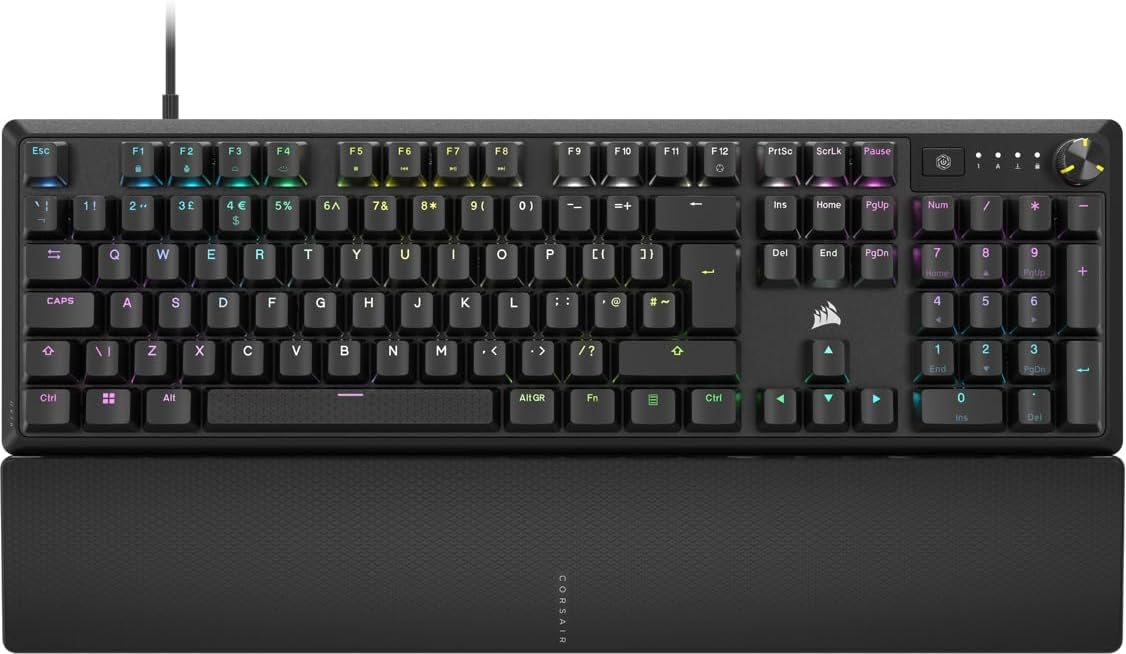
Gaming keyboards have converged on a short list of features that genuinely change how a board plays, and a much longer list that does not. The group test behind this guide assessed 126 gaming keyboards, with a dozen added in its most recent round, and the separation between the winners and the rest came down to switch behaviour, typing feel and sound rather than lighting or spec sheets.
The features that actually matter
Magnetic (Hall-effect) switches read the depth of a keypress rather than a single contact point, so the actuation point can be adjusted: shallow for the fastest possible input, deeper if you tend to catch keys by accident. Rapid trigger resets a key the moment it starts to rise instead of waiting for it to return fully, which makes repeated presses register faster. SOCD, sometimes branded snap tap or rapid tap, decides what happens when two opposing direction keys are held at once — the board gives priority to the most recent press, which matters in competitive shooters and is why several manufacturers now advertise it prominently.
Two further terms are routinely confused. Key rollover is how many simultaneous presses a keyboard can register; anti-ghosting prevents keys you did not press from registering at all. They are related but not the same thing. Hot-swap sockets let you change switches without soldering, and polling rate — now reaching 8,000 Hz on the newer boards — sets how often the keyboard reports to the PC. RGB lighting, by contrast, changes nothing about how a keyboard performs.
The overall winner: Hator Skyfall 80 Mag Ultima 8K
The Skyfall 80 took the top spot outright. It combines magnetic switches with an adjustable actuation point, rapid trigger, SOCD, hot-swap sockets and an 8,000 Hz polling rate — a set of high-end functions usually reserved for considerably more expensive boards. The typing quality convinced the testers, and so did the sound: pleasantly damped, without the clatter or metallic ping that spoils cheaper mechanical boards.
It is not flawless. The keycaps need pressing home firmly, they diffuse the backlight unevenly, and the software is mediocre. The verdict rested on how much capability arrives for the money, and on that basis it was judged a difficult offer to beat and a pointed challenge to the established brands.
UK availability: the Skyfall 80 is not sold through UK retail and has no Amazon UK listing. For a British reader it is best understood as the benchmark the rest of the field was measured against rather than a realistic purchase.
The pick most UK buyers should consider: Logitech G Pro X TKL Rapid
The Pro X TKL Rapid held the top position for a long stretch before slipping to second, and it remains the most sensible high-end choice that is straightforward to buy here. It forgoes hot-swap sockets and the highest polling rates, but every key sits on a Hall-effect switch with an adjustable actuation point, and it carries both rapid trigger and snap tap.
The typing behaviour and the feel of the PBT keycaps were rated highly. It is louder than the winner — more "clack" than "thock" — though nothing rattles and the sound is at least consistent, so this is largely a matter of taste. The rubberised control roller attracts dirt, and the detachable cable is a very basic one.
Best full-size: SteelSeries Apex Pro Gen 3
As manufacturers have packed boards with expensive features, full-size keyboards with a number pad have become either rare or costly. If you need every key and still want current technology, the Apex Pro Gen 3 is the one to look at: analogue Hall-effect switches, rapid trigger and rapid tap across the alphanumeric keys, and adjustment through an integrated OLED display rather than software alone.
The compromises are a wrist rest that is neither padded nor good at resisting dirt, software the testers found overloaded, and keys that could be better damped than they are.
Best compact: Wooting 60HE v2
The 60HE v2 was judged the best compact board in the field. It offers deep configurability, software described as mature and genuinely comprehensible, and up to four different actions from a single key depending on how far it is pressed. The second-generation model adds a rigid aluminium case that makes it noticeably more solid than its predecessor, along with an 8,000 Hz polling rate, and the keycaps and switch action both drew praise.
Two practical notes: the keycaps have to be fitted by the user, and the keys carry no printed secondary or tertiary legends, so the layer functions must be learnt.
UK availability: Wooting sells direct rather than through UK retail. Amazon UK searches surface only third-party cases and plates described as compatible with the 60HE v2, not the keyboard itself.
Best value: Tecurs KB510
The value pick is mostly plastic, and the test says so plainly — but it is still a genuinely capable wireless mechanical board for the outlay. It runs in Bluetooth, wireless-receiver and wired modes, its lighting is atmospheric and adjustable from the keyboard itself rather than only through an app, and a puller for swapping keycaps and switches is included.
Against it: the wireless range is fairly short, there is a lot of plastic in the construction, and the keycaps are very smooth to the touch.
Switch travel and battery life, in numbers
The practical span of an analogue magnetic switch is worth stating plainly: the adjustable actuation range runs between 0.1 and 4.0 mm. At the shallow end a key registers almost on contact, which is what makes rapid trigger worth having; at the deep end it takes a deliberate press, which suits typing and avoids accidental inputs. That single adjustment is the substantive difference between a magnetic board and a conventional mechanical one.
Wireless battery figures in this field depend almost entirely on the lighting. One wireless board in the test quotes 800 hours with the lighting switched off, 90 hours at half brightness and 36 hours at full — a roughly twenty-fold swing driven by the LEDs alone. The Asus ROG Azoth, which connects over 2.4 GHz wireless, Bluetooth or USB, carries a manufacturer claim of up to 2,000 hours with the lighting off; the testers could not verify that figure, noting only that it came through a week of use with little change in charge. If battery life matters to you, the lighting is the setting to change first.
Choosing between them
If you play competitive shooters, the combination that matters is magnetic switches, rapid trigger and SOCD — everything else is secondary. If you type as much as you play, weight the decision towards damping and sound. If you need a number pad, the full-size options are limited and the Apex Pro Gen 3 is the strongest of them. If desk space is the constraint, a 60% board such as the Wooting is the answer, provided you are willing to buy direct. And if the budget is the binding constraint, a wireless mechanical board no longer means a bad one.
Also assessed
The wider field included the Hator Skyfall 65 Mag Ultima 8K, Wooting 60 HE+, Corsair Makr Pro 75, SteelSeries Apex Pro Mini Gen 3, Corsair Galleon 100 SD, Trust GXT 872 Xyra, be quiet! Dark Mount, Monsgeek M1 V5 TMR, Razer BlackWidow V4 Low-profile Hyperspeed, Razer Huntsman V3 Pro 8KHz, Glorious GMBK 75%, Asus ROG Azoth, Glorious GMMK3 HE, Asus ROG Falchion RX and Logitech G515 Lightspeed TKL.
Research sources
Sources recorded for this page are linked below. Reported third-party testing belongs to the original publisher; it is not testing performed by Truthful Reviews.